
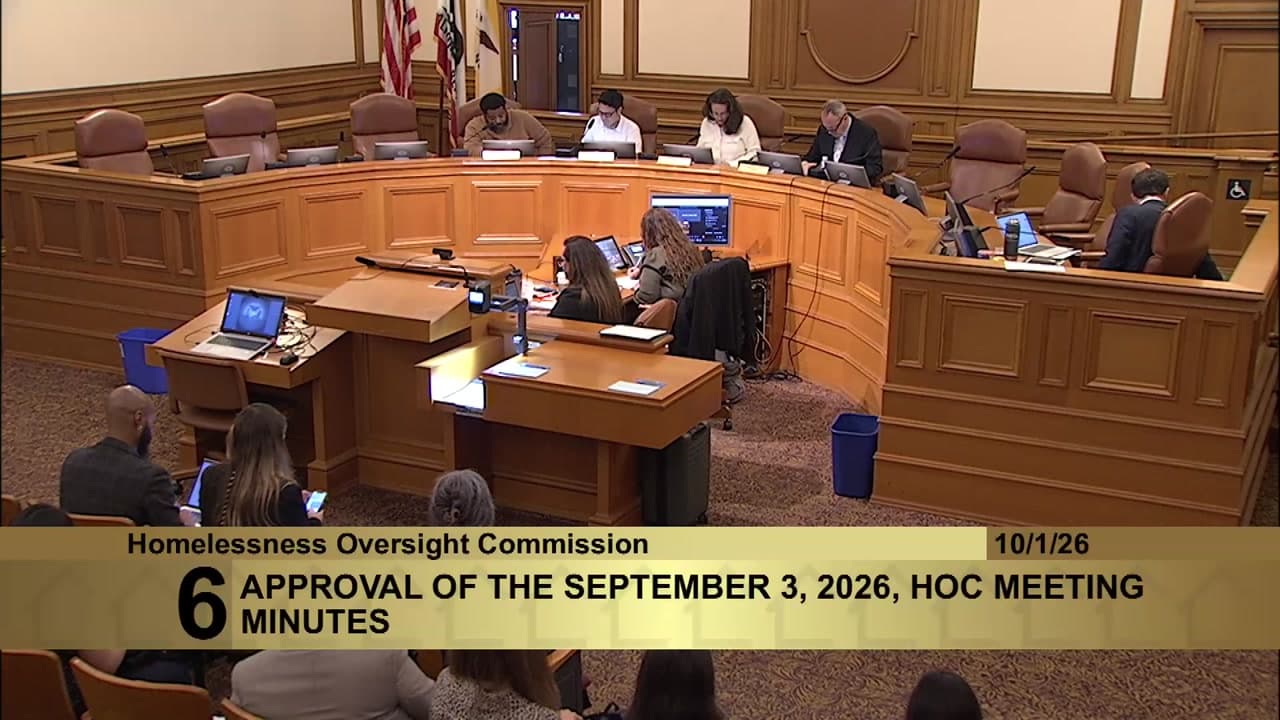
HSH Lays Out Plan to Tie Provider Contracts to Outcomes
Homelessness Oversight Commission • San FranciscoOctober 1, 2026
Locunity is an independent informational service and is not an official government page for this commission. All information is sourced from public footage and an analysis of official agendas with the aid of responsible, fact-checked AI. to report an error or omission.
San Francisco's homelessness department is preparing to change how it pays the nonprofits that run its shelters and supportive housing, moving away from reimbursing expenses and toward paying for results. At the Homelessness Oversight Commission's Oct. 1, 2026, meeting, the Executive Director laid out a multi-year reprocurement timeline, more than a dozen public commenters pushed back on how it is being designed, and the department disclosed that HomeRise, a nonprofit managing about 1,500 units, is winding down.
- Contract overhaul begins: HSH sets out reprocurement, with new contracts taking effect over 2028.
- Advocates and providers split: Speakers backed accountability but warned that new costs could mean fewer beds or units.
- HomeRise winds down: About 1,500 supportive housing units will move to other providers.
- Evictions climb: PSH evictions rose from about 106 in 2024 to about 186 in 2026.
- Three grants approved 4-0: About $8.1M in Prop C-funded grants for youth, veterans and families fleeing violence.
- Youth waitlist grows: 186 young people are waiting for transitional housing, Larkin Street says.
Paying for Outcomes, Not Invoices
Why it matters: Reprocurement will reshape how HSH funds shelter and housing providers. That affects how many beds the city can offer, how stable providers are and which clients they serve.
Where things stand: Mike Levine, Executive Director of the Department of Homelessness and Supportive Housing (HSH), described the effort as a "three-legged stool" of adequate funding, flexibility and meaningful accountability. Under today's contracts, he said, providers are held accountable mainly for expenses, which the department reviews through monthly invoices.
"We can transition from what we have today to a far more accountable, flexible, and well-supported partnership," said Levine.
He defined performance-based contracting as "tying some amount of payment or programmatic component of the contract to an outcome." He also presented a chart of "problem solving" providers that showed wide variation in exits to housing. The average was about 17%, while one organization reached about three-quarters. He said the chart was not meant to single out organizations: "This isn't a name and shame thing."
The timeline: HSH held three listening sessions in September, drawing more than 160 participants and about 50 written responses. The timeline from here:
- Responses to the request for information are due Oct. 15.
- A readout follows Nov. 5.
- Providers should have clarity on the timeline by year's end.
- Program-specific feedback is planned for the first half of 2027.
- Requests for proposals (RFPs) will run from late 2027 into 2028.
- New contracts will take effect over the course of 2028.
"I want to be really, really clear. This is the very, very beginning of the discussion," said Levine.
Commission questions: Chair Katie Albright pressed for specifics: "How will this look different when this is all in place from what is currently there?" Levine described a range of payment models, from flat fees to expense reimbursement, fee-for-service and outcomes-based contracts. He promised more detail in November and said outcomes would be defined together with providers, community members and clients. Albright also asked for trauma-informed RFP timelines and for information on professional development related to performance-based contracting.
The other side: The Coalition on Homelessness sent an organized group of speakers. Miguel Carrera, Solange Cuba and Christian Jimenez asked that the new system be led by homeless and formerly homeless people, that listening sessions be held on site, that no beds be cut and that the city share accountability. Jennifer Friedenbach, Director, Coalition on Homelessness, asked for a specific follow-up: "We would really like to see a report back in January specifically around any plans to shift budget within different interventions or reductions of beds or units."
Providers raised concerns about cost. Lauren Hall of DISH and the Supportive Housing Provider Network welcomed the added clarity but warned that a fixed budget forces trade-offs: "If that's a 20% cost increase, then we're going to have 20% less units."
Public commenter Kristen Evans objected that the department's definition of "accountability" focused only on providers, and she called the feedback questionnaire leading. Eva Moss of Senior and Disability Action said the success chart favored one type of organization and warned that centralization would hurt language-specific community groups. Aisha McCain, a public commenter, took a different view: she supported performance-based contracting and audits of every provider, and she also called for HSH itself to be held accountable.
Decisions and stakeholder impacts: No vote was taken. Commissioners largely sided with process concerns. Commissioner Dante Ball said "what's super necessary is a collaborative process." Commissioner Joaquin Guerrero argued "you cannot have flow without housing, permanent housing." He added that "before any consequence comes to providers for outcome-based reporting, there needs to be a step, which is the city responding to support."
What's next: Request-for-information responses are due Oct. 15, with a readout Nov. 5. Commissioners requested a November follow-up on performance-based contracting.
HomeRise Exits, Evictions Rise in Supportive Housing
Why it matters: Two developments point to strain in permanent supportive housing (PSH): one large operator is closing, and evictions are increasing across the system.
Where things stand: Levine announced that HomeRise's board has decided on an orderly wind-down. About 1,500 units will transfer to other providers. The Mayor's Office of Housing and Community Development (MOHCD) will coordinate the property transfers, while HSH handles contracts and services.
"No one will return to homelessness because HomeRise is winding down," said Levine.
Levine also presented preliminary data for fiscal year 2025-26:
- About 2% of PSH households were evicted.
- About 7% left for other reasons, including about 4% by client choice and about 2% through unit abandonment.
- Half of buildings had no evictions, while the top 10% of buildings accounted for nearly half of all evictions.
- Eviction notices fell, but completed evictions rose.
The other side: Reaction to the HomeRise news split sharply. Hall and Sherilyn Adams, CEO of Larkin Street Youth Services, called the closure heartbreaking and not a victory. Friedenbach called the loss significant and said buildings should not be lost. McCain welcomed the closure, telling the story of her brother, Eric McCain, who died in PSH.
On evictions, Hall and Tabitha Allen of the Tenderloin Housing Clinic cited violence and nonpayment as the main drivers. They described their eviction-prevention practices, and Allen also pointed to increased violence and fires. Tenant Jordan Vasilevsky asked for monthly, real-time exit data and a written nonpayment policy rather than guidelines. Evans warned that 9% of households exiting is unacceptable.
Decisions and stakeholder impacts: Guerrero urged ombudsperson and mediation programs. For tenants, the immediate questions are whether residents will have to move and who will manage their buildings. A public commenter during general comment asked the city to report on the transition the way it reported on the closure of shelter-in-place hotels.
Three Grants Approved for Youth, Veterans and Families
Why it matters: All three grants draw on Prop C (Our City, Our Home) funds and were approved by identical votes: For: 4 (Albright, Ball, Dufty, Guerrero); Against: 0; Absent: 3. Vice Chair Obai Rambo, Commissioner Sharky LaGuana and Commissioner Thomas Roca were excused.
42 Otis: Five Keys Schools and Programs will receive $1,747,570 to rehabilitate vacant ground-floor space at a 24-studio supportive housing site for transitional-age youth.
"The total amount is $1,747,570, which includes $1,398,057 in the rehabilitation budget and $349,514 in contingency," said Lakecia Scott, HSH Project Manager.
The work covers HVAC, electrical and sprinkler upgrades, plus new meeting, lounge, laundry and all-gender restroom space. Construction runs from Dec. 1, 2026, to August 2027 and is not expected to disrupt residents. A public commenter asked about kitchens; staff said each unit has its own kitchen and that no structural work is planned. Commissioner Bevin Dufty made the motion.
1035 Van Ness: Swords to Plowshares will receive $1,552,268 to provide services from Nov. 1, 2026, to June 30, 2029. The 124-unit, all-veteran building replaces 250 Kearney, and 93 residents will move in starting in December. The city bought the building in July 2025 using city and Homekey capital funds. Swords to Plowshares will manage the building and share case management with the VA. "1035 Van Ness will soon be home to 124 formerly homeless veterans," said Elena Kim, Chief Operating Officer, Swords to Plowshares.
Families fleeing violence: San Francisco Network Ministries Housing Corp. (Safe House) will receive up to about $4.8M through June 30, 2030. The grant funds 30 of the 130 family rapid-rehousing slots approved in the FY2025-27 budget. Families can receive up to 24 months of rental subsidy, extendable to 36 months. Ball and Guerrero both endorsed the model.
Youth Providers Sound Alarm on Waitlist
Where things stand: Adams told commissioners, "There's 184 young people right now on the waitlist for TLPs," referring to transitional living programs. Marnie Regan of Larkin Street updated that figure to 186: 50 are on the street, 46 are couch surfing and 25 are living in vehicles. Regan asked why budgeted money is sitting idle and urged immediate funding instead of waiting until 2028.
Dylan Schneider, HSH Interim Deputy Director, said transitional housing was left out of the new stabilization funding because those programs were recently reprocured.
What's next: Albright asked for data broken out for transitional-age youth (TAY). Levine proposed a deep dive on TAY data in December.
Minor Items
- Emergency vouchers: A $27M city bridge fund keeps households in the federal Emergency Housing Voucher program housed. About 650 households remain in the program.
- Stabilization funding: Provider applications are due Oct. 14, with additions to agreements rolling out from November.
- Consent calendar: Items for five providers, including Larkin Street and Episcopal Community Services, were approved 4-0.
- Drop-in closure: Dufty asked for a Department of Public Health briefing on the closure of a South of Market Hospitality House drop-in center.
- Limelight award: HSH honored program manager Havari Wilson as its October awardee.
Looking Ahead
The 2026 Point-in-Time Count report and the Data Officer report were both postponed to November, when Vice Chair Rambo is scheduled to chair the meeting.