
HSH Maps Multiyear Homelessness Contract Rebid as Advocates Guard Housing Units
Homelessness Oversight Commission • San FranciscoNovember 5, 2026
Locunity is an independent informational service and is not an official government page for this commission. All information is sourced from public footage and an analysis of official agendas with the aid of responsible, fact-checked AI. to report an error or omission.
San Francisco's homelessness department laid out its plan to rebid its provider contracts through spring 2029 and tie part of providers' pay to client results. At the Nov. 5, 2026, Homelessness Oversight Commission meeting, Executive Director Mike Levine presented the timeline and a new shelter length-of-stay policy. Advocates and immigrant families pushed back hard, warning that accountability cannot come at the cost of housing units or subsidies.
- Performance-based contracts coming as HSH rebids homelessness services through spring 2029
- Scattered-site housing procurement canceled, to be reissued under the broader plan
- Faith in Action families press for longer subsidies, social housing and basic income
- 2026 Point-in-Time Count: 7,973 people, down 4%, but family homelessness up 15%
- 90-day shelter stays with extensions proposed, launching March 1, 2027
- $15.2M Larkin Street youth housing grant tabled over a public notice error
HSH Puts Accountability at the Center of Its Rebid
Why it matters: The reprocurement will reshape how San Francisco pays the nonprofits that run its shelters, housing and prevention programs. It will also decide how those providers are held accountable.
The basics: Performance-based contracting ties part of a provider's payment to client outcomes rather than only to services delivered. Levine cited models in Denver, Detroit and Austin. He also described guardrails against "cherry-picking" easier clients and against added paperwork.
Where things stand: HSH received 53 responses to a request for information. Respondents broadly agreed on pairing outputs with outcomes, on base funding plus incentives and on reducing administrative burden. They split on population-based contracting and on out-of-city providers.
Design work begins in January 2027 for front-door and shelter services. Housing and navigation follow in summer, and prevention and transitional housing in fall. The design phase includes client focus groups.
"It is about baking more accountability for my department and for the providers that we partner with into our system," said Executive Director Mike Levine. He promised a collaborative process: "HSH is not going to go in a corner, come up with a couple outcome measures, and tell you what we decided."
Levine also said the department will scrap its scattered-site housing procurement, issued more than six months ago, because federal conditions changed. "We're going to be canceling that procurement and reissuing it as part of the overall procurement plan I just talked through," he said.
The other side: Advocates backed accountability but focused on capacity. Jennifer Friedenbach of the Coalition on Homelessness asked the Commission to "ensure that any planned reduction in housing is announced at least 3 to 6 months before the contracts are put out to bid."
"If we create a more robust model but we don't increase the availability of permanent housing solutions, we're looking at an even more fragile safety net," said Lauren Hall of the Supportive Housing Provider Network.
Jordan Vasilevsky, a public commenter, said metrics should weigh keeping tenants housed: "If a tenant is in an underperforming building, they shouldn't have to suffer."
Decisions and stakeholder impacts: No vote was taken. Commissioner Bevan Dufty raised the advance notice of housing losses, and Levine replied, "I absolutely welcome the discussion." Commissioner Dontaye Ball asked that "some of the smaller CBOs and organizations have opportunity to participate." Commissioner Sharky Laguana said he "really appreciated the emphasis on care over metrics." Larger providers with data capacity may be best positioned for incentive pay. Smaller community-based organizations and tenants in struggling buildings have the most at stake.
What's next: Design work starts in January 2027. The rebid runs through spring 2029.
Immigrant Families Organize for Longer Subsidies
Why it matters: Families relying on time-limited rental subsidies say an expiration could put them back on the street. Those warnings come as HSH reworks its housing programs.
Where things stand: Leaders and members of Faith in Action filled the public comment queue, many speaking in Spanish through an interpreter. They described fear of losing subsidies, shelter time limits, sick and disabled children, and the toll of deportation.
Brenda Córdoba, co-president of Faith in Action, cited a 27% rise in unhoused children. She urged the city to include families in planning and to "take into consideration what would be like a universal basic income and also social housing."
"I do have a home, but if the subsidies are not extended, I could very well end up in the streets," said Janet Perez, a Faith in Action leader and single mother of a sick toddler.
Violeta Roman, a Faith in Action community organizer, compared costs: "What's being paid for transitional housing is $6,600 per month for transitional housing and $5,400 for a hotel room per month." She also cited a state finding on long-term subsidies. Rocío Blas, who has lived in shelter with her daughter for nearly three years, asked commissioners to listen to families before deciding. Friedenbach urged HSH to release already-funded subsidies and make them ongoing.
The other side: Commissioner Laguana pressed staff on the family shelter waitlist: "224 families expired from the shelter waitlist before receiving an offer after 124 days on average." By comparison, 188 families were placed from April through September. Levine said "the prevailing dynamic is more people entering lists and queues than the number who are exiting to the thing that the waitlist is for."
Decisions and stakeholder impacts: No action was taken. The testimony puts family subsidy continuity on the table as the reprocurement begins.
Shelter Stay Limits and the HomeRise Handoff
What changed: HSH proposed a length-of-stay policy for adult and transitional-age youth shelters. Guests would get an initial 90 days, followed by up to three 90-day extensions approved by providers. After that, each extension would need HSH sign-off, with no cap.
Eligibility for extensions depends on housing referral status or conditions such as medical issues or pending placements. Guests whose coordinated entry status is unknown would be ineligible. A one-night bed program is planned at four shelters by April 1.
"Everyone needs to get written extension decisions at least 30 calendar days before a potential exit. This cannot be a surprise," Levine said. Guests would have five business days to file a grievance.
The other side: Lucas Illa, an organizer with the Coalition on Homelessness, argued that case management quality varies. He said requiring engagement puts the onus on overburdened case managers.
What's next: HSH expects to finalize the policy in December, launch it March 1, 2027, and begin exits no earlier than June 1, 2027.
HomeRise wind-down: HomeRise contracts expire Dec. 31. New supportive services providers will take over four properties on Jan. 1 under interim agreements. HSH will seek contract approvals in January for a Feb. 1 start.
Public testimony made the transition personal. "I am the sister of Anthony Martin, who is now deceased and found in your Home Rise MB9," said Monet Martin. She alleged her brother lay undiscovered for more than 48 hours, that staff let strangers into his room and that managers misled her family. Aisha McCain alleged further failures and said, "The city has to take administrative and fiscal control over Home Rise." These are commenters' allegations, not findings.
"My deepest apologies for your loss, and we will absolutely be following up," Levine said. He later pledged "a stable, smooth, non-disruptive transition for clients living in those buildings."
Count Shows Progress Outdoors, Strain Elsewhere
Why it matters: The federally required count shapes funding and policy debates. This year's methodology changes complicate comparisons with past counts.
The basics: Sarah Locher, HSH Deputy Director of Planning, Performance, and Strategy, explained the federal mandate. "HUD requires that Continuum of Care grantees report at least once every other year on the total number of people experiencing sheltered and unsheltered homelessness," she said.
Where things stand: HSH counted 7,973 people on Jan. 28, 2026, down 4% since 2024. Unsheltered homelessness hit its lowest level since 2011. Sheltered homelessness reached a record 4,574 as bed capacity grew 15%.
Other figures moved in the wrong direction. Families rose 15%, and Perry Weisberg, HSH Data and Performance Manager, reported 465 family households. Chronic homelessness rose to 3,498, and adults fleeing domestic violence rose 41%. Veteran homelessness fell 44%. In the survey, 37% of respondents were homeless for the first time and 44% were last housed outside San Francisco. "Homelessness is a regional challenge, and we cannot do this alone," Levine said.
The count used a survey-first approach, a 5 a.m. start and consolidated youth counts. Youth counted fell to 545, and unsheltered youth fell 80%. However, HSH flagged methodology effects and One System data showing unsheltered youth rising from about 266 to 332.
The other side: "It is a huge undercount of young people," said Sherilyn Adams, CEO of Larkin Street Youth Services. She cited a 206-person waitlist. Marnie Regan of Larkin Street, co-chair of HESPA, added: "My ask is to please get the approved FY26 funding out the door." Public commenter Kristen Evans criticized the report's timing relative to the election. Commissioner Laguana questioned the count's rigor: "We make up the rules every time we do it every 2 years."
Decisions and stakeholder impacts: Commissioner Dufty asked for the increase in children experiencing homelessness. Staff said children in households rose 27% and agreed to add a callout to the report. Commissioners also asked for breakouts and stronger data integration.
Notice Error Stalls $15.2M Youth Housing Grant
Where things stand: Louis Bracco, HSH Manager of Shelters, presented a Larkin Street Youth Services grant for bridge transitional housing at the ARD hotel on Ellis Street. The grant would run from Jan. 1, 2027, to June 30, 2032. The budget is $12,672,000 plus a 20% contingency, for a $15,206,400 cap funded entirely by Prop C.
The grant converts a mix of permanent supportive housing and transitional living units into 40 dedicated bridge units for youth ages 18 to 24. It sets a 1:15 case management ratio and is the ninth and final transitional housing award from RFP 154.
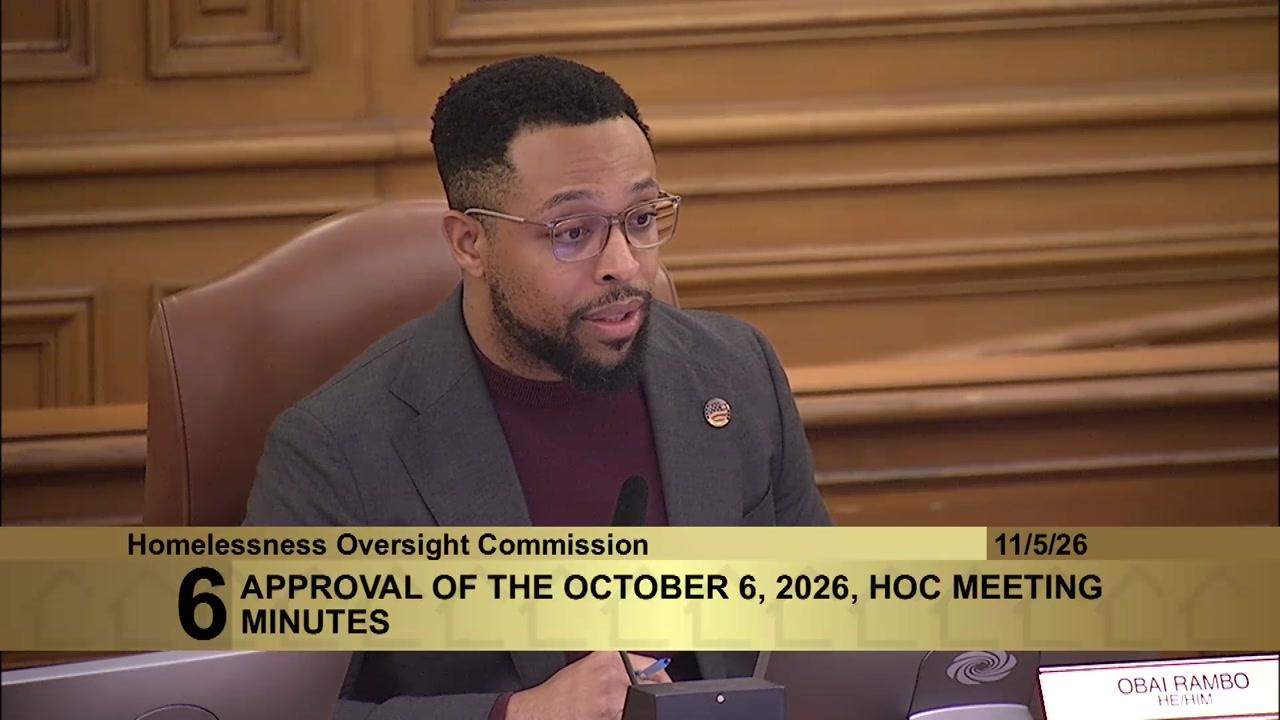
What went wrong: A commissioner noted the posted materials described Larkin Street's Lark Inn shelter instead. The Commission had already approved a consent calendar that included the ARD program. Vice Chair Obai Rambo tabled the item. Staff later said the wrong document had been posted.
What's next: Staff said the grant will return in December to ensure adequate public notice. Commissioners signaled support for the substance.
Minor Items
- Consent calendar approved 5-0 on roll call (For: Rambo, Ball, Dufty, Laguana, Rocca; Against: 0; Absent: Chair Katie Albright, Commissioner Joaquin Guerrero).
- Civil Grand Jury response letter approved on roll call. The Data Officer report was deferred to a later meeting.
- Winter shelter: The Interfaith Winter Shelter opens Nov. 23 at Cannon Kipp Senior Center, rotating among five sites, with self-referral.
- Leadership changes: Steve Adami of The Salvation Army's The Way Out will lead recovery services, drawing criticism from two speakers.
- RV residents Luis Gamboa and José Turizo described fines and tows and asked for provisional permits.
Looking Ahead
December brings the Larkin Street grant's return, HSH's detailed winter weather plan and a final shelter engagement policy. HomeRise replacement contracts come to the Commission in January.