
Hillsborough Council Eyes Four-Event Cap on Large Home Gatherings
City Council • HillsboroughSeptember 14, 2026
Locunity is an independent informational service and is not an official government page for this commission. All information is sourced from public footage and an analysis of official agendas with the aid of responsible, fact-checked AI. to report an error or omission.
Hillsborough residents who host big fundraisers and parties at home may soon need a town permit, and could be limited to four such events a year. At its Sept. 14, 2026, meeting, the City Council reviewed a draft special-events ordinance, voted 4-1 to open its Tobin Clark subcommittee to the public, and heard how state law would govern any sale of two surplus reservoir sites.
- Special events draft: Gatherings over 100 people would need a permit, capped at four per residence each year.
- Tobin Clark subcommittee goes standing, 4-1, opening deliberations to the public ahead of October presentations.
- Two reservoir sites worth an estimated $3M–$5M each were weighed under the Surplus Land Act. The council took no action.
- Solicitor rules tighten: The council favored six-month permits, visible ID and a firmer no-soliciting sign rule.
Council Weighs Permits for Big Home Events
The basics: The draft ordinance, proposed Chapter 17.18, defines a special event as a gathering of more than 100 attendees. Hosts would apply for a content-neutral permit through the city clerk after review by planning, public works, police and fire.
Why it matters: Hillsborough's large homes regularly host fundraisers and community events. The draft would cap these at four per residence in any 12-month period, and unpermitted events would count against the cap.
Where things stand: Assistant City Attorney Mark Hudak walked through the subcommittee's draft. It exempts town events, three private venues and schools. Appeals would go to the city manager, and enforcement would come through infractions or abatement. Block parties would need permits only if they close streets, and they would carry no fees. On the town's legal footing, Hudak said, "we can limit it to the extent that it impacts outside of their property."
The other side: Public commenter Kim Olive hosts frequent community events. She urged the council to measure actual neighborhood impact rather than rely on headcount and event-count proxies. She said 152 guests at one event arrived in only 44 cars, that invitations overstate attendance and that a 21-day lead time would block short-notice events. A public commenter named Anne, relaying concerns from school parents, asked for looser rules for events that benefit schools or the Beautification Foundation.
Mayor Sophie Cole shared those reservations. "I'm a strong believer of property rights," said Cole. She asked the subcommittee to add valet-parking triggers and to consider exempting nonprofit and school events.
Hudak warned that exemptions based on an event's purpose risk constitutional problems. "It's got to be content neutral," said Hudak.
Decisions and stakeholder impacts: No vote was taken. Councilmember Christine Krolik backed the framework. "This is a pretty reasonable policy overall," said Krolik, who also read into the record a letter from HSF urging the council to keep the 100-person threshold. Vice Mayor Leslie Marden Ragsdale also favored content neutrality. Both Krolik and Ragsdale supported keeping the 21-day lead time as a practical source of flexibility. The draft puts neighbors' quality-of-life concerns against hosts' property rights. Nonprofit fundraisers and school boosters stand to lose the most if no exemption survives legal review.
What's next: Staff will refine the draft with parking triggers and an analysis of nonprofit and school exemptions. The ordinance will then return for formal consideration.
Tobin Clark Panel Opens Its Doors, 4-1
Why it matters: The council's Tobin Clark subcommittee had been meeting with consultants as an ad hoc body, so its meetings were not necessarily noticed to the public. As a standing subcommittee, it brings public notice and participation to the planning process for the site's future.
Where things stand: Mayor Cole placed the item on the agenda. She argued the ad hoc structure was inconsistent with a public study session and said the consultants, not council members, would prepare the presentation. "We need to vote today to open the process up," said Cole. Councilmember Marie Chuang agreed: "It's overdue to have the standing committees." Krolik said she had no problem moving ahead.
The other side: Councilmember Laurie Davies Adams supports the subcommittee but wanted the formal announcement to coincide with public presentations on Oct. 12 and Oct. 26, 2026. "I request that we table this until October," said Adams. Ragsdale asked whether the change could take effect later. City Attorney Christopher Diaz said the council "could delay the date of the effectiveness of this by your motion tonight."
Decisions and stakeholder impacts: The motion to convert the panel to a standing subcommittee passed. For: 4 (Cole, Chuang, Krolik, Ragsdale). Against: 1 (Adams). Residents who follow the site now get noticed meetings before the Oct. 12 study session.
What's next: Public presentations are set for Oct. 12 and Oct. 26, 2026.
Reservoir Sites Test Surplus Land Rules
The basics: California's Surplus Land Act requires local agencies to offer surplus property first to affordable-housing and open-space developers before selling it on the open market.
Why it matters: The town owns 63 parcels totaling 280 acres, most of it deed-restricted open space. Staff pointed to two decommissioned reservoir sites as possible sale candidates: Orange Court, estimated at $4M–$5M, and 115 Reservoir Road, estimated at $3M–$4M. Together they cost about $50,000 a year to maintain. The town's financial advisory committee requested the inventory.
Where things stand: Attorney Billy Shepherd of the City Attorney's office laid out the process:
- The council declares a property surplus by resolution.
- Interested parties get 60 days' notice.
- A 90-day negotiation period follows.
- The state housing department, HCD, reviews the sale for compliance.
Sales can trigger affordability covenants of 15% or 25%. Penalties for violations are steep: "They start at 30% for a first disposition and 50% for the second and subsequent violations," said Shepherd. Exemptions include small parcels, transfers to other governments, land exchanges and some leases. Ragsdale confirmed HCD cannot force zoning changes. Assistant City Manager Mandy Brown stressed that no action was requested.
The other side: Krolik asked whether the sites could serve as a dog park or athletic fields. Public works staff called them poor fits. "It would be more ideal as a single-family residence property," said Director of Public Works and City Engineer Paul Willis of Orange Court. Krolik still urged caution: "Once these properties are gone, they are gone." "I don't think I'm ready to say we have a clear direction on this," said Adams.
What's next: Staff will return with procurement and remediation details and may arrange site tours. Any sale remains a future council decision.
Solicitor Permits Head Toward Six Months
Why it matters: Residents describe door-to-door solicitation as frequent and frightening. Brown cautioned that the town cannot legally ban door-to-door communication outright because of free speech protections.
Where things stand: Staff proposed several changes:
- Codifying existing application requirements.
- A 90-day permit.
- Soliciting hours of 9 a.m. to 6 p.m.
- Two solicitors per permittee, each with visible photo ID.
- An appeals process.
- Clearer language on honoring no-soliciting signs.
Insurance would stay tied to the business license, and minors would have to be accompanied by adults. Chuang asked how residents can verify a permit. Police said dispatch keeps a list.
The other side: "In Hillsborough, we do have somewhat of a tradition of no workmen on Sundays," said Adams. Counsel responded that any limits must be justified by public-safety findings. Anne said solicitors are frightening and neighbors have been robbed. She backed a legally sound ordinance that honors no-solicit signs.
Decisions and stakeholder impacts: "I would suggest 6 months would be much more appropriate," said Chuang, and Ragsdale supported the change. Ragsdale also asked that solicitors list a work address and wear clearly visible ID. Consensus formed around those changes. No ordinance text was voted on.
Minor Items
- Meadowood Estates: The council approved a parcel map splitting the roughly 20-acre site at Tartan Trail and Crystal Springs roads into 6-acre and 14-acre lots. The vote was 4-0, with Mayor Cole recused. The split relies on a July 2020 environmental impact report and an existing development agreement.
- Consent and minutes: Consent items 2–5 passed 5-0. The July 13 and Aug. 20 minutes were approved 5-0 as amended, and the Aug. 10 minutes will return.
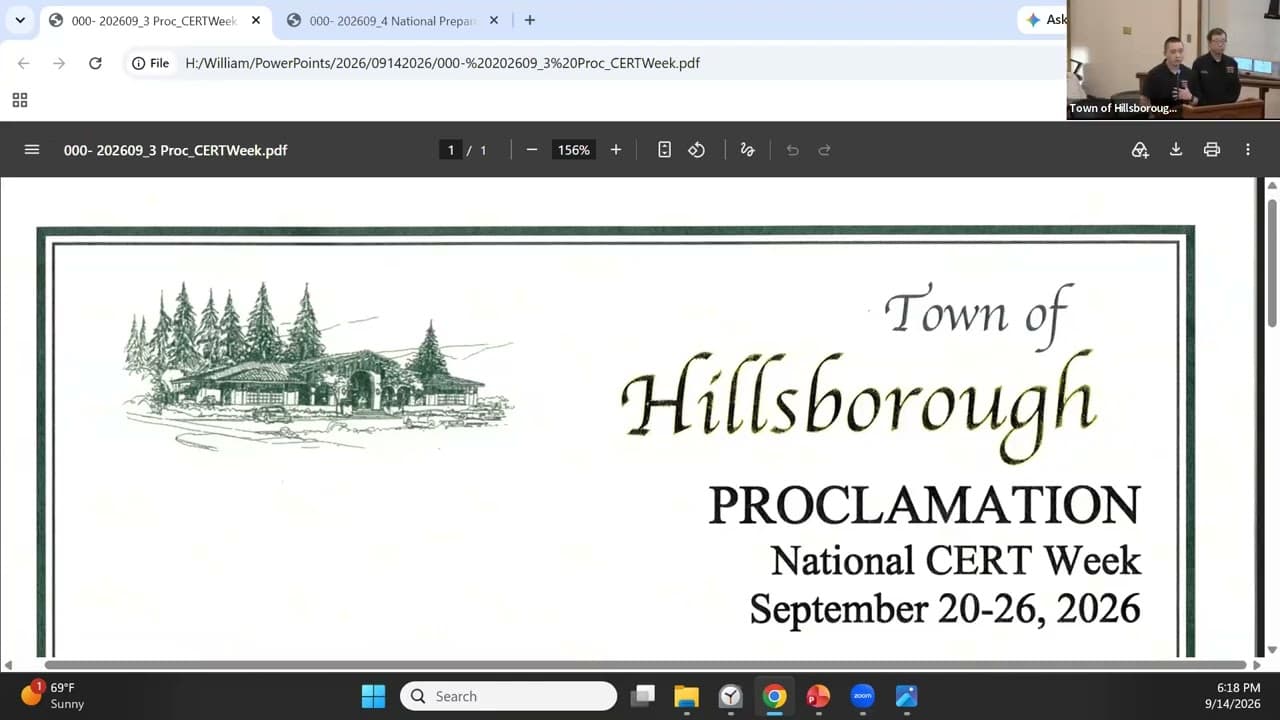
- Preparedness: Central County Fire Department CERT Coordinator Kaz Chow reported more than 200 active volunteers across three cities, about 40 of them in Hillsborough. The Hillsborough Neighborhood Network postponed Neighborfest until 2027.
- Mayor's applause: Code Compliance Coordinator Marcel Stevenson was recognized for resolving 19 of 20 August vegetation cases through education rather than citations.
- E-bikes: Ragsdale briefed the council on San Mateo County's ordinance, which sets fines of $50, $200 and $500 and a 5 mph sidewalk limit. A pending state bill would create a county pilot barring riders under 12.
Looking Ahead
The town's telecom survey closes Sept. 25. Applications for boards and committees are due Oct. 16. The Central County Fire Department holds an open house Oct. 10. Adams asked that the council agendize a review of mayor and vice mayor terms. The meeting adjourned in memory of Alex Ferguson.