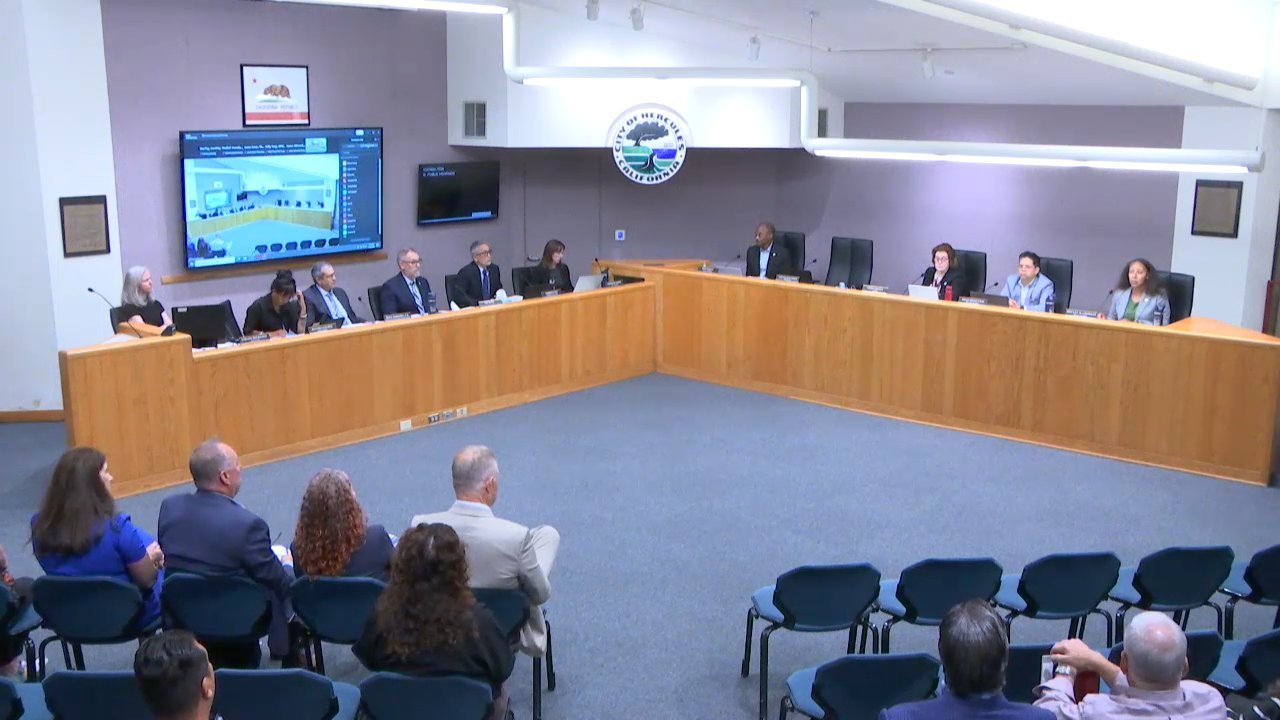
City Council - Jul 28, 2026 - Regular Meeting
City Council • HerculesJuly 29, 2026
Locunity is a independent informational service and is not an official government page for this commission.We use AI-assisted analysis and human editorial review to publish information.
Goodwill Wins Approval at Creekside Center as Hercules Eyes November Sales Tax Vote
The Hercules City Council spent the bulk of its July 28 meeting debating whether a Goodwill superstore belongs in one of the city's few remaining commercial spaces — and ultimately said yes, over the objections of residents who wanted higher-yield tenants. In a separate pivotal move, the council placed a 1% sales tax measure on the November 2026 ballot, confronting head-on a city that gets just 5.5 cents of every property tax dollar and still hasn't rebuilt from Great Recession-era layoffs.
Goodwill wins conditional use permit for a 31,600-square-foot retail store with drive-up donations at the former Big Lots in Creekside Shopping Center; council adds a six-month operational check-in
1% sales tax headed to November ballot after a community survey showed 68% support; urgency ordinance clears the required four-fifths vote
232-unit Dillon apartments sold to Interstate Equities Corporation, preserving 15 affordable units and Bayfront development covenants
Caltrans plans 53-hour closure of westbound I-80 across the Al Zampa Memorial Bridge Aug. 21–24 for deck resurfacing
Consent calendar approved unanimously with no items pulled
A Thrift Store, a Vacant Big Box, and a Fight Over Hercules's Commercial Identity
Hercules doesn't have much retail space to spare. So when the Planning Commission approved permits for Goodwill of San Francisco Bay to move into the 31,631-square-foot former Big Lots at 1551 Sycamore Ave. in Creekside Shopping Center, Mayor Christine Kelley called it up for a full council hearing — citing community fears about illegal dumping rooted in the shuttered Goodwill location in nearby Rodeo.
Why it matters: The vote crystallized a broader anxiety about what Hercules wants to be as a commercial destination. With limited retail parcels, every tenant choice carries long-term consequences for tax revenue, neighborhood character, and the city's ability to attract complementary businesses.
The basics: CUP 26-01 and DRP 26-01 authorize a retail store with a rear drive-up donation drop-off at the existing building. The project is categorically exempt from CEQA under Class 1 (existing facilities). The store would create roughly 31 jobs and operate 9 a.m. to 9 p.m. daily.
Where things stand: Community Development Director Tim Rude presented conditions of approval including an attended one-way donation loop, 24/7 video monitoring, an after-hours loudspeaker to deter dumping, and no outdoor storage. Goodwill CEO Tim — who leads Goodwill of Central and Northern Arizona, which took over the struggling Bay Area operation in 2024 — described the scale of the turnaround: "That includes us putting $20 million into the market and paying off $29 million in debt last year. That's how far in the hole they were."
The CEO committed to replacing all small Bay Area stores with large-format superstores of 25,000 square feet or more, arguing the old model of undersized locations was the root cause of dumping and disorder. He projected the Hercules store would generate about $3 million in annual sales initially, and "by year five, if we do everything right, it'll be about $4 million annually."
He also flagged a looming regulatory shift: "You have a state law that's been put in place here called SB 707 which no longer allows clothing to be thrown in landfill. You are going to have masses of donations of clothing coming into places that can't handle them unless we retrofit sites."
Kim Reiter of Thrive Real Estate Group, representing Goodwill, described donation protocols including 30-second vehicle service targets, cart containment systems, and centralized live camera monitoring from an operations center.
Residents Push Back Hard
Six public commenters spoke — four opposed, two in favor — and the opponents' message was consistent: Hercules deserves better.
Eric Williams argued the store would bring low-paying jobs and negligible tax revenue, and that the city's scarce retail space should go to higher-value tenants. Diana Baya urged the council to hold out for restaurants, cafes, or family entertainment, emphasizing the permanent opportunity cost. Gail Osana raised concerns about traffic from donation drop-offs and after-hours dumping. Maria argued that closures of nearby Goodwill and thrift locations would funnel dumping to Hercules and questioned whether the drive-up component was compatible with surrounding uses. Darlene Almeida expressed skepticism that deterrents would work and criticized Goodwill's mission presentation for lacking programs serving adults with disabilities.
On the other side, Bill Barron, managing partner of North First Street Properties and the 22-year property owner, described extensive due diligence including touring Goodwill's Arizona stores, reviewing financials, and obtaining a co-tenancy waiver from Home Depot. Cheryl Wright, a longtime resident, said she came in skeptical but was convinced by the presentation.
The City's Limited Leverage
Councilmember Dion Bailey framed the council's role bluntly: "We don't get to choose the tenant. We choose the use, basically."
The interim city manager disclosed that the city had previously tried to attract an Asian grocery store to the site, but the prospective tenant wanted several million dollars in tenant improvements that neither the property owner nor the city could fund.
Mayor Kelley reported visiting the Goodwill store in Pittsburgh, Calif.: "I drove out to the Pittsburgh store and went around it, and I have to say, it looked very good." She noted she had called the item up specifically because the Planning Commission hearing hadn't adequately addressed community concerns.
Councilmember Bailey added that he had spoken with the mayor of Pittsburgh about their Goodwill and with a Danville council member about a similar thrift store — both positive references.
Vice Mayor Alex Walker-Griffin recused himself from the vote, disclosing that he had made a social media comment that could be interpreted as prejudging the outcome.
Decisions: The council added one new condition — a six-month operational check-in after the store opens — giving them a formal mechanism to evaluate dumping, traffic, and operational concerns. Councilmember Tiffany Grimsley moved to approve; Councilmember Bailey seconded. The motion passed (For: 3 — Grimsley, Bailey, Kelley; Abstain: 1 — Bhattarai; Recused: 1 — Walker-Griffin).
What's next: Goodwill will proceed with buildout and permitting. The council will receive an operational report approximately six months after the store opens.
Hercules Puts 1% Sales Tax to Voters in November
Why it matters: Hercules receives just 5.5% of property tax revenue, nearly 40% of city staff were laid off during the Great Recession and never restored, and a budget shortfall is projected beginning in FY 2028-29. The sales tax measure is the city's primary strategy to avoid further service cuts and fund police, streets, and basic services.
The interim city manager presented the case for placing a 1-cent (1%) transaction and use tax on the Nov. 3, 2026, ballot. A community survey of more than 1,300 residents conducted last month found 68% support for a simple-majority measure. "In the community survey conducted just last month, as many as 68% of respondents would support a simple majority requirement $0.01 sales tax measure," the city manager reported. Survey respondents prioritized financial stability, the police department, 911 response times, crime prevention, business attraction, and street maintenance — with nearly 25% of neighborhood streets (more than 35 miles) rated poor or failed.
Vice Mayor Walker-Griffin emphasized that the council cannot raise taxes — only voters can — and framed the measure in terms of federal uncertainty: "A lot of the resources that historically have been available to us from the federal government have largely been cut and have been significantly more difficult to access. So this is really planning for the future."
Mayor Kelley put the property tax problem in personal terms: her own home generates only $270 per year for the city. Councilmember Bailey requested that the survey data be made publicly available.
Decisions: The urgency ordinance — which requires a four-fifths supermajority — passed (For: 4 — Grimsley, Bailey, Walker-Griffin, Kelley; Abstain: 1 — Bhattarai). The motion directs the Contra Costa County elections department to conduct the election, the city attorney to prepare an impartial analysis, and authorizes ballot arguments.
What's next: The measure goes before Hercules voters on Nov. 3, 2026. As a general tax requiring only simple-majority approval, it needs 50%-plus-one to pass.
Bayfront's Dillon Apartments Change Hands
The council consented to the sale of the Dillon, a 232-unit apartment building at Hercules Bayfront, from Hercules Block Q and R Development Partners LP (LeadCore) to an affiliate of Interstate Equities Corporation (IEC) called Dillon Apartments LLC.
Why it matters: The Dillon is the city's signature Bayfront residential asset. The sale preserves 15 deed-restricted affordable units, a public parking agreement (up to 31 spaces tied to future transit triggers), and the Bayfront Implementing Development Agreement — all of which transfer to the new owner.
Jason Silver, VP of California for LeadCore, described an extensive search for a buyer who would be a responsible steward and partner for the remaining Bayfront master plan. Brendan Gibney, director of investments for IEC, described the family-owned firm, founded in 1981, as managing more than 5,000 units in California and Seattle on behalf of charitable investors including university endowments and healthcare systems. Kelly Tang, president of IEC Property Services, highlighted 150 years of combined leadership experience in the firm's in-house property management team.
Councilmember Bailey asked about affordable unit preservation (confirmed), rent impacts (nominal inflation-based increases), and potential amenity additions — IEC said tenant workstations for remote workers were under consideration.
Vice Mayor Walker-Griffin recused himself as a Dillon resident. The motion passed (For: 4 — Grimsley, Bhattarai, Bailey, Kelley; Recused: 1 — Walker-Griffin).
Zampa Bridge: Plan for 53-Hour Closure Aug. 21–24
Bart Nave, Caltrans office chief of public affairs, presented plans for a 53-hour full closure of westbound I-80 across the Al Zampa Memorial Bridge from 10 p.m. Friday, Aug. 21, through 3 a.m. Monday, Aug. 24, 2026. "We are going to be closing one of our iconic bridges, the Al Zampa Memorial Bridge that handles westbound traffic on Interstate 80 to replace its deck," Nave said.
Crews will mill and replace 1,550 tons of Trinidad Lake asphalt on the steel orthotropic box girder deck, which has exceeded its 20-year design life after 23 years of service. Caltrans emphasized there are no structural integrity issues — this is purely a ride-surface replacement.
Detours will route westbound traffic via I-780 to the Benicia-Martinez Bridge and back through Highway 4 or Cummings Skyway. Portable changeable message signs will deploy two weeks in advance, and a media campaign including geotargeted digital ads is planned. Interim Public Works Director Mike Roberts confirmed Caltrans would monitor ramp metering from westbound SR-4 to southbound I-80 to prevent cut-through traffic on local streets. A command center at the Carquinez Bridge toll plaza will monitor regional conditions.
Minor Items
Consent calendar approved unanimously 5-0 with no items pulled (eight items).
Vice Mayor Walker-Griffin designated primary voting delegate and Councilmember Bhattarai as alternate for the League of California Cities 2026 annual conference in Anaheim. Approved 5-0.
Staff announced a ribbon cutting for the Refugia Valley Park shade structure on Aug. 3 and National Night Out on Aug. 4.
The council will go dark in August and reconvene the first Tuesday in September.