
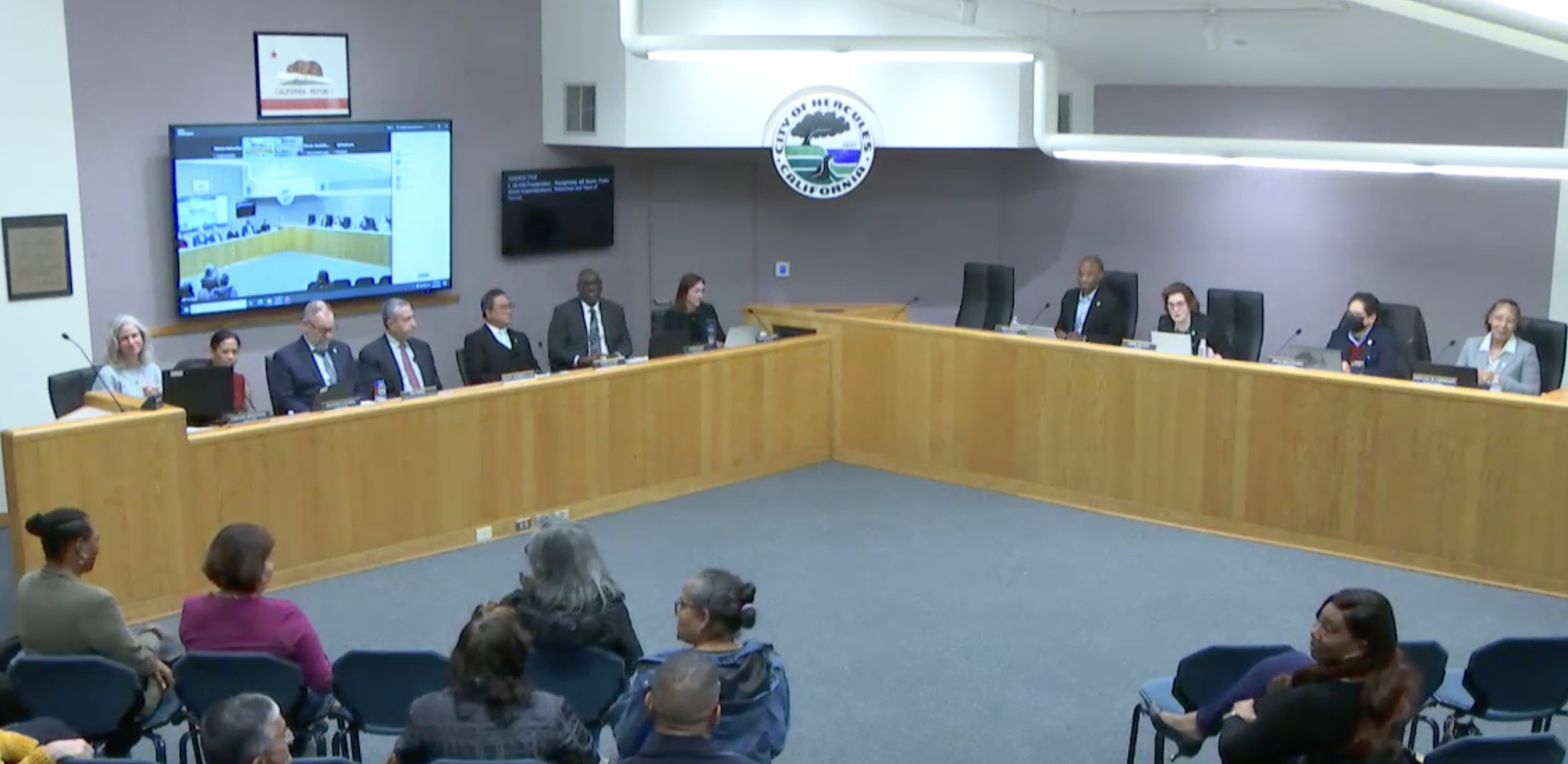
City Council - Feb 24, 2026 - Regular Meeting

City Council - Feb 24, 2026 - Regular Meeting

City CouncilHerculesFebruary 24, 2026

Sources:

Locunity is a independent informational service and is not an official government page for this commission.We use AI-assisted analysis and human editorial review to publish information.

Hercules Roads Declining as City Faces $4M Funding Gap and Bids Farewell to City Manager

The Hercules City Council navigated a packed agenda Tuesday that laid bare a structural crisis in road funding, approved a quarter-million dollars in new business grants to fill empty storefronts, and said goodbye to City Manager Dante Hall at his final meeting after 4.5 years. Every vote passed 4-0, with Councilmember Alex Walker-Griffin absent.

  • City's pavement condition index (PCI) falls to 58 — stabilizing roads would require doubling the $1.8M annual budget; improving them would cost $5.9M

  • $21.7M federal grant application filed to make the long-planned Hercules Hub transit center shovel-ready

  • $200K tiered business attraction grant program approved targeting Big Lots, Rite Aid, and smaller restaurant vacancies

  • Council debates delaying Promenade assessment vote after vice mayor warns rushed Prop 218 ballots have repeatedly failed

  • Police chief confirms no ICE operations in Hercules in 22 years after resident urges emergency planning

  • City Manager Hall departs March 23 after resolving a $7M state debt, advancing the Hub, and earning five consecutive budget awards


Hercules Roads Are Getting Worse — and There's No Easy Fix

Public Works Director Glenn Dombeck delivered a sobering capital improvement program update that put a number on what residents already feel under their tires: the city's Pavement Condition Index has slipped to an estimated 58 — fair, but declining — down from its last formal measurement.

Why it matters: Dombeck presented three funding scenarios that frame a painful choice. At the current $1.8M annual pace, road conditions will continue to deteriorate even as the city patches its worst segments. Doubling to $3.6M would merely stabilize the index. Reaching the green-line target — actual improvement — would require $5.9M a year, a 320% increase.

Where things stand: That pace cannot keep up with deterioration, particularly as the city repairs roads that have already failed, which costs far more per mile than preventive maintenance.

Vice Mayor Dion Bailey noted that the $5.2M figure would represent roughly a quarter of the general fund budget. Mayor Chris Kelley pointed to a longer-term structural problem:

"The gas tax is going down. That's a big concern up in Sacramento. And we're going to see less and less gas tax as the years go by because people are going to zero emission vehicles."

Outgoing City Manager Dante Hall acknowledged the bind:

"We clearly do not have $5 million a year to spend on roads. And if we continue to spend at the level that we're spending, the roads are going to decline."

What's next: The council will discuss alternative revenue sources in June. In the near term, several CIP projects are moving: Falcon Way pavement rehabilitation begins in March, the Foxboro neighborhood design is at 65% progress, and staff is reconsidering the over-budget John Muir Parkway traffic calming project.


$21.7M Federal Grant Could Finally Make the Hercules Hub Shovel-Ready

Buried within the CIP update was perhaps the meeting's most consequential long-term development. In early February, the city completed a $21.7 million application to the Federal Railroad Administration's National Railroad Partnership grant program.

Why it matters: If awarded, the funding would complete all project development work and final design for the Hercules Hub intermodal transit center — making it shovel-ready for the first time after years as, in Vice Mayor Bailey's words, "a talking point" that was always seven years out.

Where things stand: The application was prepared with the help of consultants Graybow and Scott. The grant includes a 20% local match to be funded from general fund monies and regional transportation grants. The city has been advancing 10% design and recently received comments from Union Pacific Railroad. Survey work proposals are being solicited to support the design effort, and a conservation easement on Refugio Creek from earlier path-to-transit work still needs to be finalized with John Muir Land Trust.

What's next: The West Contra Costa County Transportation Commission is releasing another cycle of sub-regional transportation mitigation program funding in mid-March, for which Hercules plans to apply.


$200K in Tiered Grants Aims to Fill Big Lots, Rite Aid, and Restaurant Vacancies

The council unanimously approved a renewed and expanded business attraction grant program funded by $200,000 from general fund reserves, building on a $100,000 pilot that successfully committed all its funds to four qualifying restaurants.

The basics: The program creates two tiers. Eating and drinking establishments can receive $20,000 (under 1,500 square feet) or $30,000 (1,500–5,000 square feet). A broader general business category targets larger vacant spaces: up to $50,000 for mid-size storefronts like the former Rite Aid (5,000–15,000 square feet) and up to $100,000 for the Big Lots site (over 15,000 square feet). National chains and franchises are now eligible for the larger spaces.

Why it matters: The prior pilot attracted Sugar Tooth, Tommy's Barbecue, F Hanoi 89, and Home Coffee. But two major vacancies — Big Lots and Rite Aid — remain top resident concerns.

"Our residents have been asking for more businesses and services in the city of Hercules. I think this is really important," said Councilmember Tiffany Grimsley.

Where things stand: Community Development Director Tim Rude reported that Big Lots property owners have entered a letter of intent with Goodwill for a 10-year lease (up to 20 years with options), but that tenant would not qualify for a grant due to its on-site donation station. To provide flexibility, staff eliminated per-category funding caps, allowing the full $200,000 to go toward any qualifying grants. Councilmember Dilli Bhattarai asked about outreach strategy, and staff described plans for press releases, broker communications, and Chamber of Commerce coordination.

City Manager Hall noted the city also needs to ensure transparency in grant reporting to the public. Rude confirmed that grants would go through the city manager's approval process, with council receiving reports on commitments.

Decisions: Passed 4-0 (For: Kelley, Grimsley, Bailey, Bhattarai; Absent: Walker-Griffin).


Bailey Pushes to Delay Promenade Assessment Vote, Citing Failed History

The council approved a resolution initiating the annual engineer's reports for all five of the city's Landscape and Lighting Assessment Districts (LLAD), but the substantive debate centered on whether to delay a Prop 218 ballot measure for the Hercules Village LLAD — also known as the Promenade.

The basics: Under California's Prop 218, any increase to a property-related assessment requires a ballot of affected property owners. The Hercules Village district faces an operating deficit driven by drought-related irrigation costs, EBMUD water rate increases, and unanticipated tree maintenance. Staff proposed a $50-per-year assessment increase over eight years to close the gap.

Why it matters: Vice Mayor Bailey argued forcefully that rushing to a vote would repeat past mistakes.

"My experience has been that when we do this, we're in such a time crunch that it doesn't seem to provide enough time for outreach," he said, noting the city's history of failed first-round Prop 218 attempts.

He urged beginning outreach immediately but holding the actual vote in a later fiscal year — possibly January 2027.

The other side: Councilmember Bhattarai worried that delay would grow the deficit and ultimately cost residents more.

"What I really don't want to have is residents not being very happy that, 'Hey, you guys cannot take the decision on time and it cost me more...Let's be very clear. If council has to make a decision, we wanted to make a decision, but put the facts together so that we can make informed decision'" he said.

Consultant Ed Espinoza of Francisco & Associates explained the mechanics: the county auditor's Aug. 10 deadline and a required 45-day noticing period mean that delaying the vote would push any new assessment collection to FY 27-28. Mayor Chris Kelley asked whether extending the payback period to 10 years could lower the annual amount, and staff agreed to bring comparison numbers.

Decisions: The resolution initiating the engineer's report for all five districts passed 4-0 (For: Kelley, Grimsley, Bailey, Bhattarai; Absent: Walker-Griffin). The Prop 218 timing question was deferred, with staff directed to present cost-of-delay analysis at the March 24 budget workshop.


Police Chief: No ICE Operations in Hercules in 22 Years

A resident's public comment about federal immigration enforcement sparked one of the meeting's most pointed exchanges, ultimately drawing the police chief into a detailed response.

Where things stand: During public communications, Lynn Paleo urged the council to develop an emergency response plan, bring mobile immigration services to Hercules, restrict license plate reader data from immigration tracking, and ensure officers are trained on lawful conduct during ICE actions. She cited a New York Times report on ICE enforcement in small towns and emphasized she was not asking the council to break the law.

Vice Mayor Bailey pulled the Police Chief's Advisory Board (CAB) report from the consent calendar to connect Paleo's concerns to ongoing CAB discussions. Police Chief Joe Vasquez responded directly:

"Before ICE does any type of operation in the city, I would be notified in advance. I can assure you and tell you that there has not been any ICE operation within the city."

He said that in his 22 years with the department, no such operation has occurred, and that based on conversations with other chiefs in Contra Costa County, he would receive advance notice — though he expressed hope those protocols would remain in place.

Decisions: The CAB report was approved 4-0 as a pulled consent item (For: Kelley, Grimsley, Bailey, Bhattarai; Absent: Walker-Griffin).


Council Bids Farewell to City Manager Hall

In what was announced as his final meeting before a March 23 departure, City Manager Dante Hall received tributes from community organizations and all four present council members.

Tanya Little of the Friends of the Hercules Senior Center and Kendall Cotton of the Police Chief's Advisory Board each presented certificates of appreciation during public communications.

Vice Mayor Bailey offered the most detailed accounting of Hall's tenure: resolving an approximately $7 million state debt through a meeting with then-State Senator Nancy Skinner's office, implementing a work order system, advancing the Hercules Hub from perpetual talking point to near-shovel-ready status, completing improvements at Village Parkway and Victoria by the Bay, and establishing 10-year capital improvement forecasts.

Councilmember Grimsley praised the volume of work accomplished. Councilmember Bhattarai credited Hall's leadership, integrity, and professionalism. Mayor Kelley highlighted improved communications, the Parks and Recreation master plan, and Hall's deep knowledge of Hercules.

Hall deflected the praise:

"None of this happens because of one person. It really happens because of committed staff, supportive council and a community that shows up and stays engaged with us."

The council has named J. Patrick Tang as Interim City Manager in a 4-0 vote on the consent calendar.


Minor Items

  • Mid-year budget adjustments approved (4-0): $249,000 from the general fund and $23,000 from the stormwater parcel tax fund. Key line items: $76,000 for animal control after the county raised fees post-contract ($404,000 total for FY 25-26), $50,000 to replenish grant-writing funds with California Consulting, and $98,703 for Beechnut Park from capital reserves. City Manager Hall reported the prior $50,000 grant investment returned roughly $300,000 in awards. Mayor Kelley expressed frustration with recurring animal control cost hikes: "That's going to mean we're paying 404,000 a year for this fiscal year for animal services. I know they're strapped, but so is everybody else."

  • Beechnut Park design contract amendment approved (4-0): $84,534 increase brings the Gates and Associates design contract to $136,329 for the six-acre Refugio Valley Road park. Total project funding: $514,388 ($415,685 in grants from East Bay Regional Park District, Prop 68, and Parks Impact Fees, plus $98,703 general fund). A 172-participant survey and pop-up event shaped the design, which includes ADA-accessible playground equipment for ages 5–12. Construction is targeted for late August or September 2026.

  • Lunar New Year proclamation: Council proclaimed Feb. 17 through March 3 as Lunar New Year in Hercules (Year of the Fire Horse), noting the Asian diaspora comprises approximately 45% of the city's population. The second annual Lunar New Year parade is scheduled for March 1 at 1 p.m.

  • Jeff Brown retirement recognition: Council honored Public Works Superintendent Jeff Brown on his retirement after 36-plus years of service dating to 1989, including managing the NG Solar project and twice serving as interim Public Works director.

  • Remaining consent calendar items approved 4-0.

  • Vice Mayor Bailey reported that Hercules residents pay roughly $25 annually on their property tax for BART service the city does not actually have, and provided updates on WestCAT/BART funding discussions and MCE rate smoothing efforts from regional board meetings.

  • Budget workshops for FY 26-27 are scheduled for March 24 and May 12.