
City Council - Apr 28, 2026 - Regular Meeting

City Council - Apr 28, 2026 - Regular Meeting

City CouncilHerculesApril 28, 2026

Sources:

Locunity is a independent informational service and is not an official government page for this commission.We use AI-assisted analysis and human editorial review to publish information.

Stormwater Mandate, Rising Landscape Costs Dominate Hercules Council Agenda

The Hercules City Council spent the bulk of its April 28 meeting wrestling with the mechanics of unfunded state mandates and structural budget pressures — approving five landscape assessment district resolutions while previewing a regional stormwater compliance partnership that could reshape how this small Contra Costa County city meets escalating environmental regulations. A detailed presentation from Phillips 66 on the converted Rodeo renewable diesel facility and a spirited celebration of the Hercules Library's 20th anniversary rounded out a packed evening.

  • Council previews regional stormwater JPA that would let Hercules buy compliance credits rather than build all green infrastructure locally; formal vote set for May 26

  • Five landscape district assessments advance with a 2.48% CPI increase for most property owners; the Hercules Village district's growing deficit remains unresolved

  • Phillips 66 details 98% sulfur oxide reduction at the world's largest renewable diesel facility in neighboring Rodeo, with $761K in annual local contributions

  • $55,000 approved for community events as Lunar New Year attendance triples to 2,500 and declining sponsorship pressures the city's cultural programming

  • Hercules Library celebrates 20 years with 97,000 annual visitors and rising demand from displaced Pinole Library patrons


Unfunded Mandate or Regional Opportunity? Stormwater JPA Heads for May 26 Vote

The basics: The Municipal Regional Stormwater Permit — issued by the San Francisco Bay Regional Water Quality Control Board — requires Hercules to retrofit 1.58 acres of impervious public right-of-way with green stormwater infrastructure (bioretention facilities, permeable pavement, and similar low-impact development) by June 30, 2027. The city must also meet PCB and mercury pollutant load reduction targets tied to federal Total Maximum Daily Loads.

Sixteen of 21 Contra Costa County Clean Water Program member agencies are forming a Regional Alternative Compliance Joint Powers Authority (JPA) that would allow cities to buy and sell compliance units — essentially credits representing treated impervious acreage — rather than each building its own facilities.

Why it matters: Hercules can meet the 1.58-acre retrofit requirement on its own, but the PCB/mercury targets are harder. Those pollutants concentrate in old industrial areas that Hercules, a primarily residential city, largely doesn't have. Joining the JPA could let the city pay into a regional pool where larger partners with industrial land do the heavy remediation.

Where things stand: Public Works Director Glenn Dombeck told the council the city faces a straightforward choice.

"At this time, we as a city need to make a decision whether we continue to try to meet that requirement on our own, independently, which we can achieve, or the alternative would be to join the JPA," he said.

Rinta Perkins of the Contra Costa County Clean Water Program walked the council through permit mechanics and the JPA's proposed funding model: a Community Facilities District under the Mello-Roos Act would collect assessments from property owners to cover ongoing operations and maintenance of green infrastructure built through the program.

Councilmember Tiffany Grimsley pressed on whether the JPA would reduce the city's staffing burden.

"Is there any distinct difference between being part of the JPA or not being part of the JPA in terms of staffing requirements?" she asked.

Dombeck confirmed that the JPA would consolidate administrative tasks that otherwise fall on city public works staff.

The other side: Mayor Christine Kelley framed the broader tension bluntly.

"It seems to me like this is another one of those unfunded mandates. The state comes down and says, okay, you cities, you've got to do this," she said.

Councilmember Dion Bailey pushed on cost control, asking staff to present a detailed cost comparison of going it alone versus joining the JPA.

A public commenter, Tanya Little, endorsed the JPA based on her state-level experience with utility and water joint powers authorities, citing economies of scale, limited city land, housing mandates, and staffing relief as key benefits.

What's next: Dombeck committed to presenting a cost comparison at the May 26 meeting, when the council is expected to take a formal vote on JPA membership. The permit deadline for design and full funding is June 30, 2027, with a new, more stringent MRP 4.0 already in development.


Five Landscape Districts Advance; Hercules Village Deficit Looms

The basics: Landscape and Lighting Assessment Districts (LLADs) are property-owner-funded assessments that pay for common-area landscaping, irrigation, lighting, and tree maintenance in specific neighborhoods. Hercules has five: LLAD 83-2 (covering 11 benefit zones citywide), Victoria by the Bay, Hercules Village/Promenade, Baywood, and Bayside.

Why it matters: Most districts will see a 2.48% CPI increase for FY 2026-27. But the Hercules Village district is running operating deficits driven by tree pruning costs, climate-driven irrigation increases, and East Bay MUD water rate hikes. A Prop 218 assessment increase — which requires a mailed ballot of property owners — has been postponed to next year to allow for additional outreach.

Where things stand: Ed Espinoza of Francisco & Associates, the city's assessment engineer, presented the five preliminary engineer reports. Three zones within LLAD 83-2 — Foxborough, commercial properties, and Trees and Flowers — will not see increases because current rates cover their budgets. Victoria by the Bay includes an additional $50 per year authorized by property owners last year for a 10-year period.

Councilmember Dion Bailey pushed for greater transparency.

"If we actually had a cost, and when it's not, when it's a whole number like that, an even number, it looks like it's an estimate. But if we knew we spent $12,732 and they cut this many trees, it would help us explain it because this is a contentious thing for many residents," he said.

Mayor Christine Kelley flagged a specific concern: a $12,000 tree-trimming estimate for Zone 1 (Hercules by the Bay) that would push the zone into deficit. She asked staff to reduce the figure and track actual costs going forward for the next 12 months.

Public Works Director Glenn Dombeck disclosed a bright spot: the city received a U.S. Bureau of Reclamation grant for smart irrigation controllers, noting the controllers should reduce water consumption across city parks.

Councilmember Dilli Bhattarai urged long-term strategies to reduce the structural deficits rather than deferring them year after year.

Decisions: The council unanimously adopted all five resolutions setting preliminary assessments and scheduling a public hearing for June 23, 2026.


Rodeo Refinery Reborn: Phillips 66 Reports on World's Largest Renewable Diesel Plant

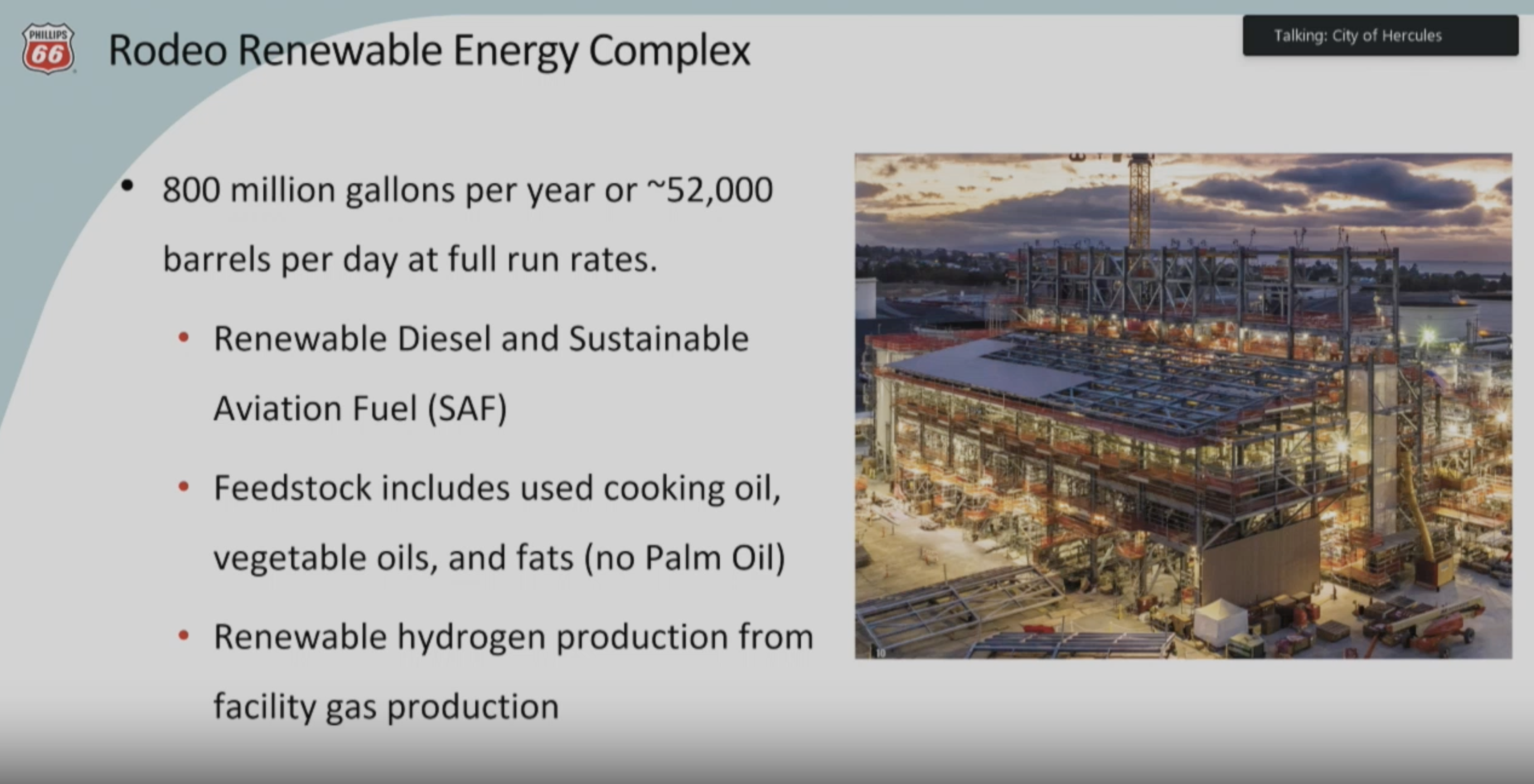
David Schoenthal of Phillips 66 presented a detailed update on the Rodeo Renewable Energy Complex — the converted San Francisco Refinery that now produces renewable diesel and sustainable aviation fuel from animal fats, cooking oils, and vegetable oils instead of petroleum.

Why it matters: The facility, located in neighboring Rodeo, is the largest of its kind globally, producing 54,000 barrels per day. It preserved its entire 385-worker USWR union workforce through both the COVID pandemic and the conversion — with no layoffs. The plant also employs roughly 225 contractors and has logged five consecutive years without serious injuries.

Environmental gains have been dramatic: sulfur oxide emissions dropped 98%. The site includes an 88-acre solar field — described as the largest private solar installation in the United States — generating 7-8 megawatts alongside three cogeneration units, meaning the facility takes nothing from the electrical grid.

"So we are the largest facility of its kind in the world in Rodeo. So you've got 800 million gallons per year or 52,000 barrels per day," Schoenthal told the council.

The conversion came at a steep cost.

"Last two years we've lost about $320 million. So to get this off the ground, the world's largest startup, it is taking a lot of time, money and effort. And now we're just starting to see the turn," he said.

On community investment, Schoenthal detailed $2.75 million provided since 2008 for John Swett High School vocational programs, $120,000 for Lupine Hills Elementary's garden program, and $761,000 in annual funding to more than 125 local nonprofits, plus support for the local veterans memorial.

He also announced that the former carbon plant on Highway 4 has been demolished and remediated. The site is zoned heavy/light industrial and available for redevelopment.

Council members praised the environmental improvements and community engagement. Councilmember Dilli Bhattarai noted the significance of the emission reductions for residents in the surrounding area, while Councilmember Dion Bailey asked about the facility's feedstock sourcing, which Schoenthal said comes from worldwide suppliers — including a special arrangement with McDonald's Singapore for waste cooking oil. The facility uses no palm oil.


$55K for Community Events as Costs Rise and Sponsors Pull Back

The council approved a $55,000 allocation — up $10,000 from the prior year — for five co-sponsored events with the Bayfront Chamber of Commerce in FY 2026-27: National Night Out, the Bayfront Festival and Run, the Crab Feed, Lunar New Year, and the Cultural Festival.

Why it matters: The Lunar New Year event has grown from 800 attendees in its first year to 2,500 in 2026 — a sign of strong community demand. But costs are rising: the Cultural Festival alone jumped from $38,000 to $48,000 in recent years, while private sponsorship dollars have declined.

Parks and Recreation Director Christopher Roke noted the Cultural Festival will move from Refugia Valley Park (closed for shade structure construction) to Hannah Ranch Park, requiring generator rentals that add to costs.

Councilmember Dion Bailey expressed concern about the upward trajectory.

"So maybe the narrative should not be that we're sponsoring them and that we're paying for more of them, I think," he said.

Bailey suggested the $10,000 increase should be framed as a one-year add-on rather than a permanent baseline. Staff, however, noted this is the third year at the same base rate.

Decisions: Approved 5-0. The Cultural Festival is scheduled for June 7, 2026.


Minor Items

  • Closed session on anticipated litigation (one case, Gov. Code §54956.9) yielded nothing reportable.

  • National Library Week proclamation: The Hercules Library celebrates its 20th anniversary with 97,000 annual visitors, 310 programs, and over 10,000 program attendees in 2025. Door counts are rising by roughly 1,000 per month after the Pinole Library closed for refurbishment through 2027. A 20th anniversary celebration is planned for Nov. 14.

  • National Volunteer Week: Staff recognized volunteers across the senior center, police department, parks, and nonprofits. Herculean Mile Award nominations are due June 1.

  • City manager search is underway and on track, per Interim City Manager Patrick Tang.

  • A new Public Works superintendent has started.

  • MCE clean energy debate: Councilmember Bailey reported the city received its 2% MCE voting share allocation and noted ongoing tension over clean energy content — 60% versus 90%-plus — given rate implications. "Some communities want more, but clean energy is very expensive. So we're kind of having that debate of what is the middle ground there," he said.

  • Vice Mayor Alex Walker-Griffin announced the Cal Cities board approved the Young Electeds Working Group he co-founded with Riverbank Councilmember Rachel Hernandez, advocating for Californians under 40 on childcare, housing, and related issues.

  • Mayor Kelley noted she attended a webinar on Assemblymember Buffy Wicks' AB 1903, which addresses defect liability reform to encourage condominium construction.

  • First budget workshop is scheduled for May 12. Cleanup Day is May 2.

  • Bureau of Reclamation grant for smart irrigation controllers received notice to proceed — expected to reduce water costs across city parks.

Stormwater Mandate, Rising Landscape Costs Dominate Hercules Council Agenda | City Council | Locunity