
Blue Shield Owns Medicare Rating Drop as Board Demands Turnaround Plan
Health Service Board • San FranciscoNovember 12, 2026
Locunity is an independent informational service and is not an official government page for this commission. All information is sourced from public footage and an analysis of official agendas with the aid of responsible, fact-checked AI. to report an error or omission.
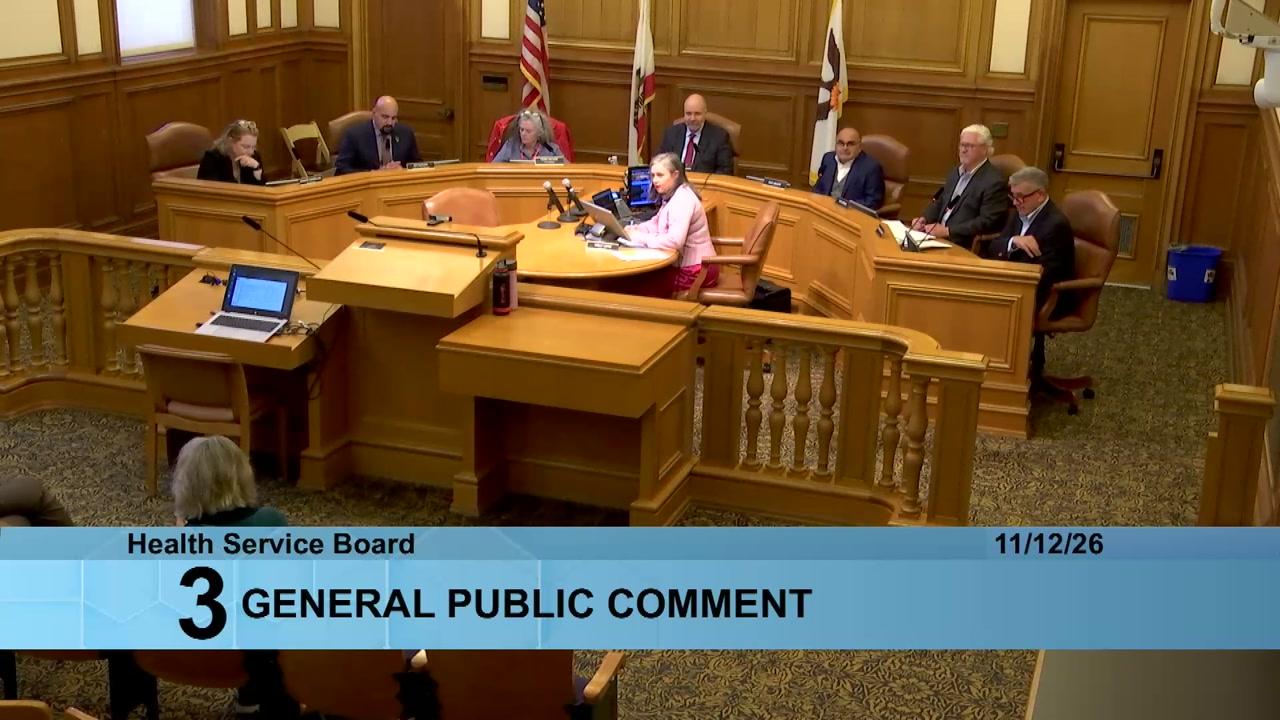
San Francisco's Health Service Board spent its longest stretch on Nov. 12, 2026, grilling Blue Shield of California after its Medicare PPO for city retirees fell from 3.5 to 2.5 stars. No vote was taken. Blue Shield accepted blame, commissioners called its fix insufficient, and staff signaled that a 2028 Medicare procurement is now on the table as premiums look set to climb.
- Blue Shield's retiree Medicare PPO drops to 2.5 stars; Kaiser Senior Advantage holds at 4.5
- Commissioners call Blue Shield's improvement plan insufficient and press for more detail in December
- Staff weigh a 2028 Medicare RFP comparing three coverage models after projections show possible steep premium increases
- Employee Benefit Trust projected to draw $62.2M, double last year, even as auditors issue a clean opinion
Blue Shield Takes the Blame for Falling Stars
The basics: CMS, the federal Medicare agency, rates Medicare Advantage plans on a star scale. The ratings cover member experience, pharmacy service and clinical quality measures.
Why it matters: HSS retirees make up more than half of enrollment in Blue Shield's Medicare PPO contract. The 2.5-star rating will materially affect Blue Shield's 2028 financial proposal to the city. It also shapes whether the board keeps the plan at all.
Where things stand: HSS moved retirees into the Blue Shield PPO on Jan. 1, 2025. Executive Director Rey Guillen said the 2027 rating reflects 2025 performance, including eligibility and benefit-loading errors during the transition that could have been prevented. The financial hit lands in 2028, which Guillen called "kind of a perfect storm to hit at the absolute worst possible time."
Blue Shield did not dispute the record. "We take full accountability that those did occur," said Alex Um, Vice President and General Manager for Medicare, Blue Shield of California.
Um attributed the decline to three areas:
- Member experience: Blue Shield's scores on how members rated their care fell short.
- Pharmacy performance: The plan struggled during GLP-1 drug shortages.
- Data gaps: Blue Shield lacked usable contact and provider information. "We lacked email addresses for 88% of members and phone numbers for 30%," Um said.
Blue Shield has since added a dedicated PPO program manager and a monthly member survey. Um reported early gains, "with 9 of 13 clinical measures already performing ahead of the prior year." Five of six pharmacy measures were also ahead.
The other side: Commissioners were unimpressed. "I'm embarrassed for Blue Shield about these results. They are terrible," said one commissioner, who called the plan insufficient. The same commissioner then asked: "Are you able to come back more in December with a greater level of detail about what it's going to take to really turn this ship?"
Amy DeHart, Area Vice President for Premier Accounts, Blue Shield of California, answered: "We'd be more than happy to outline all 40 of the measures."
Commissioner Jack Cremen said Blue Shield had broken commitments made for 2025. "And obviously you are not keeping up your end of the bargain," he said. He pointed to the higher-rated competitor: "So maybe we should try to follow Kaiser's plan."
Public commenters pushed on the same data problems.
- John Ellis, a member of the Supportive Housing Providers Network Advisory Board who spoke as an individual, urged HSS to demand a root-cause analysis of the missing contact data. He also asked for a more real-time dashboard on how quickly members receive medications.
- A retiree described the chaotic 2025 transition and the fear it caused over specialty medication costs. The retiree thanked the board for pursuing deeper analysis.
- During general public comment, Fred Sanchez, President of Protect Our Benefits, said Blue Shield, retiree groups and others have agreed to meet quarterly. He praised HSS for its responsiveness.
Decisions and stakeholder impacts: This was an informational item, so no vote was taken. Retirees are the most exposed: their plan quality is now tied directly to 2028 pricing. Blue Shield faces a board openly comparing it to Kaiser just as procurement talk begins.
What's next: Blue Shield is expected to return with measure-level detail. The commissioner who requested it asked for that update in December.
A 2028 Medicare Rebid Comes Into View
Why it matters: Retirees could face large premium increases in 2028. Staff say only one replacement plan is feasible.
Where things stand: In his Director's Report, Guillen said preliminary projections from Aon, the board's actuarial consultant, showed potentially substantial premium increases for 2028. Those numbers prompted staff to reconsider an earlier plan to skip a full procurement.
A request for proposals (RFP) would compare three approaches:
- A single plan that combines Medicare Advantage medical and drug coverage.
- Separate medical and drug coverage.
- A Medicare supplement plan paired with a separate drug plan.
Under each option, the benefit design would stay similar and the plan would remain fully insured.
The other side: Teresa Palmer, a retiree from Laguna Honda, asked whether the procurement could produce more than one plan for retirees to choose from. Guillen said no. HSS has 49 staff managing more than 140,000 covered lives, he said, and "we just do not have resources to add any additional plans to our menu at this point in time."
Board President Art Howard asked how the city can be sure it gets what it pays for. Staff said the RFP would weigh each bidder's clinical and administrative capabilities. They expect only a handful of bids.
Decisions and stakeholder impacts: Guillen also reported that Health Net will leave California's commercial market on Feb. 28, 2027. The exit affects about 2,000 covered lives. "Approximately 60% of Health Net members proactively selected alternative medical coverage during open enrollment," Guillen said.
Members who have not switched will get a special enrollment period in early 2027. Anyone who does not choose a plan will be placed by zip code, into Kaiser HMO where it is available.
Staff also shared an analysis of retiree ages. The group aged 75 and older grew about 51% from 2017 to 2026. Guillen noted that moving retirees to a fixed-dollar contribution would likely require a charter amendment.
What's next: Staff will bring a Medicare procurement strategy to the board in December.
Clean Books, Shrinking Cushion
Why it matters: The trust that funds city employee and retiree benefits passed its audit cleanly. Its reserves, however, are falling fast.
Where things stand: Chief Financial and Affordability Officer Teresa Tan reported that claims exceeded contributions in the first three months of the fiscal year. Most of the pressure came from FLEX-funded HMOs and self-funded PPO plans. "The projected use of $62.2 million is double last year's use of $30 million," Tan said.
At that pace, the Employee Benefit Trust's balance would fall from $72M to $9.7M. Tan said $25.2M in pharmacy rebates and $3M in interest are expected. The Healthcare Sustainability Fund is projected to use $0.9M, leaving $6.8M. The general fund is running ahead of budget because of salary and vacancy savings. No one asked questions or offered public comment.
Auditors from MGO (Macias Gini & O'Connell) issued an unmodified opinion on Oct. 23, 2026. They found no material weaknesses, significant deficiencies, noncompliance or misstatements. MGO's own actuary reproduced Aon's claims reserve estimate and found it reasonable. In response to a question from Howard, the auditor said HSS tends to be better organized than some other clients.
Decisions and stakeholder impacts: The board accepted the audit on a motion by Cremen, seconded by Board Vice President Fiona Wilson, M.D.
- For: 5 (Howard, Wilson, Cremen, Dorsey, Vallejo)
- Against: 0
- Absent: 2 (Guevara, Hao)
Minor Items
- Life-event notice window doubled: The board voted 5-0 to give members 60 days, up from 30, to report a newborn or a spouse's death. Wilson presented the change from the Governance Committee. A public commenter called it a no-brainer.
- Prop F carve-out: HSS is expressly excluded from the mayor's new reorganization authority under Proposition F.
- Board election rules: Proposition A includes changes on removing elected board members. The Ethics Commission is reviewing campaign reporting rules ahead of the May 2029 board election. Palmer said retiree groups opposed two related bills, one authored by Supervisor Rafael Mandelman, as lacking sufficient oversight.
- Open enrollment: HSS logged about 19,000 online elections, 2,000 paper applications and 5,800 calls. The share of callers who hung up before reaching staff fell from 19.4% to 11.4%.
- Minutes approved: October meeting minutes passed 5-0. Commissioners Diana Guevara and Mary Hao were excused.
Looking Ahead
December is a heavy month for the board. It is scheduled to approve the 2027-2031 strategic plan, receive a Medicare procurement strategy and hear more from Blue Shield on its turnaround.