
Health Board Hears Case Against Medigap as Retirees Push Back
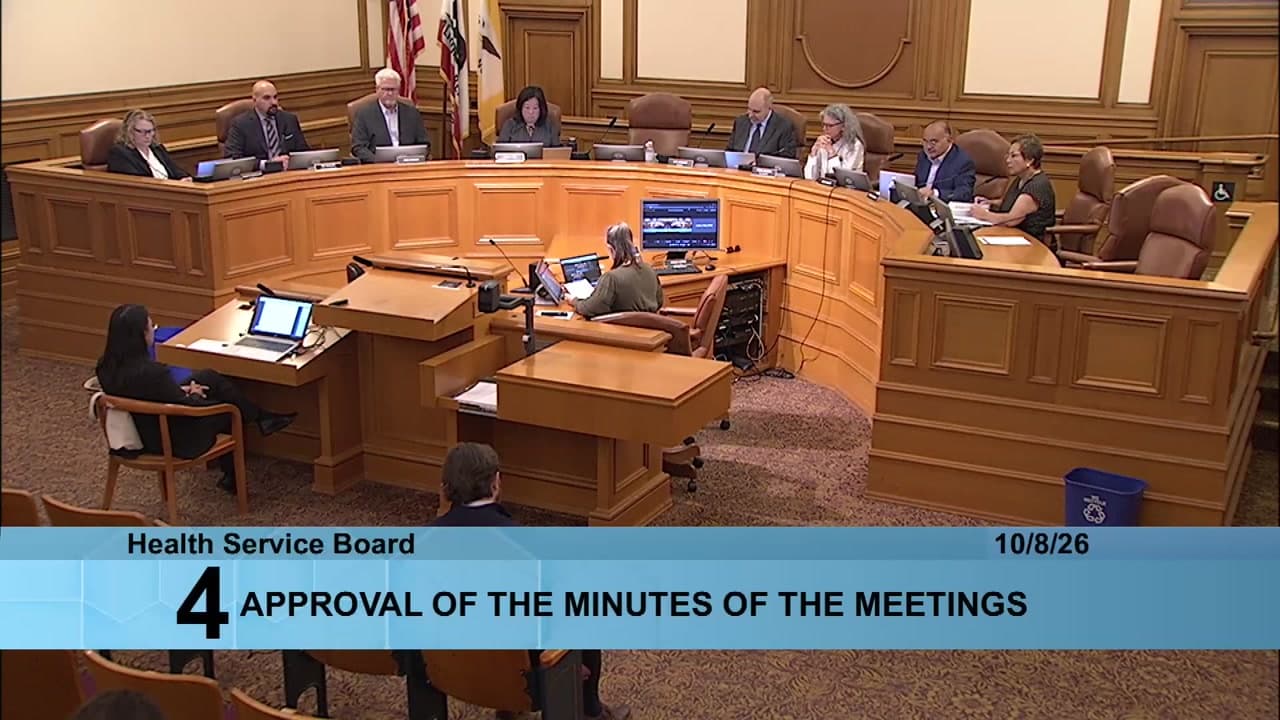
Health Service Board • San FranciscoOctober 8, 2026
Locunity is an independent informational service and is not an official government page for this commission. All information is sourced from public footage and an analysis of official agendas with the aid of responsible, fact-checked AI. to report an error or omission.
San Francisco's retiree health debate centers on one question: should the city add a Medicare supplement plan that retirees say they want, but staff say costs too much? At its Oct. 8, 2026 meeting, the Health Service Board took no action after a nearly hourlong education session in which staff advised against the option. The board also previewed a possible overhaul of retiree drug coverage and unanimously approved a contractor to rebuild its 14-year-old benefits system.
- Staff advise against adding a Medigap plan, citing premium increases of $69 to $169 per month for some retirees
- Protect Our Benefits members press for Medigap, a city dollar credit and better retiree education
- Part D drug coverage carve-out previewed for 2028, which Aon says could bring $60 to $70 per member per month in added federal funding
- Cherryroad approved 6-0 to overhaul the PeopleSoft benefits system serving about 139,000 lives
- Trust fund projected to fall $64.5M this fiscal year as cancer and cardiac claims mount
Staff: Medigap's Value Doesn't Justify the Cost
The basics: Medicare Advantage plans are private plans that bundle Medicare benefits, often with networks and prior authorization. Medigap, or Medicare supplement, plans cover costs that Original Medicare leaves behind. OPEB stands for "other post-employment benefits," the retiree health obligations the city carries on its books.
Why it matters: Since Jan. 1, 2025, city retirees on Medicare have had two choices: Kaiser Senior Advantage, an HMO, and Blue Shield's Medicare Advantage PPO. The city dropped its earlier Medigap "City Plan" after a 30% premium increase was proposed for 2017. Retirees have been asking to bring a supplement option back.
Where things stand: Executive Director Ray Guillén used a CalPERS-based 24% premium difference to show the possible effect on retirees. Under his illustration, monthly retiree-only contributions would rise from $284 to $353. Contributions for retirees with a dependent would rise from $706 to $875.
Guillén also cited the department's own capacity. Staffing is down 10% since 2018, while the number of covered lives has grown about 16%. He presented prior-authorization approval rates for Blue Shield's Medicare Advantage plan and recounted the 2008 Proposition B vesting changes that underpin retiree cost sharing.
“Staff's current assessment is that the incremental member value does not appear to sufficiently justify the additional cost and complexity,” said Guillén.
The fiscal frame: Lead Actuary Mike Clark of Aon walked through OPEB accounting and the city's $5.1B OPEB liability. Kaiser Permanente Executive Retiree Solutions Manager Jared Castillo explained Medicare Parts A through D and how Advantage plans differ from supplements. Commissioner Vallejo pushed back on the idea that accounting rules force the city to set money aside today.
“GASB 45 and GASB 75 require that we disclose our unfunded liability, not that we fund it,” said Commissioner Vallejo.
Decisions and stakeholder impacts: The board took no action. Retirees who want Medigap should expect more analysis, not a change in the near term. Commissioners praised the presentation. One commissioner asked for data on retirees by age band and on the city's potential Medigap exposure. Guillén urged the board to consult the Comptroller and the OPEB trust manager before adopting any costlier plan.
What's next: “We certainly can bring those age bands back to this board,” said Guillén. He did not give a date.
Retiree Advocates Keep Pressure on the Board
Why it matters: Retiree advocacy is the main force behind the Medicare supplement discussion, and it shapes the data staff will bring back. Several speakers came from Protect Our Benefits, and their comments spanned three agenda items.
Where things stand: Mindy Talmage, a retiree and Protect Our Benefits board member, argued that Medigap plans offer broader provider acceptance, lifetime portability and no prior authorization. She asked the city to consider a dollar credit retirees could apply toward a supplement plan. She also asked what share of retirees are enrolled in the city's Advantage plans.
Fred Sanchez, president of Protect Our Benefits, said members need education. He asked for contact addresses and phone numbers so individual retirees can compare their Medicare options.
Theresa Palmer, speaking for Protect Our Benefits and WRAC, raised three questions:
- Whether retirees who leave the city plan face underwriting for Medigap and Part D coverage
- What Medicare plans E and F are
- Whether other city retirees can join PERS
Dennis Krueger, representing active and retired firefighters and their spouses, asked whether a catastrophic insurance layer he remembered still exists.
The other side: Advocates' complaints went beyond Medigap. During the Part D discussion, Palmer asked how a separate drug plan would handle Part B drug denials. She cited a retiree whose IV chemotherapy was denied, a denial she said led to his premature death. Sarah Ko, a retired San Francisco firefighter, said Delta Dental coverage is poor, with many dentists out of network. She asked whether the board has considered another dental plan.
What's next: The board and staff did not answer questions during public comment, so these questions remain open.
Drug Coverage Carve-Out Floated for 2028
Why it matters: Staff and consultant Aon see a way to draw more federal money into retiree drug coverage. The trade-off is added paperwork for members.
Where things stand: Contracts Administration Manager Michael Visconti said most benefit contracts do not need competitive bidding this cycle. He cited recent procurements and multiyear rate guarantees, including a three-year guarantee on the Medicare Advantage plan for 2025 through 2027.
The exception is Part D, Medicare's prescription drug benefit. Mary Dale Goff, Retiree Healthcare Subpractice Leader at Aon, said the Inflation Reduction Act made the federal Part D direct subsidy more valuable. In Aon's illustration, carving out drug coverage could cut the Part D premium from about $250 to between $180 and $190. Aon estimates the change would bring $60 to $70 in added federal funding per member per month. CalPERS is making the same move for 2027.
“Leaving the MA plan as is, but looking for a separate pharmacy or PDP administrator or partner,” said Goff, describing the approach.
The other side: Plan design and enrollment would stay the same. However, members would carry two ID cards, receive separate communications and could see a changed formulary, the list of covered drugs. A commissioner asked staff to examine the effects on members with chronic conditions, on medication adherence and on shared decision-making between patients and doctors.
What's next: Staff would issue a request for proposals around December or January, with results in May or June, for the 2028 plan year. Staff will return in November or December.
“We are not making a decision today to go out to this RFP,” said Visconti.
Cherryroad Hired to Fix 2012-Era Benefits System
Why it matters: The PeopleSoft Human Capital Management system manages benefits for about 139,000 lives. The overhaul targets manual workload, data gaps and erroneous coverage terminations.
Where things stand: Chief Operating and Experience Officer Wren Coleridge said the system “went live in August of 2012” without significant changes to its benefits configuration. That left outdated setups and heavy manual work for staff.
Funding comes from two sources:
- $1.05M from the city's Committee on Information Technology (COIT), the most the department has received
- $200,000 from the Healthcare Sustainability Fund
Under Board Governance Rules Section 207, any technology consultant contract above $500,000 requires board approval.
“Cherryroad finished first overall with 124.84 out of a total of 150 points,” said Visconti. Contract negotiations are about 95% complete.
Commissioner questions: Commissioners asked about the following:
- Member-facing screens during testing
- Project management, with Brian Rodriguez as project manager and Vish Shenoy as technical lead
- Cherryroad's prior work for the Controller's Office
- The Oracle Cloud Infrastructure environment
Coleridge agreed to share member-facing screens with the board. “I definitely think that's something that we can accommodate as we go through the process,” said Coleridge.
Decisions and stakeholder impacts: Commissioner Howe moved to approve Cherryroad, and Vice President Wilson seconded. The motion passed:
- For: 6 (Board President Howard, Vice President Wilson, Commissioners Kremen, Guevara, Howe and Vallejo)
- Against: 0
- Excused: Supervisor Dorsey
What's next: The project runs 10 to 12 months.
Trust Fund Faces $64.5M Hit
Why it matters: A large projected drop this early in the fiscal year signals rising care costs.
Where things stand: “We are projecting a fiscal year-end decrease of $64.5 million, mainly due to high medical claims related to cancer, cardiac, and child with special healthcare needs since birth,” said Chief Financial and Affordability Officer Theresa Tan.
Key figures from the financial report:
- Claims: Concentrated in the Blue Shield Access HMO and PPO
- Offsets: $25.1M in pharmacy rebates and $3M in interest are expected
- Healthcare Sustainability Fund: Projected to use $900,000, ending the year at $6.8M
- General fund: Ahead of budget because of vacancies
- Audit: The fiscal year 2025-26 audit shows no findings so far and is expected to finish in October
Tan also explained how each plan is funded: fully insured, flex-funded HMO or self-funded PPO. The funding model determines who bears the financial risk and who receives pharmacy rebates. A commissioner noted that costs are rising for both Blue Shield and Kaiser.
Minor Items
- Health Net ends: The department declined an extension offered by Centene, so Health Net terminates Feb. 28, 2027. A special enrollment opportunity follows Jan. 1.
- Kaiser Hawaii error: Guillén reported a communication error that reached about 25 Medicare members. He said the 1-800 number involved was discontinued in 2021.
- Blue Shield fine: “The DMHC action relates to the timeliness and completeness of responses to inquiries from the DMHC,” said Liz Canopy, Strategic Account Executive, Blue Shield of California. She said the action does not change benefits, networks or plan offerings. Palmer said retirees face delays on acupuncture and hearing aid reimbursement.
- 10K-A-Day Challenge: More than 3,000 people registered, up from just under 1,400 in 2019. Participants included 47 of 55 departments and 461 teams.
- Closed session: The board voted 6-0 to review a midyear employee performance evaluation in closed session. It then voted 6-0 not to report any action taken and 6-0 not to disclose the discussion.
Looking Ahead
Staff will return with age-band data on retirees and, in November or December, with a Part D request-for-proposals plan. A draft 2027-2031 strategic plan is due in November, with a final version in December. The next wellness challenge, focused on produce, also starts in November.