
HR 1 Medi-Cal Changes Dominate Health Commission as Clinics Press HSA
Health Commission • San FranciscoNovember 2, 2026
Locunity is an independent informational service and is not an official government page for this commission. All information is sourced from public footage and an analysis of official agendas with the aid of responsible, fact-checked AI. to report an error or omission.
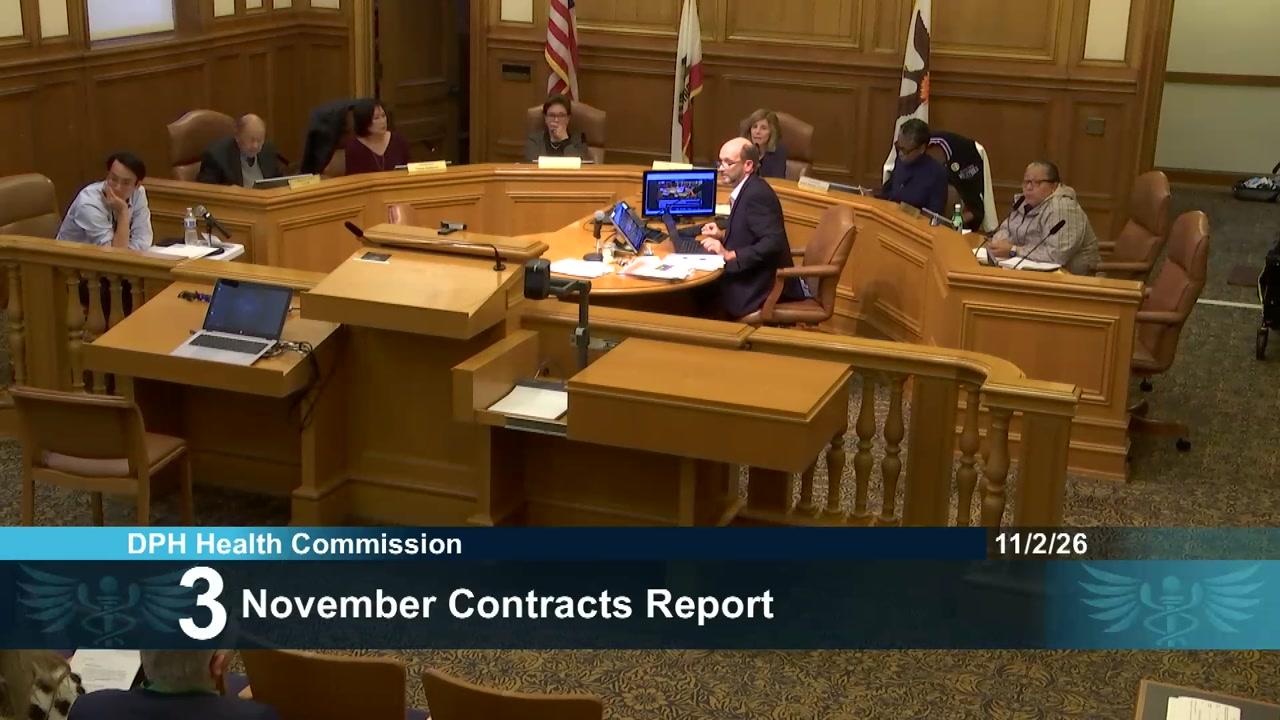
San Francisco's Health Commission spent most of its Nov. 2, 2026 meeting on federal HR 1 and state Medi-Cal changes that will reach about half of the Human Services Agency's Medi-Cal caseload starting January 2027. No vote was taken. Instead, commissioners heard HSA's six-part plan, and safety-net clinics pushed for on-site eligibility workers and a joint hearing with the Immigrant Rights Commission.
- HSA outlines six-part HR 1 response, backed by $34M for new eligibility and employment staff
- Community clinics press for co-located HSA workers, data sharing and a joint hearing
- Behavioral Health reports 48 September overdose deaths and 200-plus new beds planned through 2030
- State temporarily withholds behavioral health funds over gaps in adult timely access
- TB program warns of shrinking resources, with just two SRO beds for patients
HSA's Plan to Keep San Franciscans Covered
Why it matters: Twice-yearly renewals, work requirements and new premiums could push eligible residents off Medi-Cal. How well the city responds will decide who keeps coverage.
The basics: Susie Smith, Deputy Director for Policy Planning and Public Affairs, San Francisco Human Services Agency, walked through the timeline. Enrollment is frozen for undocumented adults 19 and older. Starting January 2027, adults 19 to 64 without young children face twice-yearly renewals and work requirements. Some immigrant populations will move to fee-for-service, and retroactive coverage drops from three months to one. In July 2027, $30 monthly premiums for people with unsatisfactory immigration status take effect, along with asset limits.
Where things stand: HSA's six strategies are to raise awareness, maximize exemptions through data sharing with DPH, expand workforce options such as workfare and a Jumpstart program, invest in technology, add capacity and partner with the community. Smith said the mayor and Board of Supervisors approved $34M from the state and federal reserve fund to hire eligibility workers and employment specialists. She stressed that only HSA eligibility workers can approve or renew benefits.
Smith was candid about the agency's stance. "We do not believe that access to food or healthcare should be dependent on additional paperwork or work requirements," she said.
DPH Director Tsai said the state, not the city, is handling most medical-frailty exemptions. DPH also sends daily substance-use treatment data to HSA. "The state is exempting those folks from even having to go through the HSA eligibility process," said Tsai, Director, San Francisco Department of Public Health. He was blunt about the limits of the response: "No amount of mitigation is going to solve some of the very, very bad things that are part of what these changes are."
Commissioners push on outreach: Commissioner Edward Chow pressed on coordination and Healthy San Francisco re-enrollment. "I just think there's got to be a full-court press here," he said.
Commission Vice President Suzanne Giraudo wanted plain-language materials. She suggested asking schools chief Maria Su to "have a couple of 4th grade teachers review the process." Commissioner Susan Belinda Christian urged school-based outreach, noting "students often help their parents navigate stuff." Commissioner Karim Salgado called for evening events and Spanish-language radio. "I think the radio is the best way to get people to know what's going on in the community," he said.
Commission President Laurie Green raised the chilling effect on undocumented residents. Smith attributed roughly 25% to 30% of HSA's decline to that factor. Green closed by tying the effort to DPH's core purpose: "This strikes at the very heart of the mission of San Francisco Department of Public Health, which is to protect and promote the health of all San Franciscans."
What's next: Tsai described recurring multi-agency coordination convened by the Mayor's Office and said he would bring a follow-up to the Commission.
Clinics Want HSA Workers in the Exam Building
Why it matters: Clinics say patients are already losing Medi-Cal and cannot get renewals approved without HSA staff. HSA says spreading workers across clinics would cut the number of cases they can handle.
Where things stand: An organized bloc of safety-net providers testified twice. First came Anna Robert, CEO, Mission Neighborhood Health Center, during comment on the minutes. She said consortium clinics deliver about half of primary care to Medi-Cal patients and cannot absorb more uninsured patients without equitable investment. "I respectfully ask the Health Commission to convene a special joint hearing with the Immigrant Rights Commission and consider endorsing the recommendations we presented," she said.
Dina Lon of the San Francisco Community Clinic Consortium cited a net loss of 23,331 Medi-Cal managed care patients, against fewer than 1,500 added to Healthy San Francisco. She worried that patients who lose Medi-Cal over work documentation will stay ineligible for Healthy San Francisco. She asked for a dedicated provider line and said, "We've asked that HSA locate eligibility staff at our most impacted clinics."
Mission Neighborhood's Chief Operating Officer, Jesus Martel Gonzalez, said four HSA events since September served 341 patients. About 1,100 patients a month need renewal help, a number expected to double. He asked for at least four co-located eligibility workers daily. "Having an onsite human services eligibility worker allows that patient to receive their healthcare and get their medical renewed all at the same time on the same day in that same trusted location," said Rosa Aragon, Patient Services Manager, Mission Neighborhood Health Center.
"We are already seeing patients fall off of Medi-Cal," said Matt McCormick, Government Affairs Representative, Northeast Medical Services. Willie Ramirez, a former DPH employee, urged joint action. He noted that immigrants in the health workforce face DACA delays and that "the cost of getting representation right now is running between $10,000 and $20,000 per matter."
The other side: Smith said HSA serves about 3,100 people daily. Outstationed staff handle three to four times fewer cases than workers at service centers. She said the agency is exploring a direct line for community-based organizations and a virtual lobby.
Decisions and stakeholder impacts: No action was taken. The clinic requests for co-location, data sharing and a joint hearing remain unresolved, even as renewals double in January 2027. Tsai called both sides valid. "I want us to be sitting around the table pulling on one rope together and figuring out and solving problems together," he said.
What's next: Tsai proposed returning to the Commission with a shared HSA and provider perspective.
Overdoses Trend Down as Bed Expansion Continues
Why it matters: Behavioral health services depend on Medi-Cal coverage. A state funding penalty also exposes access gaps in the adult system.
Where things stand: Dr. Hillary Cunnings, Director of Behavioral Health, San Francisco Department of Public Health, reported 48 overdose deaths in September. Despite that uptick, 2026 is projected to see about 20% fewer overdoses than 2025.
The Treatment on Demand report shows "the number of people accessing, entering treatment, substance use disorder treatment increased 30% over the last 3 years." Of withdrawal management requests, 59% were offered same- or next-day care. Residential stays average 57 days. The system has about 2,970 beds, more than 300 funded since January 2025 and more than 200 planned through 2030. Planned additions include adolescent psychiatric, dual diagnosis and locked subacute beds. Cunnings also described BEAM telebup, long-acting injectable buprenorphine and contingency management. Retention in buprenorphine care remains low.
State penalty: The California Department of Health Care Services (DHCS) announced in August that it would withhold funds from counties missing network adequacy standards. San Francisco's children's and psychiatry appointments met the standards. Adult timely access did not, partly because the electronic health record is not built for the state's measurement. Drug Medi-Cal deficiencies have been resolved. "So it's a temporary withholding. It's not permanent," Cunnings said. She expects the money, in the hundreds of thousands, to be returned once standards are met, hopefully by early spring.
The other side: Commissioner Christian said clinicians who work with treatment courts struggle to refer patients. "One of the reasons is that they don't have access to Epic," she said. Cunnings responded, "Whether or not a person has access to Epic should not affect their ability to make a referral into the system." On mental health diversion staffing, she noted "the law got passed without, oh, and now here are your 20 new behavioral health clinicians."
What's next: The Board of Supervisors holds a Dec. 10 hearing on LPS beds, which serve people under California's involuntary psychiatric treatment law.
TB Program Short on Beds and Funding
Why it matters: San Francisco's active TB rate is double California's and triple the national rate.
Where things stand: A DPH tuberculosis presenter, speaking during Director Tsai's report, cited reduced funding and federal policy pressures. She said the first patients on TB treatment are living in cars. One patient with infectious TB cannot be housed, and "the TB program has just 2 SRO beds at this time."
Partnerships are showing results. TB testing at Mission Neighborhood Health Center is up 20%. Sputum testing at Northeast Medical Services rose from 21% to 63%.
Commissioner Chow asked about new arrivals and latent TB. The presenter said no data system tracks latent TB treatment outside high-risk contacts, and she is discussing reportability with the California Department of Public Health. Chow suggested "it wouldn't hurt to have annual reminders to people like we do with flu vaccines."
Tsai also flagged the city's first known death involving a kratom-derived semi-synthetic opioid. Cunnings said such products are sold in gas stations and smoke shops.
Minor Items
- Baby2Baby gift: The Commission approved by voice vote a resolution recommending the Board of Supervisors accept a $94,320 in-kind diaper gift over about 20 months.
- Consent calendar: Approved by voice vote, minus a diabetes screening protocol pulled over BMI cutoffs for Asian Americans. ZSFG reported 6% nursing vacancies and deficiency-free reviews.
- Contracts: The Finance and Planning Committee backed Solient, HR360, GUYO, Public Health Foundation Enterprises and Baxter IV-monitor items. It requested quarterly updates on a new eCMS contract system.
- Q4 finances tabled: Green postponed the FY2025-26 fourth-quarter financial report to make room for the HR 1 debate.
- Public comment: Nurse candidate Jessica Pesico urged DPH to fill recruiter roles. She said San Francisco General's oral surgery clinic is open only eight days this month.
Looking Ahead
Watch for Tsai's follow-up on joint HSA–provider strategy, the rescheduled fourth-quarter financial report and the Board of Supervisors' Dec. 10 LPS bed hearing. All of this comes ahead of Medi-Cal changes taking effect in January 2027.