
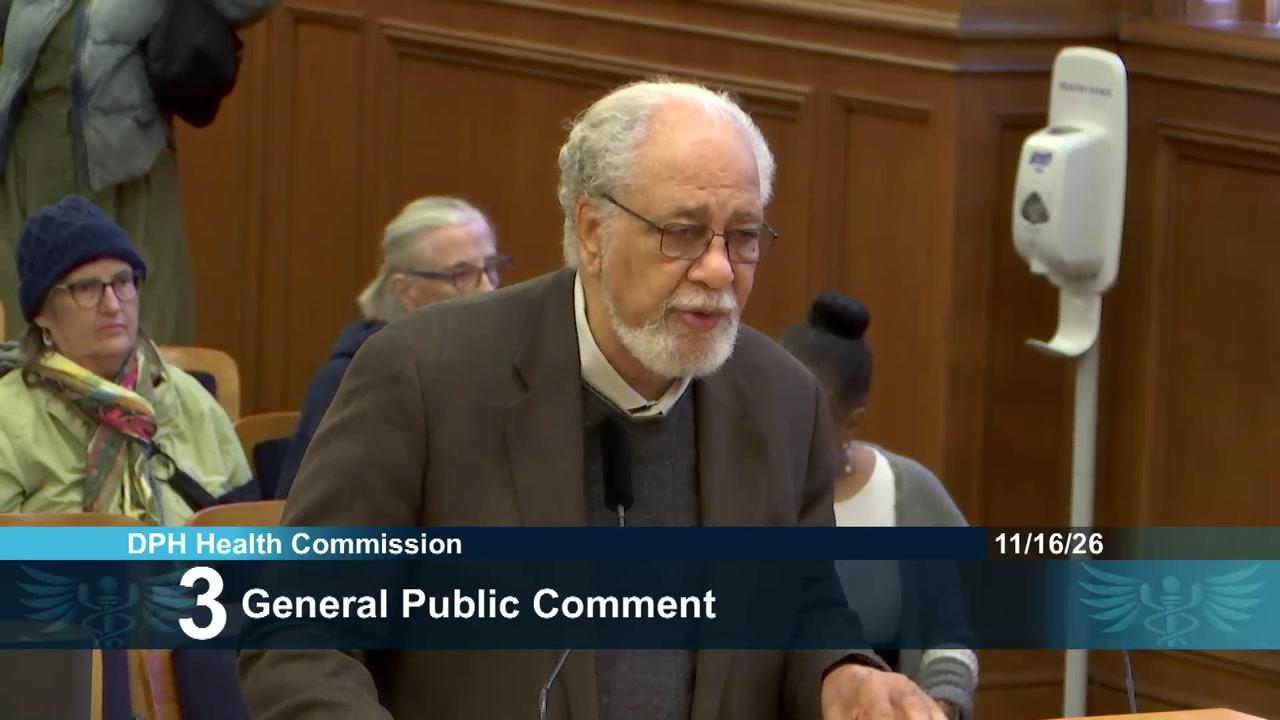
Commissioners Demand Hard Data on Hunters Point Shipyard Contamination
Health Commission • San FranciscoNovember 16, 2026
Locunity is an independent informational service and is not an official government page for this commission. All information is sourced from public footage and an analysis of official agendas with the aid of responsible, fact-checked AI. to report an error or omission.
San Francisco's Health Commission spent more than an hour Nov. 16, 2026, on the Hunters Point Naval Shipyard, where residents and outside experts described contamination risks the city's health department has no power to regulate. Commissioners took no vote. They told the Department of Public Health (DPH) to return with harder data on Navy monitoring, agency relationships and practical fixes. The same meeting showed a department reporting a year-end surplus built largely on one-time money, with federal cuts approaching.
- Shipyard follow-up ordered: Commissioners questioned Navy data and the city's liability if the land is transferred
- $72.6M DPH surplus is largely one-time, offset by a $90.3M ZSFG shortfall
- Director of Health Tsai estimated H.R. 1 impacts of about $400M per year in billed services
- ZSFG annual report: expenditures rose about 33% while revenues rose about 21%
- Public commenters urged DPH health reviews of AI data centers and a moratorium on artificial turf
Shipyard: Trust Deficit Meets Limited Authority
Why it matters: The Navy leads the Hunters Point cleanup, and DPH has no regulatory authority there. Commissioners argued the city still needs to define what a safe end state looks like before any land transfer leaves San Francisco holding the liability.
Where things stand: Health Officer and Director of the Population Health Division Dr. Susan Philip walked through the oversight structure shared by the Navy, the EPA and state regulators. She described a July 23 vegetation fire at the landfill and a Nov. 11 fire at Building 500, where radiological screening came back at background levels. Under the incident notification rules, regulators get notice within 24 hours and a debrief within 72 hours. Philip said DPH had called out the Navy over its delayed plutonium notification: "not notifying the regulators for that amount of time was completely unacceptable," said Dr. Philip.
Medical Director for Chronic Disease Prevention and Climate Health Dr. Nena Okoye described community listening sessions and a public health prevention framework. She also outlined a draft Community Emissions Reduction Plan, an upcoming release of Bayview data and plans for signage.
The other side: Four public commenters challenged the department's view that the site is safe. Toxicologist Dr. James Dahlgren said past health department studies found excess cancer and asthma, and urged measuring radionuclides beyond the fence line. He reported that in urine testing, "8 out of the 10 people had measurable plutonium in their urine."
Dr. Ahimsa Porter-Sumchai of the Hunters Point Biomonitoring Foundation disputed the Building 500 radiological findings and cited falsified air monitoring reports. She also noted that the notification protocol rests on a Federal Facilities Agreement.
Chemist Raymond Tompkins, a member of the Southeast Advisory Board, pressed for fence-line and community air monitors and closer attention to PM2.5, the fine particulate matter that lodges deep in the lungs. Ronnie Diamant Wilson of the 1,000 Grandmothers Bayview Hunters Point Working Group recounted issues raised at the September advisory committee meeting: a toxic drum, Parcel F sediment contamination, a wharf collapse and unanswered questions about contractors.
These are commenters' claims. DPH did not verify them during the meeting.
Commissioners push back: "How can we trust the data that they're giving us," asked Commissioner Karim Salgado, who also raised the city's liability after a transfer. Commissioner Edward Chow contrasted the shipyard with progress at Zuckerberg San Francisco General Hospital (ZSFG): "that has not happened at the shipyard." Commissioner Susan Belinda Christian argued the commission should press federal partners "even when we don't have any jurisdiction, because it's our responsibility."
Director of Health Tsai explained why DPH had not pursued tarps on the shipyard fence: "a tarp is not going to do anything one way or another around that." Tsai offered to align with commissioners on data and to push the Navy on transparency.
What's next: Commission President Laurie Green requested a follow-up report covering data, agency stability, epidemiology and cost-effective solutions. Under Other Business, Tompkins asked for time to present two research projects with Dahlgren.
Surplus on Paper, Federal Cliff Ahead
Why it matters: DPH's year-end cushion comes mostly from one-time money, so it is a poor baseline for future budgets. Federal changes under H.R. 1 threaten the Medi-Cal revenue that funds the city's safety net.
Where things stand: "The department ended with a $72.6 million surplus after a $4.1 million deposit into the management reserve," said Acting Chief Financial Officer Matt Searle. The report had been tabled from the prior meeting.
The surplus masks wide gaps between divisions:
- ZSFG: negative $90.3M, driven by lower inpatient volume and the rollout of observation status
- Laguna Honda: positive $42.2M
- Behavioral health: positive $83.4M, mostly from changes in the timing of state payments and one-time settlements
- Other divisions: health network $23.4M, population health $11.6M, primary care $7.5M and jail health $3.5M
- Administration: negative $4.6M
Searle said the Quality Incentive Payment program is expected to shrink 5% annually under H.R. 1. Tsai put the cumulative federal toll in starker terms: "Cumulatively, that'll be about a $400 million loss per year of billed services," said Director Tsai. He attributed the impact to safety-net payment cuts and Medicaid disenrollment.
The other side: Chow and Salgado asked about ZSFG's trend and how the surplus is allocated. Searle said ongoing revenue was built into budget targets and is not divided by division.
Public commenters asked whether positive variances could be redirected to staffing, data analysis and behavioral health accountability. Diamant Wilson, a retired nurse practitioner, asked whether the surplus would restore closed youth clinics such as Huckleberry.
Decisions and stakeholder impacts: The report was informational, and no vote was taken. Commissioners requested ongoing reporting on ZSFG's financial trend. Patients and providers who depend on Medi-Cal face the greatest exposure if federal cuts arrive as projected.
ZSFG Annual Report: Record Demand, Rising Costs
Why it matters: "ZSFG is San Francisco's only public safety net hospital," said ZSFG CEO Susan Ehrlich. Its expenditures grew about 33% while revenues grew about 21%. Heavy reliance on Medi-Cal and Medicare leaves the hospital exposed to federal and state changes.
Where things stand: Ehrlich reported the following for fiscal year 2025-26:
- 77,863 emergency visits
- 2,269 trauma activations
- 1,161 births
- About 309,782 outpatient visits
She also cited a top-10 national health equity ranking, the go-live of a new lab information system, completion of a seismic retrofit, relocations of dialysis and psychiatric emergency services, and UCSF research funding. After staff member Alberto Rangel's death in December 2025, the hospital added weapons detection and other security measures.
The other side: Public commenter John Ellis asked how much of the strain on the emergency department stems from nursing coverage rather than beds and patient acuity. He urged better discharge planning, stronger links to supportive housing and data-driven accountability.
Decisions and stakeholder impacts: Commissioners offered praise. "This institution is nothing short of remarkable," said President Green. Commissioner Judy Guggenhime credited San Francisco voters for supporting the hospital.
Public Comment: Data Centers and Turf
Why it matters: Organized groups are trying to bring public health into land-use fights. According to commenters, the Board of Supervisors is weighing data center moratoria, and no formal DPH assessment was part of the city's impact report.
Where things stand: "I urge the Health Commission to ask the Environmental Health Branch to conduct a cumulative health impact assessment of existing and proposed data centers in Bayview and SOMA," said Ann Kolachidis of the Gray Panthers of San Francisco. She said the group hopes for a permanent ban.
Dr. Porter-Sumchai proposed biomonitoring and environmental monitoring at the Paul Avenue data center. She cited noise readings she had taken and the facility's proximity to homes, senior housing and the Southeast Health Center. "It is very, very clear that there needs to be a public health presence here," she said. Peter Warfield, executive director of the Library Users Association, urged DPH to treat AI as a mental and societal health issue.
Three speakers targeted artificial turf:
- Bob Hall: "I'm here to ask why the Department of Public Health hasn't joined California Medical Association in calling for a moratorium on artificial turf yet." He also asked for a webpage for parents on plastics harms.
- Olivia Qureshi: sought a citywide moratorium on new turf at public schools and city partner properties, plus a public audit of SFUSD turf.
- Susan Mulaney: mapped Recreation and Parks turf fields in redlined neighborhoods and alleged lead and PFAS contamination at Kimball fields.
What's next: Consistent with state open-meeting rules, commissioners did not discuss the items, which were not on the agenda.
Minor Items
- Ultrasound privileges: By voice vote, commissioners extended point-of-care ultrasound privileges to family and community medicine providers, matching existing hospital standards.
- Epic gift: A corrected resolution accepting $11,679.56 from Epic passed by voice vote; the gift covers conference travel for five health record analysts.
- Staff awards: Five ZSFG teams were honored, including an overnight MRI program that cut the unscheduled backlog from 1,116 to 243.
- Laguna Honda housing: Chow reported an option for Mercy Housing to lease Laguna Honda land; remote commenter Mr. Minichaw urged, "Please don't recommend Mercy's option to ground lease today."
- Procedural: The consent calendar's outcome was not announced, the Community and Public Health Committee update was tabled, and commissioners voted to keep closed-session discussions undisclosed.
Looking Ahead
The Mercy Housing lease option returns to the full commission Dec. 7. DPH owes commissioners a data-focused shipyard follow-up. In an abbreviated report, the director flagged ongoing work on El Niño preparedness and H.R. 1.