
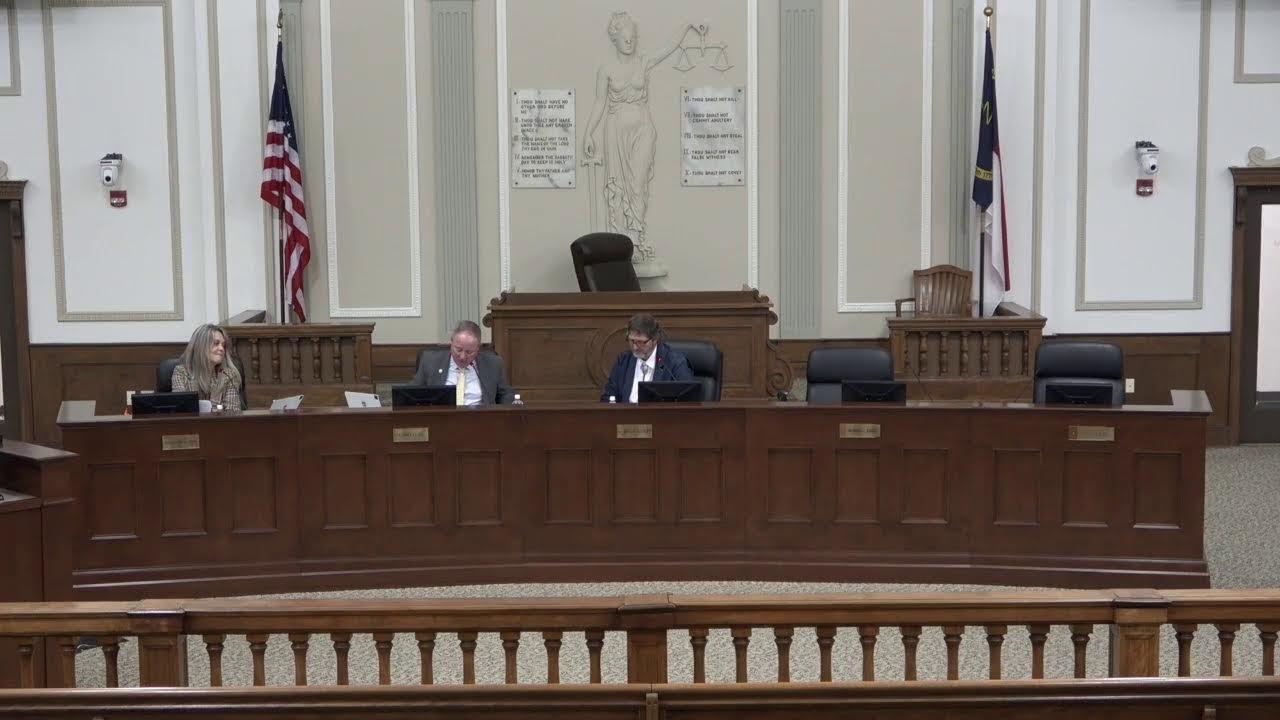
Haywood Commissioners Advance $4M for HCC Education Building in Farewell Meeting
Board of County Commissioners • Haywood CountyNovember 16, 2026
Locunity is an independent informational service and is not an official government page for this commission. All information is sourced from public footage and an analysis of official agendas with the aid of responsible, fact-checked AI. to report an error or omission.
Haywood County commissioners started financing what Board Chair Kevin Ensley estimated as a $50 million rebuild of Haywood Community College's core academic building, approving a reimbursement resolution and a $4M design advance on Nov. 16, 2026. The board also cleared a state-funded tri-town water link, Hurricane Helene watershed contracts and three contested Canton planning board seats. Every motion passed by voice vote at the final meeting for Commissioner Jennifer Best and Sheriff Bill Wilkie.
- $4M advance and reimbursement resolution launch design of HCC's new general education building
- $2,006,840 state resilience grant moves forward to link Canton, Clyde and Waynesville water systems
- Resource Institute hired for Helene watershed recovery as the county fronts cash for reimbursable state work
- Three Canton planning board appointments approved as commissioners say ETJ residents face "regulation without representation"
- Best, Wilkie depart after a term shaped by COVID, floods, the Canton mill closure and Helene
HCC's Core Building Gets Its First $4M
Why it matters: The aging Hickory Building is not ADA-compliant, and it anchors HCC's core academics. Ensley put the replacement project in the $50 million range.
The basics: A reimbursement resolution lets the county pay early project costs now and repay itself later from borrowed money.
Where things stand: HCC President Dr. Shelly White introduced college trustees and asked the board to start the project. She described a new center for general education and infrastructure modernization. The building houses general education classes, computer and science labs, GED and adult high school programs and the tutoring center.
"This project will transform our ability to serve students and our community," said White.
The financing mechanics came next. The county will move $4M from HCC's debt service and capital fund, which is supported by sales tax, into a project fund for design and engineering. Finance Director Christian Owen described how that money comes back.
"Once we complete the debt service process, we will replenish those funds with the debt proceeds," said Owen.
Commissioners praised the project and a recent joint meeting with HCC trustees. No member raised objections.
Decisions and stakeholder impacts: Best moved the reimbursement resolution, and Commissioner Tommy Long seconded it. Best also moved the $4M capital project ordinance. The chair declared both votes unanimous by voice. Vice-Chairman Rogers and Commissioner Terry Ramey were absent.
The advance draws on dedicated sales-tax debt service money rather than a new local appropriation. The groups that stand to benefit are students in general education, labs and tutoring, along with adult learners in GED and adult high school programs.
What's next: Design and engineering begins. The county will then complete the debt process to fund construction and refill the debt service fund.
State Grant Links Three Towns' Water Systems
Why it matters: Outages during Hurricane Helene showed that towns relying on a single water source are vulnerable. An interconnect lets one town's supply serve another in an emergency.
Where things stand: The item combined three actions:
- A $2,006,840 budget amendment from a North Carolina disaster relief and mitigation resiliency grant
- Subrecipient agreements with Waynesville and Canton
- Signing authority for the county manager
The county attorney said Canton draws from the Pigeon River, while Waynesville has a protected watershed and impoundment. Once linked, any of the systems could draw from any source.
"The point is, these interconnections make your community stronger," he said.
He also stressed that the money is state grant funding, not local tax dollars. It will cover roughly 10% of the project, for planning and design.
The other side: No one opposed the item. Long moved preemptively to head off a common worry: that new water capacity invites growth.
"This is an emergency connect. This is not designed for massive development," said Commissioner Tommy Long. He credited the area's legislator for securing the funds.
Decisions and stakeholder impacts: Best moved approval, and the chair declared it unanimous by voice. Ratepayers in all three towns gain backup supply. The towns gain grant-funded design work without spending local tax revenue.
What's next: The county will execute the subrecipient agreements with Waynesville and Canton, and planning and design will proceed.
Helene Recovery: County Fronts Cash, Awaits Reimbursement
Why it matters: Federal and state reimbursement for Helene recovery may take years. That means the county must advance its own money and document every dollar.
Where things stand: Owen said the county ran a four-week request for qualifications for Emergency Watershed Protection (EWP) engineering and grant administration. It received five proposals and interviewed two firms. The evaluation committee recommended Resource Institute. Ensley said he and Vice-Chairman Rogers sat on that committee.
A second ordinance accepts two N.C. Department of Agriculture and Consumer Services contract awards. The awards fund the Streamflow Rehabilitation Assistance Program (STRAP) work through Haywood County Soil and Water. The general fund will advance the money, and the state will reimburse it as work proceeds.
Best used the moment to make a case for fiscal reserves. "We are advancing the funds for the projects to begin," said Best. She urged future boards to keep a strong fund balance so the county can make such advances. Staff described a 17-layer FEMA approval process as the backdrop.
Decisions and stakeholder impacts: Best moved both items, and Long seconded the Resource Institute contract. Both passed by voice vote, and the chair declared the STRAP ordinance unanimous.
Property owners along damaged streams stand to benefit from the restoration work. The county's fund balance carries the timing risk until reimbursements arrive.
What's next: Resource Institute begins engineering and grant administration. STRAP work will draw reimbursements as it is completed.
Canton Board Seats Pass Amid ETJ Frustration
The basics: An extraterritorial jurisdiction (ETJ) is land outside town limits where the town exercises planning authority over residents who cannot vote in town elections.
Where things stand: The board first amended its agenda to substitute Eric Worley for Doug Howell, who had died, as the Rough Creek ETJ nominee. Ensley noted two emailed public comments contesting Canton's claim to the Rough Creek ETJ:
- One from Project Solutions
- One from Deborah King, framed as a jurisdictional objection and public records request
Ensley said the Rough Creek ETJ appears on county GIS maps.
Long said the board's hands are tied. Commissioners cannot block appointments beyond 90 days, and ETJ boards are advisory.
"This body of commissioners, we cannot block these ETJ appointments," said Long.
The other side: Commissioners aimed their criticism at the system itself rather than the nominees.
"I think ETJ folks should have a voice and be able to vote," Long said. He added that he opposes ETJs without voting rights.
"I call it regulation without representation," said Ensley. Best agreed.
Decisions and stakeholder impacts: All three appointments passed by voice vote:
- Worley, Rough Creek ETJ: declared unanimous
- Jeff Denton, Pigeon River Watershed: unanimity not stated
- Howard Nepper, Asheville Highway ETJ reappointment: declared unanimous
The town keeps its planning reach. Rough Creek residents keep a seat at the table but no vote.
What's next: A summary of the emailed comments will go in the minutes. Commissioners said they favor legislation granting ETJ residents a vote.
A Term Closes for Best and Wilkie
Why it matters: Several officials who steered the county through COVID, floods, the Canton mill closure and Helene are leaving at once.
Where things stand: Ensley opened the meeting with tributes. "I don't think I've known anybody that loved their public service office more than you do," he told Sheriff Bill Wilkie.
He presented Best a plaque recognizing her 2020–2026 service. Best cited library improvements, new EMS bases, the armory and the college's response to the mill closure. She noted that "we were historically the first all-Republican board to serve in Haywood County."
Ensley also detailed retiring Register of Deeds Sherry Rogers' work restoring survey maps and scanning records. He recognized Ramey, who was absent for health reasons.
What's next: Best moved every item on the agenda before the board adjourned.
Minor Items
- PILT to fire departments: The board approved a $95,102 budget amendment distributing federal payment-in-lieu-of-taxes money to fire departments based on call responses, with payment targeted for late November or early December. "If you have to do a helicopter extraction, that money can vaporize in one mission," Long said.
- Hospital diversions: Best pressed the local hospital over diversions to Mission, saying "when we send a truck out of the county, it's a 70-minute turnaround." Long will gather diversion data for the Dec. 21 meeting.
- Trash complaints: Public commenter Dale Glantz criticized the contractor's inconsistent bag and drop-off rules. Long said the Fines Creek site may not be fixable.
- K-9 Kilo retires: A resolution honored Kilo's seven years of service; handler Chief Deputy Matthew Trantham said "his body can no longer keep up with his heart." Kilo's last public event is Dec. 3 at the Canton Library.
- Consent agenda: Six routine items passed, declared unanimous by the chair.
Looking Ahead: Hospital diversion data is slated for the board's Dec. 21 meeting.