
City Council - Apr 07, 2026 - Meeting

City Council - Apr 07, 2026 - Meeting

City CouncilHaywardApril 7, 2026

Sources:

Locunity is a independent informational service and is not an official government page for this commission.We use AI-assisted analysis and human editorial review to publish information.

Council Advances $14.4M Business Tax Overhaul Toward November Ballot

Hayward's City Council took its biggest step yet toward closing a structural budget deficit, directing staff to bring back final ordinance language for a November ballot measure that would modernize a business license tax frozen since 1978. The council also endorsed a new equity-focused plan for spending tree mitigation fees and unanimously adopted a salary plan amendment funded entirely outside the general fund.

  • $14.4M business license tax ballot measure moves forward after polling shows 68% voter support; final ordinance due back in May

  • Labor pushes for higher rates while landlord group warns of tenfold tax jump on small rental owners

  • $250,000 annual tree fee spending plan endorsed, targeting canopy gaps in western Hayward, citizen grants, and fire-zone defensible space

  • Library faces loss of $130,000 in state ESL funding serving 300 residents as Sacramento signals cuts

  • La Vista Park breaks ground — 39-acre hillside recreation area in South Hayward on track for fall 2027


1978 Called: Hayward Finally Picks Up

The centerpiece of Tuesday's meeting was a nearly 75-minute work session on whether — and how — to ask voters to update a business license tax that hasn't changed since the Carter administration.

The basics: Hayward's current business license tax generates roughly $3.3 million a year under a flat-fee structure adopted in 1978. Staff's preferred "Match Neighbors" model would shift to a gross receipts tax with four brackets and a $60 minimum, projected to bring in approximately $14.4 million annually — a net increase of about $11 million for general fund services including public safety, street maintenance, and parks.

Why it matters: The city is staring down a structural deficit that has already triggered hiring freezes and service reductions. A successful November measure would be Hayward's most significant new recurring revenue source in decades — and polling suggests voters are ready.

The Numbers Look Strong

Miranda Everett, a pollster with FM3 Research, told the council that initial polling showed 59% yes votes, climbing to 68% after respondents heard plain-language information about the proposal.

"You can see we moved from 59% yes to 68% yes with that information. And our definitely yes share jumped 10 points from 29% definitely yes to 39% definitely yes," she said. Both figures clear the simple-majority threshold required for a general tax.

Matt Newman of Blue Sky Consulting walked the council through rate comparisons showing Hayward's proposed rates would land near San Jose's among Bay Area cities. A separate business engagement survey of 154 respondents showed mixed feelings: businesses broadly supported the idea of "modernization" but more than 75% reported moderate-to-extreme sensitivity to cost increases.

City Manager Jennifer Ott offered concrete examples to ground the discussion:

"A small retailer that has five employees has gross receipts of $1.5 million. They're currently paying $404 per year. And with this new tax measure, they'd be paying $450 per year."

A restaurant would go from $512 to $570; a 50-unit apartment complex from $566 to $5,100.

Labor Wants More; Landlords Want Less

The public comment period exposed a fault line that will likely define the campaign.

Emily Wallace, speaking on behalf of organized labor, argued the Match Neighbors model doesn't go far enough because it benchmarks against cities whose tax codes are equally outdated. She called for higher rates on professional services, commercial banks, and landlords, citing U.C. Labor Center research that tax structure is not the sole factor in business location decisions.

Derek Barnes, CEO of the East Bay Rental Housing Association, took the opposite tack. He supported modernization in principle but warned the flat $3-per-$1,000 rate on residential rental income amounts to roughly a tenfold increase for owners of four-plus-unit properties, pulling approximately 4,800 small landlords from effectively zero tax liability into a new gross receipts obligation. He requested staff model at least one alternative with a reduced rate below $250,000 in gross receipts.

Suzanne Luther of Hayward Concerned Citizens challenged the polling methodology as misleading and objected to framing the measure as "modernization." Ro Aguilar asked whether revenue could be directed toward homelessness, arguing businesses cannot thrive until the issue is addressed.

Where the Council Landed

The council was broadly supportive of the Match Neighbors framework but pushed staff to sharpen the pitch.

Councilmember George Syrop delivered the most pointed commentary, arguing the council should also compare Hayward's rates to cities that have recently modernized — not just neighbors with equally stale codes.

"Maybe Match Neighbors version 2, which is here are business license taxes in the Bay Area that have been updated in the last 10 years," he said.

He also defended the proposed rate for small landlords, calculating that a three-unit owner collecting median rents of $2,350 per month would earn $84,000 annually and pay roughly $252 — a figure he called "pretty reasonable" for a business that has been exempt for 50 years.

Mayor Pro Tem Julie Roche emphasized that the 1978 baseline is the strongest argument for voters.

"I even found the most compelling piece of all this was that it hadn't been updated since 1978, because when we recognized that we were going to be going into a pretty big deficit, I felt really clearly like we can't tax everybody again," she said, cautioning against overreach.

Councilmember Ray Bonilla Jr. backed the Match Neighbors approach directly:

"I specifically support the approach of the matching neighbor scenario. I think it strikes a thoughtful balance between modernization, competitiveness, and fairness."

He later urged colleagues to give staff clear direction to move forward.

Councilmember Dan Goldstein credited labor for raising the issue in the first place —

"I also want to thank labor for bringing the idea forward" — and endorsed comparing to modernized neighbors.

Mayor Mark Salinas closed the discussion by insisting the city identify a tangible benefit to the business community from the additional revenue:

"What I would like for us to do is figure out a defined benefit to the business community that we can say that this tax is supporting."

Councilmember Francisco Zermeño asked about including pedestrian and bicycle safety in the ballot language and confirmed his support.

Decisions: No formal vote was taken — this was a work session — but the council directed staff to return in May with final ordinance language for a November ballot. City Manager Jennifer Ott confirmed the next draft will emphasize the 1978 baseline in educational materials, include a comparison to recently modernized cities, and set a two-week deadline for labor to submit additional feedback.

What's next: Staff returns in May with the final ordinance. If the council approves ballot language, Hayward voters will decide the measure in November 2026.


Closing the Canopy Gap

Why it matters: Fees collected under Hayward's 2025 Tree Preservation Ordinance — about $250,000 a year — now have a spending plan, and the council wants equity front and center.

Where things stand: Landscape Architect Theo Spores presented a three-category framework. Roughly 15% (~$37,500) goes to administration — PlanetGeo software, street tree planting, and program management. A second bucket funds social equity and community partnerships, including a new citizen tree grant and approximately $75,000 for nonprofit planting partners like 100K Trees Hayward. The third category covers environmental resilience: periodic canopy studies, an urban forest plan, and defensible space planning for high-severity fire zones.

Council discussion was unanimously supportive but layered with specific asks. Councilmember George Syrop pointed to stark neighborhood differences:

"When you go into the western parts of Hayward, it starts to feel like a desert. And the heat sinks that are created by the wide roads and the lack of tree coverage — you really do feel the difference."

Councilmember Angela Andrews urged staff to reduce heat island effects, incentivize business participation, and rename the planned "master plan."

"I will also say that I would be also interested in alternative names to master plan. It is an outdated term that we should not really be using anymore as it connotes subordination," she said, suggesting "Tree Canopy Action Plan" instead.

Councilmember Francisco Zermeño asked about heritage tree identification, citywide tree counts, and whether fruit trees could be planted in liability-free zones. Mayor Pro Tem Julie Roche suggested encouraging tree planting during home renovations. Councilmember Goldstein supported an equity lens and resident education. Mayor Mark Salinas highlighted the need to fund tree trimming assistance for homeowners who can't afford it.

What's next: Staff will incorporate council feedback and move forward with the three-category spending plan.


State ESL Funding at Risk for Library

Mayor Pro Tem Julie Roche pulled a consent calendar item authorizing the library to accept up to $350,000 in grants to ask about funding stability. The Library Director confirmed the city has received over $200,000 regularly from the state but faces the potential loss of approximately $130,000 in English as a Second Language program funding. The state has signaled it does not want to invest in ESL next year. The program serves about 300 Hayward residents. The California Library Association is working with legislators through the May budget revision to try to restore the money; federal HPN grant funding is separately at risk.

The item was approved as part of the consent calendar (7-0; moved by Roche, seconded by Councilmember Goldstein).


Minor Items

  • Consent calendar approved 7-0, including adoption of a local speed management plan to reduce severe traffic injuries and fatalities. Councilmember George Syrop praised the plan as cutting-edge and thanked Mayor Salinas and Councilmember Andrews for their work on the Infrastructure and Airport Committee.

  • FY 2026 salary plan amendment adopted 7-0 (moved by Councilmember Goldstein, seconded by Andrews). Syrop confirmed for the public that all costs come from the Water Enterprise Fund, Stormwater Fund, and Sewer Fund — not the general fund. Staff said the raises are compaction adjustments baked into previously negotiated labor contracts.

  • Covenant House California announced its grand opening April 11 at 27211 Tyrell Ave., a facility serving 30 young people exiting homelessness that will become Alameda County's point of entry for youth social services.

  • La Vista Park construction is underway — a 39-acre hillside recreation area above Mission Boulevard at Tennyson Road, funded by HARD Measure F1 bond proceeds and developer in-lieu fees, with sports fields, a ridge trail, amphitheater, and 180-degree-plus bay views. Groundbreaking ceremony set for April 14; completion expected fall 2027.

  • Telecommunicators Week proclamation honored Hayward Police Department 911 dispatchers. Chief Brian Matthews called dispatchers "the first, first responders."

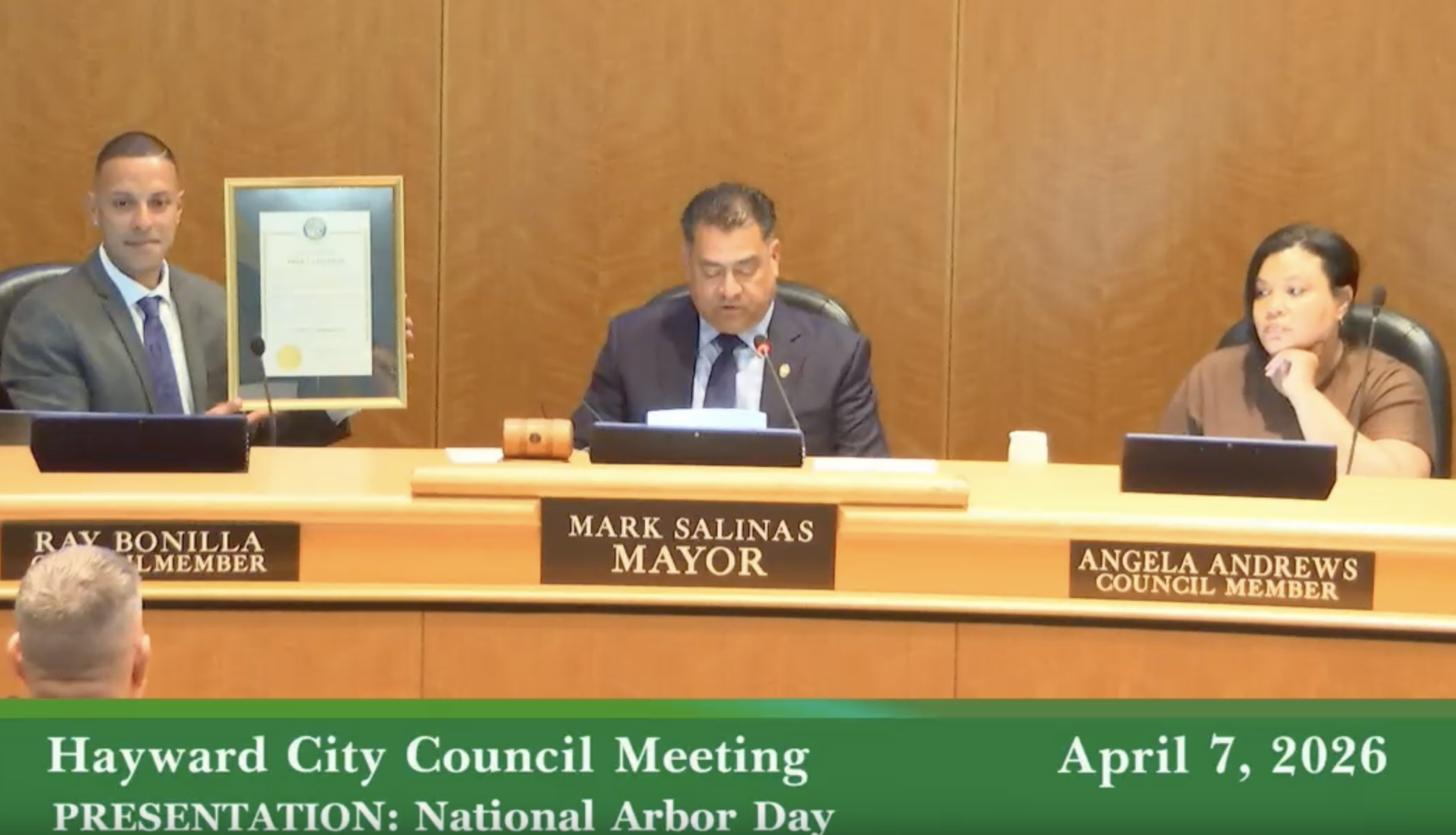
  • National Arbor Day proclamation celebrated Hayward's 38th consecutive year as a Tree City USA, with an Arbor Day event at Treeview Elementary on April 28.

  • Closed session on labor negotiations with all city bargaining groups yielded no reportable action.

Council Advances $14.4M Business Tax Overhaul Toward November Ballot | City Council | Locunity