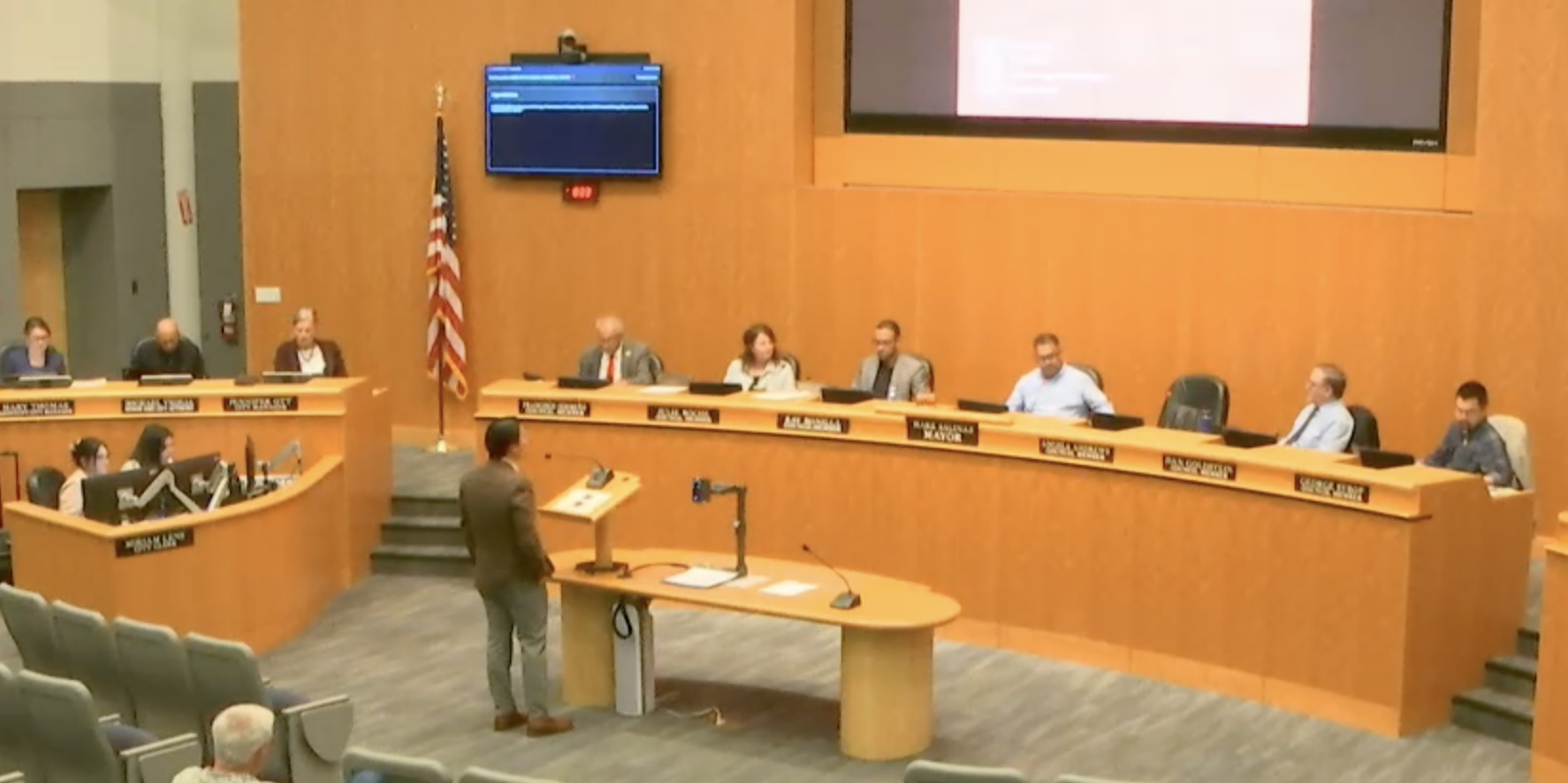
City Council - May 19, 2026 - Meeting

City Council - May 19, 2026 - Meeting

City CouncilHaywardMay 19, 2026

Sources:

Locunity is a independent informational service and is not an official government page for this commission.We use AI-assisted analysis and human editorial review to publish information.

Hayward's Homeless Count Drops 21% as City Claims Countywide Leadership

Hayward's City Council convened May 19 for a meeting that spotlighted the city's strongest homelessness results in years, celebrated a 16-year environmental compliance milestone, and heard the opening salvos of what promises to be a bruising fight over business license taxes. The session also featured Ava Community Energy's first-ever impact report and a Heritage Month proclamation that doubled as a call for greater civic representation.

  • Hayward's homeless population fell 21% in two years, outpacing Alameda County's 13% decline, as the mayor claimed countywide leadership on the issue

  • Chamber of Commerce and SEIU 1021 staked opposing positions on a proposed business license tax increase of more than three times the current rate

  • City achieved zero-trash-discharge compliance after a 16-year, 629-device stormwater installation program

  • Ava Community Energy reported $8.6 million in cumulative customer savings for Hayward's 55,000 accounts while flagging a cautious approach to data center energy demands

  • AANHPI Heritage Month proclamation sparked calls for more Asian American representation on elected bodies in a city that is over 30% AANHPI


Homeless Count Hits Lowest Point in Years

Why it matters: The Alameda County point-in-time count — the biennial census that shapes federal and state funding formulas — showed Hayward's homeless population dropped from 512 people in January 2024 to 404 in January 2026. That 21% decline nearly doubles the countywide average of 13%, and the share of homeless individuals who are sheltered has climbed from 21% in 2017 to 46% in 2026.

Where things stand: City Manager Ott announced the figures during City Manager comments. Mayor Mark Salinas expanded on the results during council reports, framing them as validation of a multi-agency strategy.

"We have been working collectively and collaboratively with other cities, we've been working with the county, we've been working with regional agencies and our regional partners. And I mean, we are leaving nothing on the table when it comes to strategies, when it comes to pooling resources," said Mayor Salinas.

He went further, positioning Hayward above its neighbors: "Hayward, we have led the way. We have been leading in this space, county wide. County wide. We have been the leaders in this space, and I think it's something that we should all be proud of."

Salinas also reported meeting with Alameda County supervisors and the mayors of Alameda, Livermore, San Leandro, and Newark to discuss the results. He serves on the Homelessness and Housing Task Force alongside Vice Mayor Julie Roche and Councilmember Dan Goldstein.

What's next: The point-in-time data will factor into upcoming state and federal funding allocations. How Hayward sustains — and builds on — a 46% sheltered rate will test whether the multi-agency approach can scale.


Chamber and Union Draw Battle Lines Over Business License Tax

The basics: Hayward is considering modernizing its business license tax, with a proposed increase exceeding three times the current rate. The item is not yet on the council's formal agenda but drew dueling public comments that previewed the stakes.

Why it matters: Business license tax revenue funds general city services. The gap between what Hayward collects and what neighboring cities charge has become a flashpoint — and the decision could reshape the city's competitive position for employers while determining whether it can stabilize revenues long-term.

Where things stand: Lucy Lopez of the Hayward Chamber of Commerce acknowledged the business community supports modernization in principle but warned against sticker shock. "As the proposed increase is more than three times the concurrent rate, we want to suggest a phase or incremental approach not to exceed the three times which would decrease the severe and immediate impact," she said. Lopez cited rising costs in labor, insurance, utilities, rent, healthcare, and regulatory compliance, and noted the increase would not fund new services — only maintain existing ones.

The other side: David Padilla of SEIU 1021 congratulated the council for moving forward and called the modernization long overdue. He argued the city should go bigger: "A true match your neighbor model could bring in additional $7 million," he said. Padilla contended that businesses primarily evaluate a city based on its ability to deliver services and process permits, and that bold revenue action now would stabilize Hayward long-term.

What's next: The formal proposal has not yet come before council. When it does, expect the Chamber to push for phased implementation and the union to advocate for a rate that fully closes the gap with neighboring jurisdictions. The outcome could be the most consequential fiscal policy decision of the year.


16 Years, 629 Devices: Zero Trash to the Bay

Why it matters: The Municipal Regional Stormwater Permit requires Bay Area cities to achieve zero trash discharge to waterways by July 1, 2025. Hayward hit the mark after a 16-year, multi-phase installation program — a quiet engineering achievement that protects San Francisco Bay.

Where things stand: Water Pollution Source Control Administrator Elisa Wilfong walked the council through the scale of the effort. "The city has installed a total of 629 small devices that fit into the gutters along the road, six large devices underground in very large stormwater pipes and four screens in selected creeks to filter the trash," she said.

Funding came from an EPA competitive grant, state grants, and a cooperative agreement with Caltrans. A standout project on Tennyson Road — involving two large stormwater pipes owned by the Alameda County Flood Control District — was the first such installation in the county. The city also completed a year-long private land drainage area inspection program to cover non-city property.

Vice Mayor Julie Roche called the milestone cause for celebration: "I just thought it was incredible news after a 10 year period that we reached this hundred percent compliance with this new rule. I thought was amazing and something we should be celebrating in Hayward."

Councilmember George Syrop, Councilmember Francisco Zermeño, and Councilmember Roche discussed refreshing "no dumping — drains to bay" markers on storm drains and publicizing the achievement.

What's next: One additional project on Cabot Boulevard is planned for spring 2027 that would treat over 1,000 acres, further expanding coverage beyond the permit requirement.


Ava Community Energy: $8.6M in Savings, Data Center Caution

The basics: Ava Community Energy is a community choice aggregator serving 18 member jurisdictions across Alameda and San Joaquin counties with approximately 760,000 accounts. Hayward's 55,000 accounts are defaulted to Renewable 100 — 100% renewable energy at a modest premium over PG&E.

Why it matters: As one of the largest community choice programs in the state, Ava's decisions on rates, programs, and load management directly shape Hayward's clean energy trajectory and household energy costs. A growing wave of data center applications poses financial risks that could shift costs to residential customers.

Where things stand: CEO Howard Chang presented Ava's inaugural impact report. Hayward-specific highlights include $8.6 million in cumulative customer savings, roughly 15,000 income-qualified CARE/FERA customers, nearly 67,000 solar customers, and nearly 7,500 registered EVs. Active programs include a $10 million e-bike incentive initiative (Bike Electric), a Smart Home Charging program for EV optimization, and a newly launched Smart Home Battery program creating a virtual power plant.

Local infrastructure investments include DC fast chargers targeting underserved areas, solar and storage installations at the corporation yard and a fire station expected to be operational within months, fleet electrification technical assistance, and full sponsorship of Habitat for Humanity's Sequoia Grove all-electric low-income housing project.

Councilmember Syrop pressed Chang on data centers, noting that new facilities often build gas-powered generation rather than relying on the grid. "One of my concerns is when new data centers show up, they're often times building gas powered electricity generation services versus relying on the pre existing grid, which kind of undermines the larger goals we're trying to accomplish here," Councilmember Syrop said.

Chang was direct about Ava's posture: "From an energy generation perspective, we do not intend to sort of socialize the cost of data centers," he said, adding that the agency is considering long-term contracts, financial security requirements, and monitoring state legislative guardrails.

Councilmember Goldstein praised Ava's expansion beyond wholesale power into community-facing programs and asked about future initiatives. Chang described a multi-year strategic roadmap process to evaluate scaling existing programs and developing new ones.

What's next: Ava will continue its strategic planning process. The data center question — how to serve growing load without burdening residential ratepayers — will likely intensify as demand accelerates statewide.


AANHPI Heritage Month: Celebration and a Call for Representation

Mayor Salinas proclaimed May 2026 as Asian American, Native Hawaiian, and Pacific Islander Heritage Month under the theme "Power, Unity, Strengthening Communities Together." Multiple community leaders, educators, and students spoke, turning a ceremonial item into a substantive discussion about civic inclusion.

HUSD Board President Peter Buffetti, the first Filipino trustee elected to the Hayward Unified School District board, highlighted the work of the Asian Pacific Islander Community Initiative (APCI), the district's first parent-led AANHPI group, and called for more representation. "Right now, the Asian Pacific Islander, Native Hawaiian and Asian Pacific Islander communities make up over 30% of Hayward population," Board President Buffetti said, noting that fewer than five council members of Asian American heritage have ever served.

Additional speakers included Parent Ambassador Lani Liamido, who described APCI's mission of celebrating cultural identity and advocating for students' academic and social-emotional needs; Teresa Huang, CEO of the Strong Smart and Kind Foundation and the Fremont Chamber of Commerce, who spoke about women's empowerment and youth leadership; Winton Middle School Principal Lisa Torres Tess, who described year-round cultural celebrations; APIC Club Advisor Nyleen Tamandong, who highlighted student-led programming including Tinikling dance; high school senior Darren Thu, who spoke about his Asian Culture Club; and Library Director Jayanthi Adelman, who invited the public to upcoming taiko drumming events at the library.

Councilmember Syrop offered a personal reflection: "I think growing up as a Chinese American, there wasn't a space for that. I didn't feel seen. And I think it's absolutely incredible the work that you're doing to facilitate that space for people to come and know one another."


Minor Items

  • GHAD FY 2026-27 budget approved — Resolution 26-03 authorizes $198,000 for the Geologic Hazard Abatement District covering 427 residential units along Mission Boulevard; the reserve is projected to grow from $1.6 million to $1.9 million. Councilmember Syrop flagged a stormwater drainage concern near La Vista Park where construction may be directing water toward Reserve development homes; GHAD Manager Haley Raulston said the park parcel has not been accepted into the GHAD's responsibilities. (Passed 6-0-1; Councilmember Angela Andrews absent.)

  • Consent calendar (items 3–14) approved unanimously (6-0-1; Andrews absent), including authorization for a nighttime safety enhancement plan to guide future street lighting improvements. Councilmember Syrop praised Councilmember Ray Bonilla Jr.'s advocacy for lighting districts across the city.

  • Telephonic/internet disruption policy adopted — A resolution pursuant to Government Code Section 54953.4 formalizes procedures for maintaining public access during technical failures at hybrid meetings. (6-0-1; Andrews absent.)

  • Heart of the Bay FIFA World Cup campaign launchedCity Manager Ott presented a promotional push positioning Hayward as a lodging and dining base for World Cup visitors, citing a 30-minute train ride to Levi's Stadium. Two local watch parties are scheduled at the Hard on June 12 and June 24.

  • Resident praises Animal Services — A caller from Hayward Concerned Citizens commended city Animal Services for responding within 30 minutes to a report of an injured deer in Hayward Hills, coordinating with HPD and Fish and Game. The positive feedback followed earlier community concerns about cuts to Animal Services per diem staffing.

  • Gas ban commenter — Long-time resident Bruce Anthony praised the council for delaying a natural gas appliance ban past Jan. 1, urged an "educate, don't legislate" approach to electrification, and shared frustrations with heat pump installation challenges.

  • Councilmember Zermeño reflected on the transformation of the quarry site now covered by the GHAD, recalling community opposition to housing development there: "When I first ran for council, everybody was against housing on this particular quarry. And look at it now."

Hayward's Homeless Count Drops 21% as City Claims Countywide Leadership | City Council | Locunity