
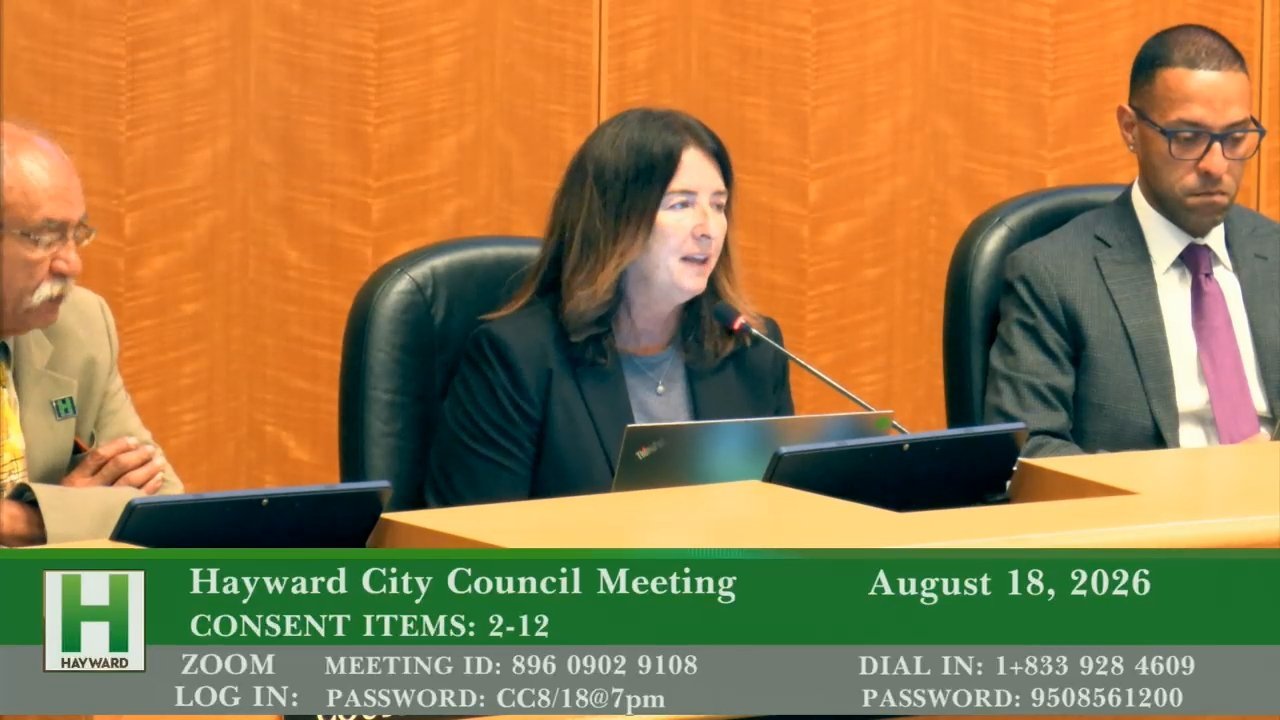
City Council - Aug 18, 2026 - Meeting

City Council - Aug 18, 2026 - Meeting

City CouncilHaywardAugust 19, 2026

Sources:

Locunity is a independent informational service and is not an official government page for this commission.We use AI-assisted analysis and human editorial review to publish information.

Council Approves Historic Russell City Reparations Fund, Divisive Drone Contract

The Hayward City Council's Aug. 18 meeting delivered a rare blend of restorative justice and sharp civil liberties debate — unanimously adopting the city's first reparations fund for families displaced from Russell City decades ago, then splitting 6-1 over a $2.9 million surveillance technology package that drew pointed questions about ICE access to police data. Meanwhile, residents flooded public comment demanding emergency action on a massive data center already under construction, and AC Transit warned that without voter approval of a regional sales tax, Hayward bus riders could face steep service cuts by mid-2027.

  • Historic Russell City Redress Fund unanimously approved, creating a first-of-its-kind municipal reparations MOU with Alameda County
  • $2.9M Axon drone and surveillance package passes 6-1 as Mayor Pro Tem Syrop casts lone no vote over ICE and mass surveillance concerns
  • Residents demand emergency action on 76-megawatt data center approved without council vote; September ban discussion confirmed
  • AC Transit warns of $200M deficit that could slash bus service 16% and eliminate 300 jobs without new regional funding
  • Cal Cities housing resolution backed unanimously, signaling city interest in strengthening local land use authority against state mandates

From Apology to Action: Russell City Redress Fund Moves Forward

Why it matters: Approximately 1,400 residents were displaced from Russell City decades ago with no meaningful financial remedy. The industrial park built on that land now generates tax revenue that funds Hayward city services — a fact council members framed as an ongoing moral debt.

Where things stand: The council unanimously adopted a resolution authorizing the city manager to execute a memorandum of understanding with Alameda County for administration of the Russell City Redress Fund and Phase 1 payments. The item was pulled from the consent calendar so members could give it special recognition.

Councilmember Angela Andrews thanked Alameda County Supervisor Liza Marquez and the Russell City Steering Committee for years of effort. "This is not something that will make total amends, but this is a step, this is an acknowledgement of what happened here," she said.

Councilmember Julie Roche provided extensive historical context, noting that "for decades, the displacement of approximately 1,400 residents caused profound economic, personal and generational harm" — harm that was never meaningfully redressed. She recognized Aisha Knowles and her family for keeping the community's memory alive, including through the documentary film "The Apollo."

Mayor Pro Tem George Syrop connected the vote directly to Hayward's present-day finances: "When we look at the industrial park that was built where Russell City is today, every day we're extracting tax revenue that pays for the services, that keeps the city's lights on, that keeps our roads paved, that pays for our public safety services." He called the redress fund a potential new model for other cities grappling with historical displacement.

Mayor Mark Salinas shared a personal story about meeting a woman in her 90s in New Mexico who remembered Russell City. "She kind of quietly shook her head and she said it was a travesty what had been done to those families. A travesty," he recalled.

Decisions: Passed 7-0. (For: Andrews, Bonilla Jr., Goldstein, Roche, Syrop, Zermeño, Salinas.)

What's next: The MOU enables the city and county to begin administering Phase 1 payments to eligible families. Council members suggested the model could be replicated by other municipalities addressing historical displacement.


Drones, Cameras, and ICE: $2.9M Axon Contract Splits Council

The basics: The resolution authorizes a five-year, approximately $2.9 million agreement with Axon Enterprises for a Real-Time Information Center technology package, including drone-as-first-responder equipment, 64 replacement body-worn cameras, and automated license plate reader cameras replacing the city's current Flock system.

Why it matters: The contract makes Hayward one of the latest Bay Area cities to deploy drone-as-first-responder technology, but it arrives amid national debate over whether police ALPR data ends up in the hands of federal immigration authorities.

Where things stand: The item was pulled from the consent calendar at Mayor Pro Tem Syrop's request, triggering the evening's most contentious debate. Public comment was sharply divided.

A public commenter named Ariana urged a no vote or 60-day continuance, citing an Elk Grove audit that found only 3% of ALPR searches were conducted by local police while 97% came from roughly 3,600 external agencies, including fusion centers and the Department of Homeland Security. She also flagged ICE's $220 million in Axon contracts and more than 50 officers nationwide charged with misusing Flock for personal surveillance.

Supporters from Hayward Concerned Citizens pushed back. Brian Schott, a 50-year Hayward resident, called the contract a bargain, noting the five-year cost breaks down to roughly $68 per hour. TJ, representing Hayward Concerned Citizens, called drones a force multiplier. Teresa Resentis, also of Hayward Concerned Citizens, said safety is her top concern, stating that she is not alarmed by law enforcement use of recording technology to track criminal behavior.

The other side: Mayor Pro Tem Syrop acknowledged the transition from Flock to Axon as a positive step but said he could not support expanding ALPR infrastructure during a period of aggressive federal immigration enforcement. "I don't think it addresses the underlying issue of the expansion of mass surveillance infrastructure in our communities. And so at this time, when we're seeing really blatant abuse by ICE agents and contracts being signed with ICE agents, I just can't get behind the expansion of more ALPR cameras," he said.

Councilmember Ray Bonilla Jr. pressed Police Chief Matthews on data security. "The main issue I think that I have is, and not with this particular contract, but in general, is the inappropriate usage or access to this data and to this information," Bonilla said. The chief described monthly audits, individual user IDs with reason codes, and compliance with SB 34 and SB 54 — California laws restricting local law enforcement cooperation with federal immigration authorities. "We do not. And it's under SB 34 and SB 54. It's illegal for us to do that. Our policy has been in place well before the current Federal Administration," Chief Matthews said of ICE coordination.

Captain Dan Olson clarified that the Axon Outpost ALPR product can live stream but does not pan, tilt, zoom, or record for later recall. The chief also described two infant abduction cases resolved using ALPR technology: "We had that person in custody in 20 minutes. Without ALPR technology, that would have been a statewide Amber Alert, and who knows what the outcome would have been?"

Councilmember Angela Andrews requested that misuse reports for ALPR and drone technology be presented at every Public Safety Committee meeting as a standing item.

Mayor Salinas spoke passionately in support, declaring: "My number one responsibility, number one, is to ensure that we have a safe community. Full stop."

Decisions: Passed 6-1. (For: Andrews, Bonilla Jr., Goldstein, Roche, Zermeño, Salinas. Against: Syrop.)

What's next: The Public Safety Committee will receive regular misuse reporting on the new technology. The five-year Axon contract replaces the existing Flock system.


Residents Demand Emergency Action on 76-Megawatt Data Center

Why it matters: The STAC SVY03A data center on Eden Landing Road was approved administratively by staff — without a council vote — before new rules requiring council approval for facilities over 50 megawatts took effect. At 76.6 megawatts, the facility would consume enough electricity to power roughly 76,000 homes.

Where things stand: Six speakers dominated public comment with demands for an emergency session, a construction moratorium, or independent environmental monitoring of the project. Concerns centered on 28 diesel backup generators, millions of gallons of annual water consumption across four data center projects in the city, and a lack of community notification before approval.

Marla Sather, a 40-year Hayward resident, called for a community committee to study the project, noting the absence of solar or battery storage and referencing Pennsylvania Governor Shapiro's signing of what she described as the nation's most stringent data center executive order.

Tom Wong urged an emergency meeting and moratorium, citing combined energy usage of 160 megawatts across Hayward's data center projects — four times the city's residential electricity consumption — and questioning whether data centers received tax credits that should go to small businesses instead.

Sheila formally requested that the mayor agendize a dedicated council meeting on the existing project, calling it the single largest consumer of power and water in Hayward history. Caitlin Kilia referenced a packed town hall the previous week and called for a public hearing and environmental impact report, noting her father lives 1.5 miles from the site.

Mayor Salinas confirmed that he, Mayor Pro Tem Syrop, and Councilmember Andrews have co-authored a referral for a Sept. 15 discussion on banning future data centers in the city. "Myself, along with Mayor Pro Tem Syrop and Council Member Andrews, we have co-authored a referral to hear discussion and to direct staff in the exploring of banning data centers in the city of Hayward," the mayor said.

What's next: The council is scheduled to take up the data center ban discussion on Sept. 15. Residents are pushing for immediate action on the existing project already under construction, not just future facilities.


AC Transit's $200M Cliff: Hayward Bus Cuts Loom Without New Funding

The basics: AC Transit faces a projected $200 million deficit over the next four years after federal pandemic relief funds dried up, sales tax revenue flattened, and costs for fuel (up 28%), parts, and new buses (up 35%) climbed sharply.

Why it matters: Hayward has roughly 14,000 daily AC Transit riders, many of them low-income residents and people of color who depend on bus service for jobs, school, and essential services.

Where things stand: AC Transit General Manager Salvador Yamas laid out the fiscal picture starkly: "AC Transit faces a projected $200 million deficit over the next four years. That translates to an annual funding gap at least $50 million beginning in 2027." A $55 million state bridge loan will close this year's gap but must be repaid with interest.

Without long-term funding, a contingency service plan would reduce service up to 16% and potentially lay off 300 employees. Transportation Planner Owen Christofferson detailed the Hayward-specific impact: Line 9 along Mission Boulevard would keep 15-minute weekday frequency but lose early morning and late evening trips; Line 97 on Hesperian Boulevard would drop to 30-minute service and terminate at Union Landing; and Line 60, serving Chabot College and Cal State East Bay, would see weekend service cut to 60-minute intervals.

Hope rests with Senate Bill 63, a regional transit ballot measure for a half-cent sales tax that would generate approximately $980 million annually. AC Transit's share would be roughly $52 million per year.

Council members rallied behind the measure. Mayor Pro Tem Syrop connected transit to climate: "When we think about climate change, the majority of CO2 output in the city of Hayward comes from private passenger vehicles. And so if we're serious about tackling climate change, public transportation is one of the critical components of that strategy."

On a brighter note, Yamas announced that a hydrogen fueling station will be built at AC Transit's Hayward facility: "I am happy to announce that here in Hayward we are going to build … a hydrogen fueling station here in our Hayward facility," using $40 million in federal grants received in 2023 and 2024.

What's next: The regional transit sales tax measure tied to SB 63 would go before voters in November. Without approval, service cuts could take effect by June 2027.


Cal Cities: Council Backs Local Housing Authority Working Group

Why it matters: The resolution signals growing municipal interest in pushing back against state housing mandates — though Hayward staff cautioned that supporting a working group does not commit the city to endorsing whatever it ultimately recommends.

Where things stand: The council unanimously designated Mayor Salinas as voting delegate for the Cal Cities 2026 Annual Conference (Sept. 23-25), with Councilmembers Bonilla Jr. and Roche as alternates. The council also directed support for a proposed resolution from the City of Murrieta to form a working group on strengthening local housing and land use authority.

Mayor Pro Tem Syrop raised a pointed concern: the resolution could become a vehicle for NIMBY opposition to state housing production mandates. The City Manager acknowledged that possibility but noted that supporting the formation of a working group does not commit the city to supporting its eventual recommendations. Staff recommended support consistent with the city's existing legislative program balancing local control with state housing laws.

Decisions: Passed 7-0.


Minor Items

  • Consent calendar (Items 1-9, 11) approved 7-0, covering routine business.
  • Three Hayward firefighters received letters of commendation for rescuing residents from two separate structure fires. Firefighter Mitch Klimek was honored for a Jan. 27 rescue at Bahama Avenue. Battalion Chief Darren Ferguson and Apparatus Operator John Irizarry were recognized for a Feb. 7 fire at Buchanan Way involving security bars and heavy hoarding conditions. Irizarry's family accepted on his behalf while he was deployed to the Timber Fire in Big Sur.
  • Cheryl Jure spoke on behalf of the Save SkyWest campaign, opposing a proposal to expand the Hayward airport onto a former golf course, citing habitat for monarch butterflies and endangered turtles. The proposal is expected before the council in the fall.
  • Joe Ramos, a 41-year Hayward resident and former school board member, raised a range of issues during public comment including unlicensed taco trucks, city employee residency requirements, and zero-interest loans for business owners.
  • Closed session settlements announced: $600,000 in Gali v. City of Hayward and $850,000 in Smith v. City of Hayward (paid by the city's excess insurance carrier).
  • Capital Improvement Program FY 2026 Q3/Q4 progress report received without discussion.
  • Meeting adjourned in memory of Judy Harrison, longtime president of Friends of the Hayward Library.
Council Approves Historic Russell City Reparations Fund, Divisive Drone Contract | City Council | Locunity