City Council - Jul 16, 2026 - Meeting

City Council - Jul 16, 2026 - Meeting

City CouncilHaywardJuly 16, 2026

Sources:

Locunity is a independent informational service and is not an official government page for this commission.We use AI-assisted analysis and human editorial review to publish information.

Hayward Staff Rehearse AI Translation Tool to Open Council Meetings to Spanish Speakers

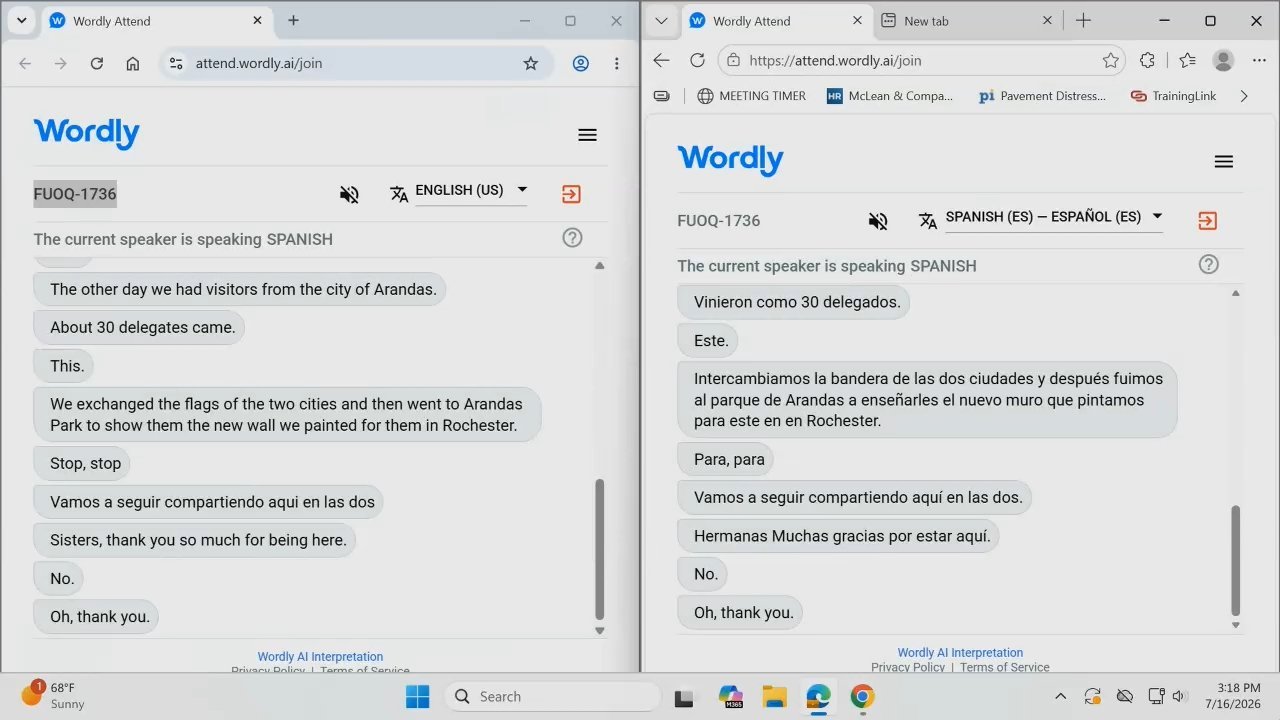
Hayward city staff spent an entire session testing Wordly, an AI-powered live translation platform, ahead of its planned deployment at City Council meetings. The rehearsal surfaced key technical lessons — from audio-echo problems to language-detection delays — and drew advice from the City of Sunnyvale, which already uses the tool.

  • Hayward prepares real-time Spanish-English translation for council meetings, aiming to let residents speak and follow proceedings in their language

  • Staff identify workarounds for detection delays and audio-echo issues during live testing with remote and in-person Spanish speakers

  • Sunnyvale shares its playbook, including free OBS Studio software to composite translation feeds into a single video stream

  • Wordly will be standing by at every meeting but activated on-screen only when a language-access request comes in


Breaking the Language Barrier at City Hall

Hayward is preparing to replace the traditional pause-and-translate model of public comment — where a Spanish-speaking resident speaks, stops, and waits for an interpreter to relay the message — with a system that translates in real time. The tool at the center of the effort is Wordly, an AI platform that listens to spoken input in one language and produces written (and spoken) output in another.

Why it matters: Spanish-speaking residents who want to address the City Council currently face an awkward, time-consuming process that can discourage participation. Real-time translation would let them speak naturally while councilmembers read a live English transcript — a shift that could meaningfully expand who shows up to shape local policy, and bring the city into compliance with state language-access mandates.

Where things stand: The entire session was a technical dry run. Miriam, a staff member working from the clerk's station, led the test. Geraldine, an IT staffer, provided technical guidance and operated the Wordly dashboard. Lilia joined remotely via Zoom to test Spanish-language input, and Voltaire Garcia tested Spanish input from the podium in person.

The team discovered that Wordly needs several words of continuous speech before it can auto-detect the language being spoken, which causes a noticeable lag at the start of each speaker's turn. Geraldine found a workaround: manually pre-selecting the expected input language before a commenter begins.

"If I click back into the actual language immediately, it won't have the delay because I've already told Wordly what it's expected versus it trying to detect it automatically," said Geraldine.

A second problem emerged when the system's spoken English output was picked up by room microphones, creating a doubling effect. "Yeah, so no. Okay, this was bad idea," Geraldine said after the echo test, confirming that audio routing will need careful separation before the tool goes live.

Staff also drew a clear distinction between two types of language access. One staffer framed it simply: "There's two facets. There's the watcher and the participator." For residents who only want to watch with translated captions, Zoom's built-in translated captions are already available at no cost, and Granicus — the city's meeting-streaming platform — supports Spanish captions as well. Wordly is specifically needed when a resident wants to participate: to speak in Spanish during public comment and have that translated to English for councilmembers in real time.

Geraldine noted the practical upside for the dais: "It's gonna be a big help to the members on the desk to actually be able to read it live instead of waiting for the person and cut them off and then translate," one staffer observed.

Geraldine recommended keeping both English and Spanish pre-loaded as default input languages for all meetings: "By default, when we open up a meeting, we'll have Spanish and English. Because you want to have English as another input language in the case that people attending want to understand what we're talking about."

On the question of when to activate the system, Geraldine said Wordly should be standing by from the start of every meeting but only displayed on-screen when needed. "I'm going to have this available to us at the beginning of every meeting, just in case a request comes on the fly. But this only comes up when they decide to route it out." She added: "As long as we meet the law that says it's available, it's available upon request."

Sunnyvale's Playbook

A staff member from the City of Sunnyvale joined the session to share how that city already deploys Wordly at its own meetings.

Sunnyvale makes Wordly available by default at council meetings, with a link printed directly on the agenda. For boards and commissions, translation is available by 48-hour advance request. The Sunnyvale staffer explained: "For our council meetings, we have Wordly available for the public. The agenda says, here's the link, you can get translation. For our other boards and commissions where we don't have it set up by default, we say request language translation."

To display the translation feed alongside the live camera and a QR code for audience access, Sunnyvale uses OBS Studio, a free open-source video-switching program. "It's called OBS Studio. It's free. You take in that tool, you set up a scene, and you say, okay, one of my sources is this USB video feed," the Sunnyvale staffer said.

The other side: The Sunnyvale representative flagged a practical limit. Manual language toggling — where a staff member switches the input language between speakers — works during structured public comment periods where the order of speakers is predictable. But it breaks down in less structured settings. "For a commission meeting where people are talking in two languages, you can't. That's just too much to do as a person. You can't predict who's going to talk next. But for a public comment period, you kind of know — the mayor is going to talk now, and now the person is going to talk, and back and forth."

Geraldine also briefly tested Google Translate's spoken translation feature as a free alternative but found it stops translating whenever the speaker pauses — a significant limitation for natural conversation.

What's next: Staff plan to have Wordly ready at the start of every council meeting, activating the on-screen translation feed when a language-access request is received or a Spanish-speaking commenter is identified. The formal agenda items listed for this session — approval of meeting minutes — were not addressed during the recorded portion.