
Hayward Nearly Doubles Downtown Housing Density Cap to 210 Units
City Council • HaywardOctober 7, 2026
Locunity is an independent informational service and is not an official government page for this commission. All information is sourced from public footage and an analysis of official agendas with the aid of responsible, fact-checked AI. to report an error or omission.
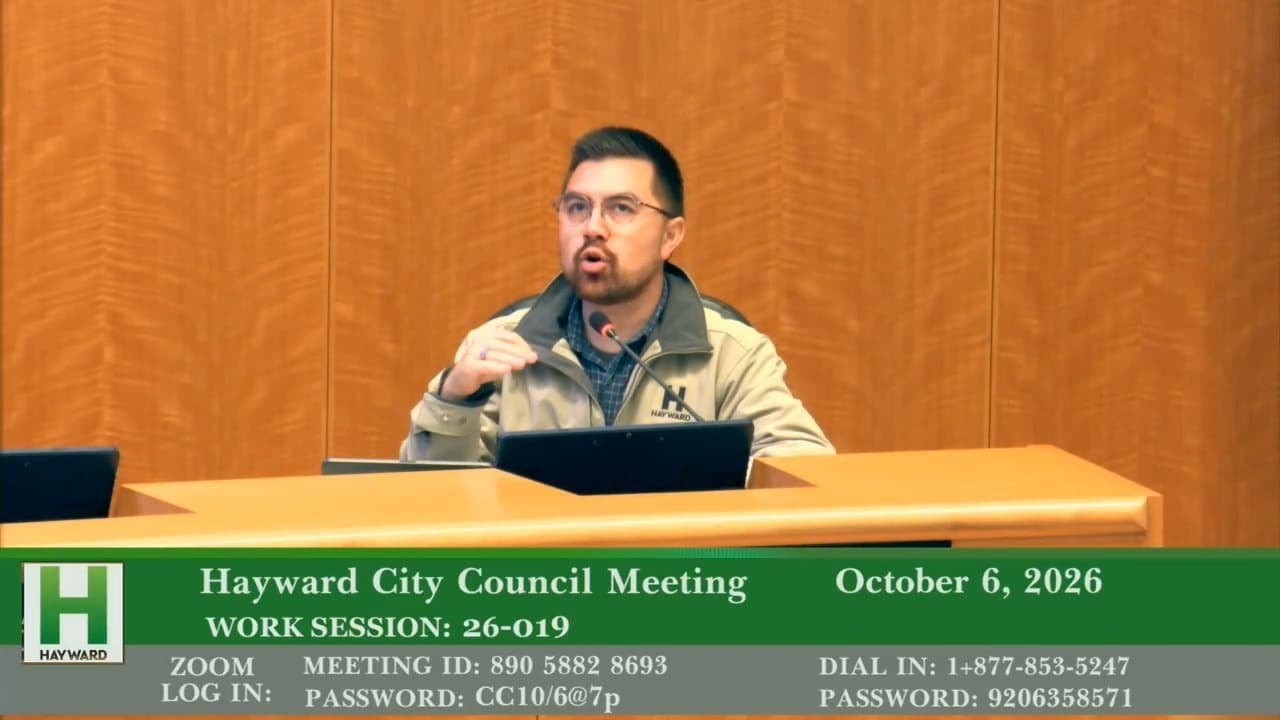
Hayward's City Council voted Oct. 6, 2026, to let downtown developers build up to 210 homes per acre on 130 parcels, nearly doubling the old 110-unit ceiling. The council adopted General Plan amendments that match long-standing downtown rules and steer builders toward Hayward's own design standards instead of new state density law. The council also heard about a fast-track permit program for small businesses and an invasive mosquito that has been found downtown.
- Downtown density range set at 34.8 to 210 units per acre, with 130 parcels redesignated, in a unanimous vote
- New TIGER program cuts small-business plan review to 10 business days, along with a new amnesty path for unpermitted ADUs
- Invasive Aedes aegypti mosquito trapped downtown and near Hesperian, and residents are urged to empty standing water
- Council settles Costa v. City of Hayward, with $800,000 coming from the city's risk fund
- Resident cites PG&E report of 800-MW data center ahead of the Oct. 20 moratorium discussion
Downtown Gets Room to Grow Up
The basics: The council adopted the Downtown Specific Plan in 2019. A specific plan is a detailed rulebook for one area. But the city's General Plan, its top-level land use document, never caught up. The two downtown designations, City Center Retail and Office Commercial (CCROC) and City Center High Density Residential (CCHDR), had no minimum density and capped housing at 110 units per acre.
Where things stand: Associate Planner Dulce Ochoa presented the changes:
- New floor of 34.8 units per acre
- New ceiling of 210 units per acre
- 130 parcels redesignated to CCROC. These parcels are now zoned commercial high-density residential, medium-density residential, parks and recreation, sustainable mixed-use, or public/quasi-public.
Allowable uses and building forms do not change. Senior Planner Taylor Rashard said the Downtown Specific Plan's environmental impact report already covered the work, so no new review is needed under the California Environmental Quality Act (CEQA). Ochoa said the change would also boost the city's competitiveness for grants and support BART's redevelopment of the Downtown Hayward BART Station.
Why it matters: The real target is SB 79, the new state law allowing transit-oriented density near stops, including Hayward BART. Councilmember Angela Andrews asked whether recent legislation shaped the update. Planning staff said the city wants applicants to use local rules because "our regulations are crafted for the Hayward community and have more thoughtful design standards than SB 79."
That is a notable trade. "So while these amendments do allow higher densities than SB 79, they will encourage compliance with our design standards," said planning staff. In short, Hayward is offering builders more height and units in exchange for following its local design rules.
Councilmember Julie Roche asked about the Housing Element. Staff said some housing inventory sites sit in the plan area, and the change helps the city meet its RHNA (Regional Housing Needs Allocation) targets. "So we'll be zoning for more housing actually with this," Roche said.
The other side: No one spoke against the change. One public commenter asked for a copy of the EIR, and staff said it is on the city website and offered to email it. The same speaker asked where Hayward's air quality sensors are located. That question was not answered.
Councilmember Francisco Zermeño asked about linking two green spaces near the Lincoln complex and the Japanese Gardens. Staff said the Hayward Area Recreation and Park District (HARD) is planning San Lorenzo Creek Trail improvements, but the parcel in between is privately owned. Mayor Mark Salinas relayed Andrews' note that the plan document uses outdated downtown photos.
Decisions and stakeholder impacts: Andrews moved the resolution and Councilmember Ray Bonilla Jr. seconded. The mayor announced it would pass unanimously (For: 7, Against: 0, Absent: 0). Individual votes were not read aloud. Developers of downtown and BART-area sites gain capacity, and the new minimum density rules out low-density projects. Residents who want greener connections downtown will depend on HARD's trail planning and private landowners.
Fast-Track Permits Aim at the "Lease Trap"
Where things stand: Development Services Director Buizer introduced Chief Building Official Jeff Thomas, who has 27 years in building departments in Fairfield, Placer County and Santa Barbara County. His division issues more than 4,000 permits and conducts about 17,000 inspections a year.
His main offering is TIGER, a program he said he adapted from the City of Folsom. "It's got a reduced plan review timeline down to 10 business days, 5 business days for any rechecks, which reduces the average turnaround time by about 50%," Thomas said. To qualify:
- Fewer than 100 employees and under $15M in gross revenue
- Tenant improvements up to 5,000 square feet, a limit set largely by fire sprinkler requirements
- Occupant loads of 50 or fewer
The program also offers optional pre-lease inspections with Building and Fire Prevention. It was also stated that TIGER comes at no additional cost to small businesses.
Why it matters: Andrews named the core problem: "the issue is that people move into buildings and then they look at the code." Thomas said early review means tenants are "not stuck into a lease for 3, 6, 9, 12 months before they can even get a permit."
Thomas also announced a streamlined amnesty process under AB 2533 for accessory dwelling units (ADUs) built before 2020. He described a software update due by year-end. He said Hayward already beats the state's new 30-day turnaround requirement. Small tenant improvements now take 15 business days and large ones take 21.
The other side: No one opposed the program. Council pressure focused on speed of outreach. Mayor Pro Tem George Syrop wants the city "not just spinning up a webpage, but we're kind of going on the offensive" to promote it. He suggested reaching small-business lenders and owners of vacant downtown buildings. Thomas said Economic Development will contact vacant-space owners after a pilot, "so that what we market, we deliver." Zermeño backed outreach to property owners.
Decisions and stakeholder impacts: This was an informational session, with no vote and no public comment. Small businesses and the owners of unpermitted pre-2020 ADUs stand to benefit most. Outreach is planned with the East Bay Association of Realtors, the Chamber and Hayward Rotary.
An Invasive Mosquito Turns Up Downtown
Where things stand: Ryan Clausnitzer, General Manager, Alameda County Mosquito Abatement District, reported that Aedes aegypti was recently trapped in Hayward. This mosquito can spread dengue and chikungunya. "We found it just downtown, and we found it also toward Hesperian in that area," he said. No residents had complained. District teams went door to door checking backyards. He called the species "the cockroach of mosquitoes."
Why it matters: This mosquito breeds in backyard containers, so household habits now matter more than spraying. Answering Roche, Clausnitzer said residents should empty plant saucers and standing water every one to two weeks and give them a quick scrub to remove eggs.
The basics: The district runs on small property tax assessments totaling almost $6M a year. Service requests through mosquitoes.org are already paid for. In Livermore, the district releases sterile males carrying Wolbachia, a natural bacteria, and may expand the program, probably to Fremont, next year.
What's next: Syrop, the council's representative on the district board, urged residents to report dead birds at mosquitoes.org to help track West Nile virus. He also noted the district gives away free mosquito fish for standing pools. Clausnitzer told Andrews the district works with pool associations and pottery suppliers, because imported pots can carry the mosquito.
Costa Lawsuit Settled in Closed Session
Where things stand: The City Attorney reported that the council unanimously approved settling Costa v. City of Hayward. Salinas moved the settlement and Councilmember Dan Goldstein seconded. The vote was For: 7, Against: 0, Absent: 0, as reported; individual votes were not read. The City Attorney gave a "total amount of $1.5 million," with the city paying $800,000 and insurers paying "the balance of $750,000." Those two figures add up to $1.55M, so the exact total should be checked against the official record.
Why it matters: The city's $800,000 share is budgeted in its risk fund, a direct public cost. The nature of the case was not discussed in open session.
Data Center Questions Before Moratorium Debate
Where things stand: During public comment, Joe Vieira, who described 40 years in tech, said PG&E's 2024 annual report referenced budgeting for an 800-megawatt data center in Hayward. "It's very dangerous in the tech industry to sort of make long-term decisions about things that can change amazingly quickly," he said. He added that city planning documents lack context.
Salinas said he had not heard of such a proposal and promised staff would call Vieira the next day. Vieira said an earlier promised callback never came. The mayor noted Vieira's comment card had no phone number.
What's next: The City Manager said direction from an earlier referral discussion, along with a possible moratorium on data centers, will be on the council's Oct. 20 agenda.
- Traffic safety grants: The Alameda County Transportation Commission nominated Hayward for $3.1M to design the Tennyson project, starting July 2027. The project is expected to add a protected bike lane between Hesperian and Mission Boulevard. A separate $270,000 nomination covers Safe Routes to School construction.
- Consent calendar: Items 1–11 passed with no items pulled (Syrop/Goldstein), announced as unanimous. A commenter said item 7 continues tiny homes for survivors of interpersonal violence.
- Winter shelter call: Online commenter Roe A warned that "400-plus homeless people" will need winter shelter. The commenter urged partnerships with the county, other cities and nonprofits.
- Library perk: Youth 18 and under who get a new Hayward library card or verify an existing one receive a free Sky Zone ticket worth about $31.
- Firefighter memorial: Andrews thanked Alameda County and the fairgrounds for hosting the service for firefighter Travis Foster.
Looking ahead:
- Oct. 10: Hayward Arts Council art walk, 11 a.m. to 3 p.m.
- Oct. 10: Puente Car and Bike Show at Tennyson High School
- Oct. 11: E-bike test rides with Bike East Bay and Ava Community Energy at the Hayward BART lot
- Oct. 13: Next council meeting
- Oct. 17: Hayward Night Market at St. Rose
- Oct. 20: Council takes up the data center moratorium
- Oct. 22: Taste of Hayward