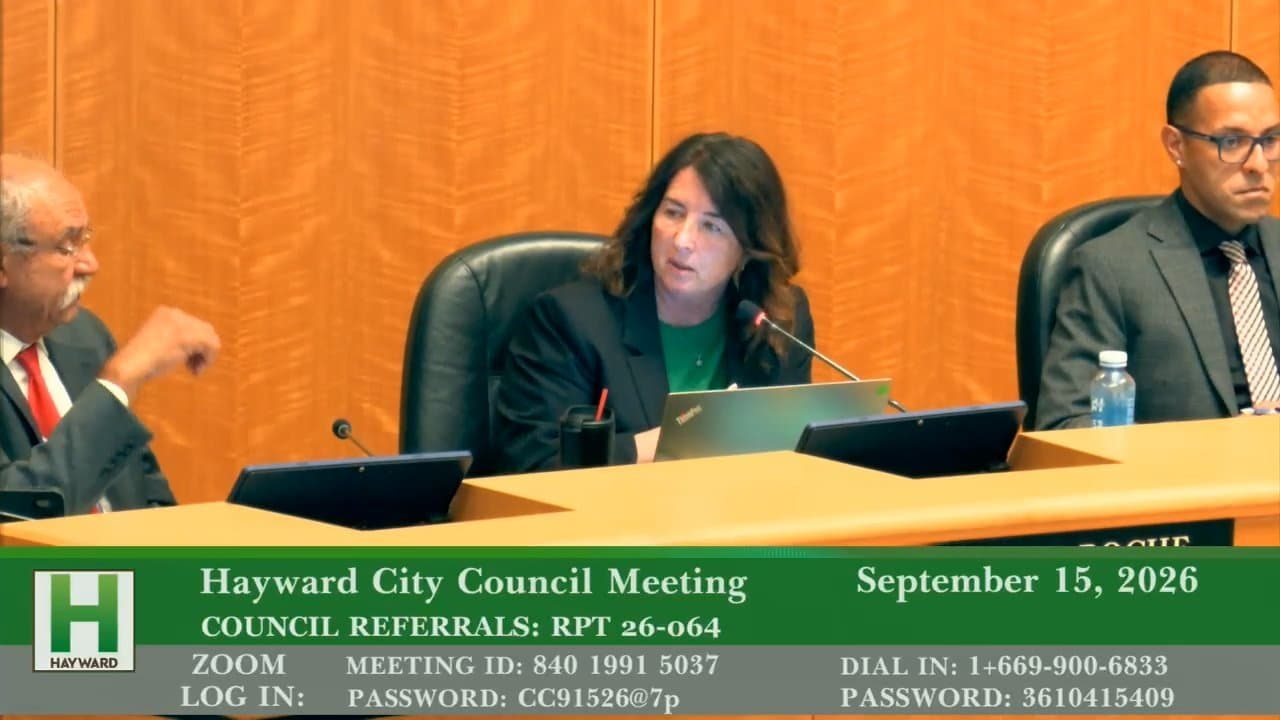
City Council - Sep 15, 2026 - Meeting
City Council • HaywardSeptember 16, 2026
Locunity is a independent informational service and is not an official government page for this commission.We use AI-assisted analysis and human editorial review to publish information.
Council Unanimously Backs Data Center Moratorium After Marathon Public Hearing
More than 30 Hayward residents, union leaders, educators and advocates packed city council chambers to demand the city pump the brakes — or slam them — on data center development, and every councilmember agreed. The council voted 7-0 to direct staff to return by late October with an urgency moratorium ordinance, keeping a permanent ban on the table.
Full council directs staff to draft urgency moratorium on data center development by late October
Hayward Education Association's 1,100-member assembly unanimously calls for a data center ban
Former top-5 AI company employee reveals he quit over data center buildout, urges city to act
Petition with roughly 2,300 signatures delivered to council supporting the referral
Union trades back a pause but push for labor standards and ratepayer protections
Critics blast $500K City Hall renovation on consent calendar amid layoffs and service cuts
Hayward Hits Pause on Data Centers
Why it matters: Hayward joins a growing wave of California cities reconsidering data center development as communities raise alarms about water consumption, diesel emissions, noise, electricity demand and the unchecked pace of AI infrastructure. Staff confirmed that developers are already seeking to build facilities in Hayward even larger than the 77-megawatt Stack Infrastructure project that sparked the current uproar.
The basics: A data center moratorium is a temporary freeze on new applications, buying the city time to study impacts and strengthen regulations before any additional facilities can be approved. An "urgency" moratorium requires a supermajority — six of seven council votes — and can take effect immediately upon adoption.
Where things stand: The referral, authored by Mayor Mark Salinas, Councilmember George Syrop and Councilmember Angela Andrews, grew out of a South Hayward town hall and sustained community opposition to the Stack Infrastructure data center (known as SVY03) approved on Eden Landing Road. Planning Manager Leah Schmidt presented three options: maintaining the status quo while tightening rules over six months, an urgency moratorium pausable for up to a year, or a permanent ban that would take several months to implement. Schmidt noted that Hayward already adopted what she described as the Bay Area's strictest data center regulations in April 2026, requiring major conditional use permits, sustainability plans and community benefits packages. But with additional developers expressing interest in even larger projects, the council signaled that existing rules are not enough.
"Our goal tonight is to listen. Our goal tonight is to talk to staff and direct staff as to what next steps are," said Mayor Salinas, who later framed three policy priorities emerging from public testimony: transparency (wider notification areas and regular operational reporting), accountability (clear labor and threshold standards), and community benefits.
The public comment period stretched well over two hours, with the overwhelming majority of speakers calling for an outright ban. Marla Sather delivered a petition with approximately 2,300 signatures and submitted a proposed oversight ordinance. Jesse Gunn, treasurer of the Hayward Education Association, announced that the union's roughly 1,100-member faculty assembly had voted unanimously — not for a pause, but for a ban. "Yesterday, our faculty representative assembly, representing roughly 1,100 teachers, psychologists, counselors and nurses in the Hayward Unified School District, voted unanimously to oppose data centers here in Hayward and to call for their ban," Gunn said.
Among the most striking speakers was Prairie Jain, a former developer at a top-5 AI company, who told the council he had quit five days earlier partly because of the industry's data center buildout. "I worked at a top 5 AI company on Frontier AI models. I quit 5 days ago partially due to data center build out," Jain said, urging the city to slow construction of facilities whose primary purpose is powering AI systems.
Residents raised concerns spanning water consumption — staff confirmed the Stack facility's peak demand at 173,000 gallons per day — diesel emissions from 28 backup generators, low-frequency noise not captured in the project's original environmental review, electricity rate impacts, and proximity to the Hayward shoreline. Jeannie Buchanan called for independent low-frequency noise baseline testing and enforceable limits, noting the CEQA study only measured standard dBA levels, not the low-frequency dBC levels that affect nearby residents. Habiba, representing the Council on American Islamic Relations, argued data centers are disproportionately sited near Black and brown communities, driving up utility costs and heat exposure. Sheila Cho urged the council to support three state bills — AB 1577, AB 2619 and AB 2469 — that would require data centers to report energy, sound, fuel and water usage.
Ernest Pacheco, a 30-year Hayward resident, drew a historical parallel, reminding the council that in 2007 the community successfully blocked two fossil fuel power plants, setting state and national precedents. "Hayward came together and we stopped the power plant. What we did is we revitalized. We set a state precedent," Pacheco said, noting that fight led to the creation of the city's community choice energy program, AVA Energy.
The other side: Not everyone called for a ban. Planning Commissioner Jeffrey Hammond, who voted to approve the Stack project, pushed back on the prevailing sentiment. "I believe that much of the outrage and concern surrounding this project is unfounded and based on misinformation," Hammond said, questioning how many critics had read the environmental and staff reports. Planning Commissioner Robert Stevens argued data centers have operated in Hayward since the 1980s and that Stack alone would generate nearly $9 million in annual revenue.
Business groups urged caution. Lucy Lopez of the Hayward Chamber of Commerce asked the council to allow more time for research and expert input before prohibiting all data centers. Peter LaRue Muñoz of the Bay Area Council cited San Jose's framework development and noted data centers can deliver $3–$7 million per project in general fund revenue. Eric Nagamir of the Silicon Valley Leadership Group urged the council to build on its recent regulations rather than move toward prohibition. "Data centers deliver significant tax revenues and infrastructure upgrades," Nagamir said.
Union construction representatives carved out a middle lane. E.J. Sire, representing 1,500 Hayward union construction workers, called for responsible regulation that includes skilled workforce requirements and ratepayer protections, while warning that Prop 45 on the November ballot could strip cities of local land-use control. Andreas Kluver of the Alameda County Building Construction Trades Council echoed the call for a deliberate process. Brent Haug of IBEW Local 595 supported strong environmental and labor standards before any new facilities are built.
Decisions: The council voted 7-0 to direct staff to return by late October with an urgency moratorium. Councilmember Syrop delivered the most detailed policy vision, supporting the moratorium while insisting a permanent ban remain on the table. He proposed prohibiting city officials from signing nondisclosure agreements related to development projects and urged staff to bring the moratorium back before the November election. "I am in support of it. Given the time needed to develop a ban and given that there's already interest in a data center coming to Hayward, I'm supportive of an urgency moratorium because that's something that we can put in place sooner rather than later," Syrop said.
Councilmember Ray Bonilla Jr. called for a community-driven policy process. "I also agree with a comment from one of the public commenters that said, let's watch these data centers like a motherhawk. I think it's our responsibility to do that," Bonilla said. Councilmember Dan Goldstein pressed staff on factual details, establishing that Stack's total water use is approximately 3 million gallons per year — equivalent to 28 households — and that its energy is sourced 100% from renewables (77% solar, 23% wind). Councilmember Francisco Zermeño supported the moratorium to allow further study, and Councilmember Andrews emphasized Hayward's already stringent regulations while acknowledging more oversight is needed.
What's next: Staff will prepare the urgency moratorium ordinance for council consideration by late October. The moratorium requires six of seven votes to take effect immediately. A permanent ban remains under consideration. Once enacted, no new data center applications could be approved while the city conducts environmental, fiscal and community impact studies. Several state data center bills await the governor's signature and could shape the regulatory landscape further.
Budget Tensions Surface Over $500K City Hall Renovation
Why it matters: Hayward narrowly avoided insolvency last year, triggering layoffs, library service cuts, frozen positions and canceled community programming. Three public speakers argued that approving more than $500,000 in City Hall improvements — a new conference room and two enclosed offices — on the consent calendar without discussion sent the wrong message about the city's priorities.
Where things stand: Tom Ferreira, a citizen and SEIU UHW labor leader, told the council the city was less than $1 million from bankruptcy after balancing its budget and questioned spending $500,000 on a conference room when police staffing, maintenance and library positions had been eliminated. Terry Martin raised broader concerns about $1.5 million in consent calendar contracts being approved without public discussion. TJ of Hayward Concerned Citizens challenged the city's argument that the renovation funds don't come from the general fund, pointing out that Measure D utility taxes and water enterprise revenue all come from taxpayers. TJ ticked off a list of recent austerity measures — voluntary council pay cuts, Measure C funds used for budget balancing, library service reductions and the cancellation of National Night Out — calling the improvement project tone-deaf.
Decisions: Despite the criticism, the consent calendar passed unanimously (For: 7, Against: 0, Absent: 0). The renovation will proceed.
Minor Items
Commission appointments: The council unanimously confirmed appointments and reappointments to five city commissions — Clean and Green, Community Services, Library, Personnel and Planning — with roughly 19 individuals sworn in by the City Clerk (For: 7, Against: 0, Absent: 0).
Mental health care facilities: Tom Wonder urged the council during public comment to investigate funding and quality-of-care challenges facing small residential mental health facilities in Hayward, noting operators earn less than $50 per day. He asked that revenue from the proposed November business tax ballot measure be directed to support these providers.
City Manager report: The City Manager announced record attendance of 15,500 at the Hayward Executive Airport open house and highlighted the upcoming Hayward Mariachi Festival on Sept. 26.
MTC pavement management grant: An informational item noted a Metropolitan Transportation Commission grant award for updating the city's pavement management program (Project No. 05110).
The next Hayward City Council meeting is Oct. 6 at 7 p.m.