
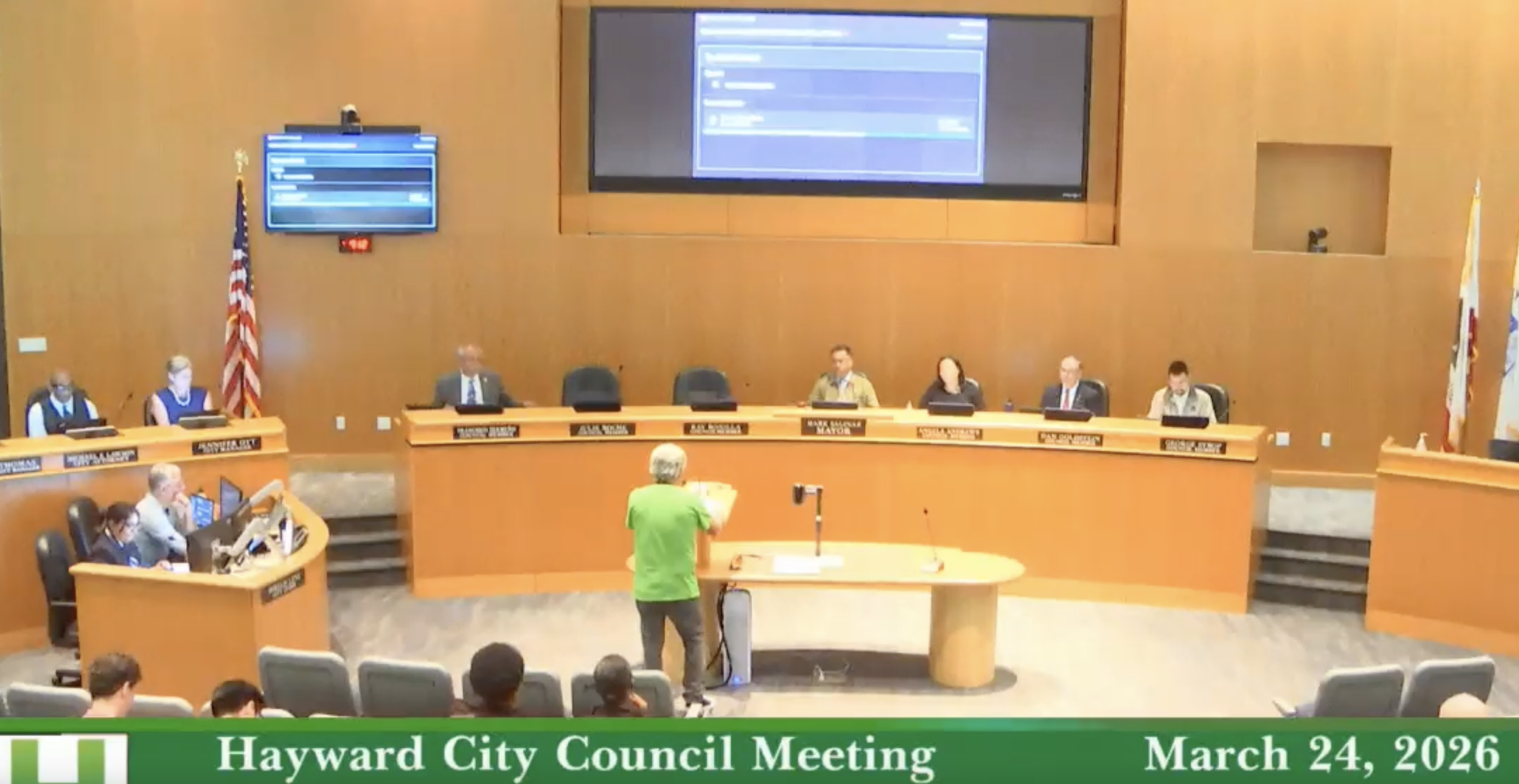
City Council - Mar 24, 2026 - Meeting

City Council - Mar 24, 2026 - Meeting

City CouncilHaywardMarch 24, 2026

Sources:

Locunity is a independent informational service and is not an official government page for this commission.We use AI-assisted analysis and human editorial review to publish information.

Council Backs Aggressive Safety Overhaul After Three Pedestrian Deaths

Three fatal pedestrian crashes in 10 days brought Hayward's traffic safety crisis into sharp focus Tuesday night, as council members directed staff to fast-track intersection improvements, launch a police enforcement blitz, and pursue up to $25 million in federal funding to redesign the city's deadliest road. In a separate unanimous vote, the council renamed the March 31 Cesar Chavez Observance Day to Farm Worker Day following revelations of abuse against Dolores Huerta.

  • Three pedestrian fatalities in February drive sweeping Vision Zero response, including quick-build intersection fixes and a 3-month police enforcement operation

  • Council directs staff to pursue $25M federal grant for Tennyson Road corridor redesign, with construction targeted as early as 2028

  • Seven public commenters, backed by Bike Hayward and neighborhood groups, urge the city to prioritize pedestrian and cyclist safety over car convenience

  • Cesar Chavez holiday unanimously renamed to Farm Worker Day and city artifacts under review after abuse revelations

  • City manager addresses HPD officer arrest in illegal brothel investigation, expresses full confidence in department leadership


Street Safety in Crisis: Quick Builds, Enforcement and a $25M Bet on Tennyson Road

Three pedestrian deaths within a 10-day span in February 2026 made this work session the most consequential traffic discussion Hayward has held in years. The presentation spanned nearly 100 minutes of staff briefings and council direction, plus passionate testimony from seven public commenters — a clear signal that the political will and community demand for safer streets have converged.

The basics: Hayward adopted a Vision Zero policy in 2023 with a goal of eliminating traffic fatalities by 2050. The city's High Injury Network — 14% of roadway that accounts for 75% of fatalities and severe injuries — became the framework for Tuesday's action plan.

Why it matters: The February fatalities exposed dangerous gaps between policy and infrastructure. Pedestrian-vs-vehicle collisions jumped 33% from 2024 to 2025, according to Lt. Ryan Sill, Hayward Police Department Traffic Bureau, and three of those collisions turned fatal in a single brutal stretch. Council's response could redirect millions in federal funds and reshape how the city builds and polices its streets for the next decade.

Immediate Action: Quick Builds and Enforcement

Where things stand: Byron Tang, Principal Transportation Engineer, told the council that the city has already completed its first quick-build project at Tennyson Road and Baldwin Street — advance yield lines, warning signage, painted bulb-outs, and red curb paint. Staff plans to extend similar treatments to the remaining top 10 high-injury intersections. Additional short-term measures include evaluating no-turn-on-red restrictions, leading pedestrian intervals at signalized intersections, and launching a Vision Zero webpage.

On the enforcement side, Sill outlined Operation Safe Travels — a three-month campaign deploying a minimum of 20 hours per week of targeted enforcement on five high-injury corridors. Officers will focus on speeding, failure to yield, distracted and impaired driving, and red light violations.

"Pedestrian versus automobile collisions have increased from 2023 to 2025, with a significant increase from 2024 to 2025, resulting in an actual 33% increase in vehicles versus pedestrian collisions," said Sill.

Tennyson Road: The Big Bet

Staff recommended prioritizing Tennyson Road for a federal Safe Streets and Roads for All implementation grant worth up to $25 million, with an ambitious timeline: environmental review in 2026, design in 2027–28, and construction beginning as early as 2028–29. Medium-term projects also in the pipeline include Hayward Boulevard pedestrian improvements, Orchard Avenue Phase 2, D Street traffic calming, Safe Routes to School covering 12 school sites through a CARB grant, Safe Routes for Seniors near Weeks Park, and a potential red-light camera enforcement pilot. Longer-term, the city is eyeing a reimagination of the downtown loop with two-way conversion options, corridor redesigns on Hesperian, Mission, and Jackson boulevards, the East Bay Greenway regional trail, and I-880 interchange improvements.

Public Commenters Push for Bolder Action

Seven speakers — representing Bike Hayward, the NOMA Prospect Hill Neighborhood Association, and individual residents and cyclists — overwhelmingly called on the council to treat street safety as non-negotiable.

Naomi Powell, President, NoMa Prospect Hill Neighborhood Association, described being hit by a vehicle at Hazel Avenue and Main Street and detailed cut-through traffic funneling between Foothill Boulevard, A Street, Mission Boulevard, and freeways 238 and 580. She called for enhanced speed bumps, curb bulb-outs, and closing Hazel Avenue to through traffic.

"Bike lanes are minimum safety infrastructure rather than quality-of-life amenities," argued Ahmed Sharab, Bike Hayward.

Sharab presented the group's "Safe Streets for Hayward" platform of five core demands. He praised the city's proactive work but warned against a pattern of delaying projects when they become politically difficult, urging that safety be a non-negotiable element of any street project, including repaving.

Alejandro, a public commenter, highlighted a dangerous blind spot at the St. Regis crosswalk where a person in a wheelchair was killed and noted that median signal equipment has been repeatedly destroyed. He also reminded the council that the California Freedom to Walk Act makes mid-block crossing legal, cautioning against fatality reports that imply pedestrian fault.

Tyler Dragoni, a public commenter, argued that leading pedestrian intervals should be implemented immediately and framed traffic calming as a leadership question.

Council Direction: Faster, Bolder, Branded

All five council members present expressed strong support and piled on specific directives:

Councilmember Francisco Zermeño, a daily cyclist, called for accelerating the Vision Zero target from 2050 to 2035 and urged staff to keep installing traffic calming measures regardless of political pushback.

"The purpose of traffic calming is to slow drivers down. That's simple as that," said Zermeño.

Mayor Pro Tem Julie Roche proposed piloting a quick-build street closure on Hazel Avenue, similar to Berkeley's approach, and pressed for faster repair of non-functional flashing beacons.

"When we hear that traffic beacon isn't working on Tennyson or it's not working on B Street, the ones on Main Street still aren't functional," she said. "We need to figure out how we speed up the process between receiving that information and getting those lights up and running because it can cost lives the longer we wait."

Roche also connected the urgency to economics:

"We're looking at gas that's at $6.30 a gallon and probably only going to go up. This isn't a matter of if people are going to start riding their bikes, but a matter of when."

Councilmember Angela Andrews pushed for an e-bike safety policy, benchmarking against San Mateo County's emerging framework, and urged partnerships with the Downtown Hayward Improvement Association for downtown safety events. She also called on staff to leverage development permit conditions to require pedestrian safety enhancements near project sites.

Councilmember Dan Goldstein proposed programming traffic signals to reward speed-limit compliance —"If you're speeding to get to the next light, you should be getting a red every single time" — and advocated for promoting employer BART discounts and local job creation to reduce commuter traffic volume.

Mayor Mark Salinas called for branding the initiative as "Safe Streets Hayward" and acknowledged the political difficulty of implementation.

"We need support up here," he told advocates in the chamber. "I'm glad all of you are here, but conversely, we need support out there."

What's next: Staff will bring traffic safety updates regularly to the infrastructure committee. The federal Safe Streets and Roads for All grant application for Tennyson Road is the immediate priority. Council directed staff to review Bike Hayward's five "Safe Streets for Hayward" demands and study a Hazel Avenue closure pilot.


Cesar Chavez Holiday Renamed to Farm Worker Day

Why it matters: Revelations about Cesar Chavez's abuse of Dolores Huerta and other victims forced a reckoning in a city with deep Latino and labor roots. The council acted unanimously — and with unusual speed — to separate the holiday's meaning from its namesake.

Where things stand: Mayor Mark Salinas, co-authoring the referral with Councilmember Francisco Zermeño and Councilmember Ray Bonilla Jr. (absent), proposed three actions: issue a public statement, review city facilities and artifacts bearing Chavez's likeness or name, and recast the March 31 Cesar Chavez Observance Day as Farm Worker Day, aligning with the State of California's naming convention.

The referral was submitted without the required 10-day notice period. Council suspended the rule by consensus given the approaching March 31 holiday.

Zermeño spoke from personal experience:

"As a former farm worker and as a former Brown Beret follower, I was devastated. So I'm glad that we're doing this."

Councilmember Dan Goldstein balanced grief with solidarity:

"I think we do owe it to the farm workers union to continue to stand in solidarity with them."

Salinas reflected on the complexity of accountability:

"What's especially hard in this case is we don't have an individual to hold account because they're no longer with us. The victims are with us."

The other side: Councilmember Angela Andrews supported the motion but emphasized respecting the 10-day referral policy going forward. Mayor Pro Tem Julie Roche suggested developing an expedited referral process for time-sensitive matters.

Decisions: Passed 5-0 (For: Salinas, Andrews, Zermeño, Goldstein, Roche; Absent: Bonilla Jr., Syrop).

What's next: Staff will review city facilities and artifacts and implement the holiday renaming before March 31.


Minor Items

  • Consent calendar approved 5-0 (two absent), including acceptance of an animal shelter spay/neuter grant for the trap-neuter-return program and a request to add water treatment plant project updates as a standing infrastructure committee item.

  • Closed session on labor and property matters yielded no reportable action.

  • City Manager Jen Ott addressed the arrest of HPD Officer Ben Yarborough in a San Jose Police Department-led investigation into illegal brothels. The officer was placed on administrative leave immediately. "The conduct alleged in this case is in no way a reflection of the professional men and women of the Hayward Police Department," Ott said, expressing full confidence in Chief Brian Matthews.

  • Union representative Danny Magalis urged the city to let structural budget changes take effect before demanding further payroll concessions from workers, noting Phase 1 negotiations ended without agreement in January.

  • Councilmember Andrews pushed for stronger marketing partnerships with the Downtown Hayward Improvement Association, BART, and the chamber of commerce ahead of the FIFA World Cup, now less than 70 days away. City Manager Ott confirmed staff discussed World Cup promotional strategies that same day, including watch parties and hotel promotion.

  • Mayor Pro Tem Roche questioned how 22% of general plan projects remain unstarted. City Manager Ott argued for aspirational goal-setting: "If we don't aspire, then you're not going to get them." Roche called for better integration of general plan goals, strategic priorities, resident satisfaction surveys, and the city budget.

Council Backs Aggressive Safety Overhaul After Three Pedestrian Deaths | City Council | Locunity