
City Council - Jun 16, 2026 - Meeting

City Council - Jun 16, 2026 - Meeting

City CouncilHaywardJune 17, 2026

Sources:

Locunity is a independent informational service and is not an official government page for this commission.We use AI-assisted analysis and human editorial review to publish information.

Council Approves Citywide Drone First-Responder Program Over Surveillance Concerns

Hayward's City Council authorized the police department to deploy eight autonomous drones to answer 911 calls across the city, voting 6-1 in its final meeting before a two-month summer recess. The marathon session also produced a unanimous vote on a water plan that warns commercial demand will overtake residential use by 2050 — and a pointed debate over millions in cannabis penalties levied against property owners who say they didn't know what their tenants were doing.

  • Council greenlights drone-as-first-responder program 6-1, authorizing HPD to station eight drones citywide for 911 response at roughly $589,000 per year

  • 2025 Urban Water Management Plan adopted unanimously, projecting 40–50% supply shortfalls during extended droughts and a major shift toward commercial water demand

  • Attorney challenges $14.5 million cannabis penalty against a landlord as unconstitutional — nearly four times the property's value

  • Residents blindsided by July 1 parking enforcement in city garages, with no permit program yet available and Council leaving for summer recess

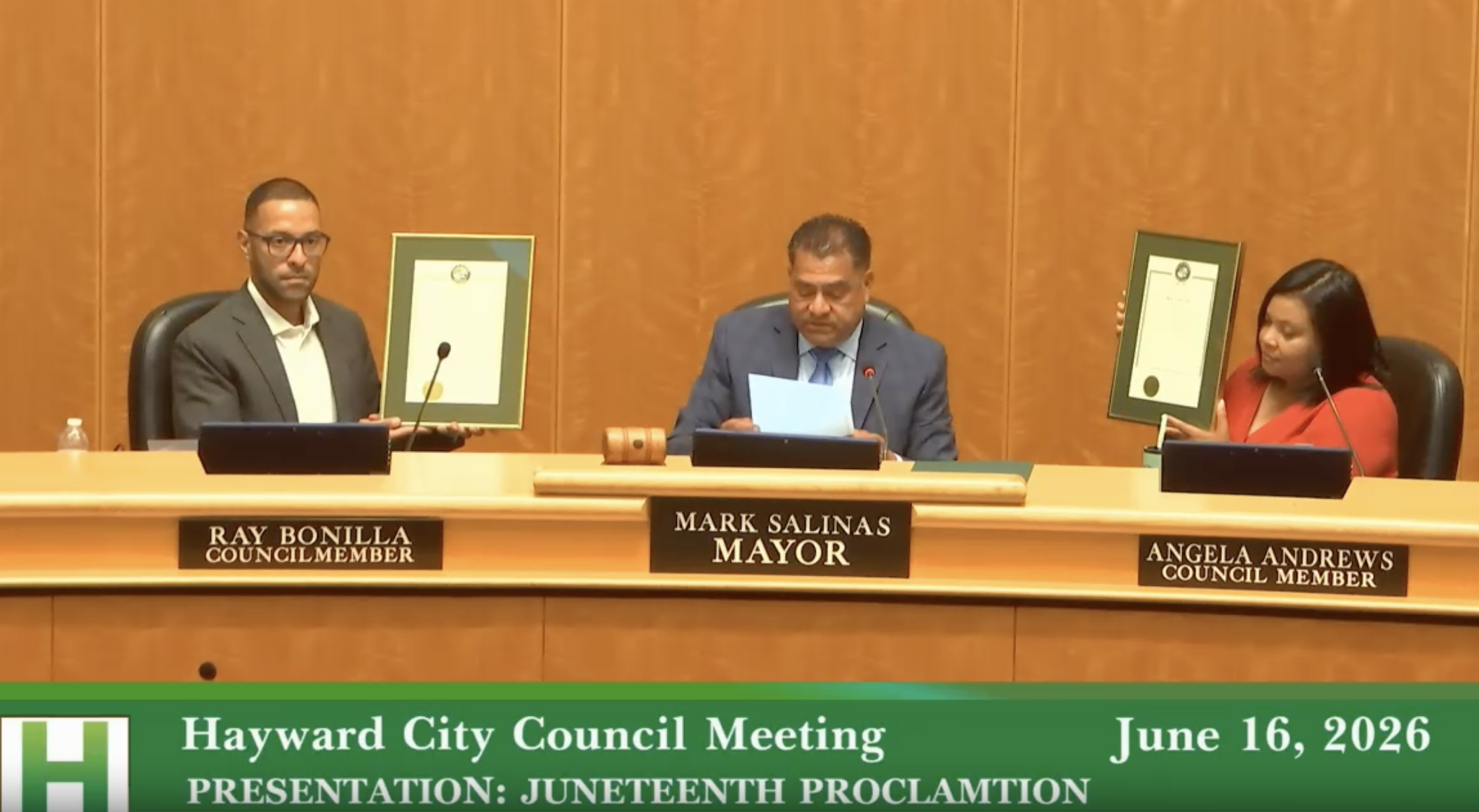
  • Juneteenth proclaimed with community partners previewing the sixth annual Freedom Celebration on June 20


Eight Drones, One Dissent: Hayward Bets on Autonomous Policing

The biggest debate of the night centered on whether Hayward should become one of the first Bay Area cities to deploy an autonomous drone fleet for 911 response — a program that its supporters say could save lives and its sole critic on the dais called an expansion of surveillance infrastructure the city isn't ready to manage.

The basics: Under AB 481, California cities must annually review and re-authorize military and surveillance equipment used by law enforcement. Police Chief Bryan Matthews used that mandatory report to introduce a new Drone-as-First-Responder (DFR) program that would station eight drones at launch points across Hayward, operated by civilian community service officers from the department's Real Time Information Center.

Why it matters: HPD is carrying roughly four dozen sworn and staff vacancies. The DFR program promises to put eyes on a scene before officers arrive — or to clear calls entirely without dispatching anyone, freeing patrol resources in a department stretched thin.

Where things stand: During a four-week trial with Axon and Skydio, drones responded to 326 calls, cleared 108 without dispatching officers, arrived first 53% of the time, and cut average response times by 2 minutes and 30 seconds.

"I do want to highlight that this is a 100% reactive program, which means that it's only utilized when somebody calls 911 to report something, whether it's a crime in progress or an issue or a community complaint," said Matthews.

He also disclosed a correction from the earlier Public Safety Committee presentation: staff had initially said drone cameras could not be manually manipulated in flight, but later learned an operator could override that.

"We want to acknowledge that that was our error. However, in response to that, we made an amendment to the policy that expressly prohibits this, and staff members can be disciplined if they do so," Matthews said.

The estimated average annual cost is $589,000, funded through grants, asset forfeiture, and existing budget.

Public comment ran heavily in favor. Suzanne Luther of Hayward Concerned Citizens voiced complete support. Claire Dugan, a 40-year Hayward resident and fellow member of the group, said she wanted criminals to know the city is serious about crime prevention. Dennis Houghteling, a retired deputy chief with more than 50 years of service, strongly endorsed the program based on his experience with the Alameda County Sheriff's drone operations. Lucy Lopez of the Hayward Chamber of Commerce framed drones as essential to improving the city's safety reputation:

"A safe and responsive and very well prepared city is the foundation for a strong local economy, and Hayward deserves this."

Lopez offered to help secure private-sector funding.

The other side: Dylan Rogers of the Hayward Coalition for Human Rights in the Philippines was the only public commenter to oppose the item, connecting the technology to broader militarization concerns.

"We specifically condemn the proliferation of drones and their use of surveillance on our fellow community members here in Hayward all the way to those in the Philippines, with the same companies being used in test trials being used to surveil those in the Philippines that have been murdered," he said, also raising concerns about drone use at protests and taxpayer dollars flowing to private tech companies.

Retired Hayward Police Chief Toney Chaplin offered perhaps the most vivid endorsement, drawing on decades of experience:

"If President Obama's Task Force on 21st century policing had drones as an option, I think it would be listed number one as a de-escalation tool. Because when I look at some of the shootings, officer-involved shootings, that happened over my tenure as a police officer, which spans over three decades, I would go out and venture to say a lot of them could have been avoided with a quick overview of the scene before the officers got on scene."

Council members probed data transparency, deployment criteria, privacy safeguards, and long-term funding. Councilmember Ray Bonilla Jr. asked about the drone vendor's data practices, referencing community concerns about the Flock camera company's ethics around data retention and access. Matthews confirmed the vendor is Axon/Skydio. Councilmember Angela Andrews expressed conditional support, saying the community retains the power to pull the plug:

"I am tired and frustrated of seeing officer-involved shooting videos. And if we can find a way to not have that, if there is a technology out there that can help reduce that, I'm interested in trying it."

The dissent: Mayor Pro Tem George Syrop cast the lone no vote, weaving together surveillance, fiscal, and trust concerns.

"I think that I just have a lot of concern with expanding surveillance infrastructure," he said.

He called his earlier vote to expand Flock cameras a lapse in judgment after learning the parent company was accessing data from children in gymnasiums and partnering with ICE. He also cited the city's budget deficit and the absence of a guaranteed long-term funding source beyond the initial years.

Decisions: The motion, made by Mayor Mark Salinas and seconded by Councilmember Julie Roche, passed 6-1 (For: Salinas, Roche, Andrews, Bonilla, Goldstein, Zermeño; Against: Syrop; Absent: none).

What's next: HPD will begin deploying the eight-drone fleet citywide. The annual AB 481 review process ensures Council will revisit the program's performance, policy compliance, and funding each year.


Water Plan Warns of Major Drought Shortfalls and Demand Shift

Why it matters: Hayward's state-mandated five-year water plan reveals that by 2050, commercial and industrial water use — driven by beverage manufacturers like La Croix and Pepsi and potential data center growth — is projected to rise to 46% of total demand, overtaking residential use, which is expected to fall from 56% to 35%. Meanwhile, the SFPUC's Bay Delta Plan reliability analysis projects one-year supply shortfalls of 31–38% and multi-year drought shortfalls of 42–47%.

Public Works Director Alex Ameri and Water Resources Manager Cheryl Munoz presented the plan, noting Hayward serves more than 38,000 connections and exceeded the state's SBX7.7 conservation mandate by achieving a 30% per-capita reduction by 2020 versus the required 20%.

Councilmember Angela Andrews asked about data center water consumption. Ameri estimated a closed-loop system would use roughly 4,000 gallons per day per 100 megawatts — far less than an open-loop system. Andrews also noted that reservoirs are currently at 94% capacity.

Mayor Pro Tem George Syrop pushed on recycled water capacity and whether residents would be prioritized during shortages. Ameri confirmed four standby wells can produce nearly Hayward's average daily use for extended periods, providing an emergency backstop.

Councilmember Ray Bonilla urged the city not to wait for a crisis to establish a rationing hierarchy.

"I do think that it's so important that we have a very clear prioritization method for water demand when we are using our wells," Bonilla said, calling on the Infrastructure Committee to take up the question proactively.

Decisions: The plan passed unanimously, 7-0 (For: Salinas, Roche, Andrews, Bonilla, Goldstein, Zermeño, Syrop; Against: none; Absent: none)

What's next: Multiple council members directed that water rationing prioritization — specifically, whether residents should come before commercial users during shortages — be discussed at the Infrastructure Committee before the next drought cycle.


$14.5 Million Cannabis Penalty Draws Constitutional Challenge

The consent calendar passed unanimously, but item 14 — confirming special assessments for unpaid penalties tied to illegal cannabis operations — drew the sharpest public testimony of the evening.

Attorney Robert Finkle, representing property owner 3 San Antonio 30630 LLC, told Council his client faces $14.5 million in penalties — roughly three-quarters of all penalties on the agenda.

"My client accounts for $14.5 million of those penalties. And to consider those numbers in the grand scheme, the property itself that's being penalized is worth $4 million," Finkel said.

He argued the penalty is unconstitutional as applied, noting no environmental harm remains and the illegal grow has been removed. His client's tenant had promised in writing to obey the law.

Kashmir Dhugga, a 43-year business owner on Mission Boulevard, presented citations he believes were improperly issued. Selena Ni, citing severe medical circumstances including cataracts and caregiving responsibilities, requested a waiver. Alejandro Rodriguez argued the assessment notice for his property lacked a required date under Government Code Section 3873.5.

Councilmember Dan Goldstein raised an equity concern, noting five of the 15 addresses facing penalties are in the historically underprivileged Tennyson neighborhood.

"My concern is that by adding those fines, we may be adding to the financial burden of folks who are already potentially overly burdened. Rather than relying on fines alone, I'm asking that the city reach out and work with our community partners like Glad Tidings," Goldstein said.

Mayor Mark Salinas said the city attorney would evaluate the objections raised. The consent calendar, including item 14, passed 7-0.

What's next: The city attorney will review the constitutional and procedural challenges. Whether Hayward's aggressive cannabis enforcement ordinance can withstand legal scrutiny when applied to landlords claiming no knowledge of tenant activity could shape future enforcement strategy.


Parking Enforcement Catches Residents Off Guard

Two residents used the public comment period to protest the city's plan to begin enforcing overnight parking and time-limit rules in downtown garages effective July 1.

Eric Eichorn noted the rules had apparently gone unenforced for years and called the timing "cart before the horse" — enforcement starts right as Council leaves for summer recess, and a promised parking permit program has not yet been established.

Karen Goldman said she received no response to inquiries about expanding permit parking to her area and that most of her neighbors are renters with no alternative parking options. No Council action was taken.


Minor Items

  • Juneteenth proclamation: Mayor Salinas read a lengthy proclamation; community organizations including the Duane P. Wiggins Foundation, Delta Sigma Theta Sorority, and NAACP previewed the sixth annual Freedom Celebration at Mount Eden High School on June 20, noon to 6 p.m. Councilmember Roche credited Councilmember Andrews for spearheading Juneteenth recognition in Hayward over six years.

  • Navigation Center contract: Councilmember Roche commented on the BACS management contract for the Hayward Navigation Center, praising its success moving people into housing but flagging that the new Regis Village location has been "a bit bumpy," particularly with non-emergency calls straining the fire department. She welcomed plans for two on-site nurse/medical staff to triage calls.

  • Assessment district levies: LLAD 96-1, MD-1, and MD-2 assessment hearings for FY 26-27 all passed 7-0 without public opposition.

  • Community Services Commission ordinance: An ordinance amending the Municipal Code to clarify the advisory body's scope passed 7-0, following research by Councilmember Bonilla into neighboring cities' commission structures.

  • Hayward Executive Airport hangar: An informational report on a new 39,900-square-foot hangar by APP Jet Center was received without discussion.

  • City Manager's comments: City Manager Jennifer Ott highlighted Juneteenth events, World Cup watch parties supported by Hayward Amplified small-business grants, and commission vacancies open until July 31.

  • Summer recess: Council adjourned until Aug. 18, 2026.