
City Council - Apr 21, 2026 - Meeting
City Council • Half Moon BayApril 21, 2026
Locunity is a independent informational service and is not an official government page for this commission.We use AI-assisted analysis and human editorial review to publish information.
Half Moon Bay Repeals Rent Stabilization, Pivots to Service-Based Tenant Support
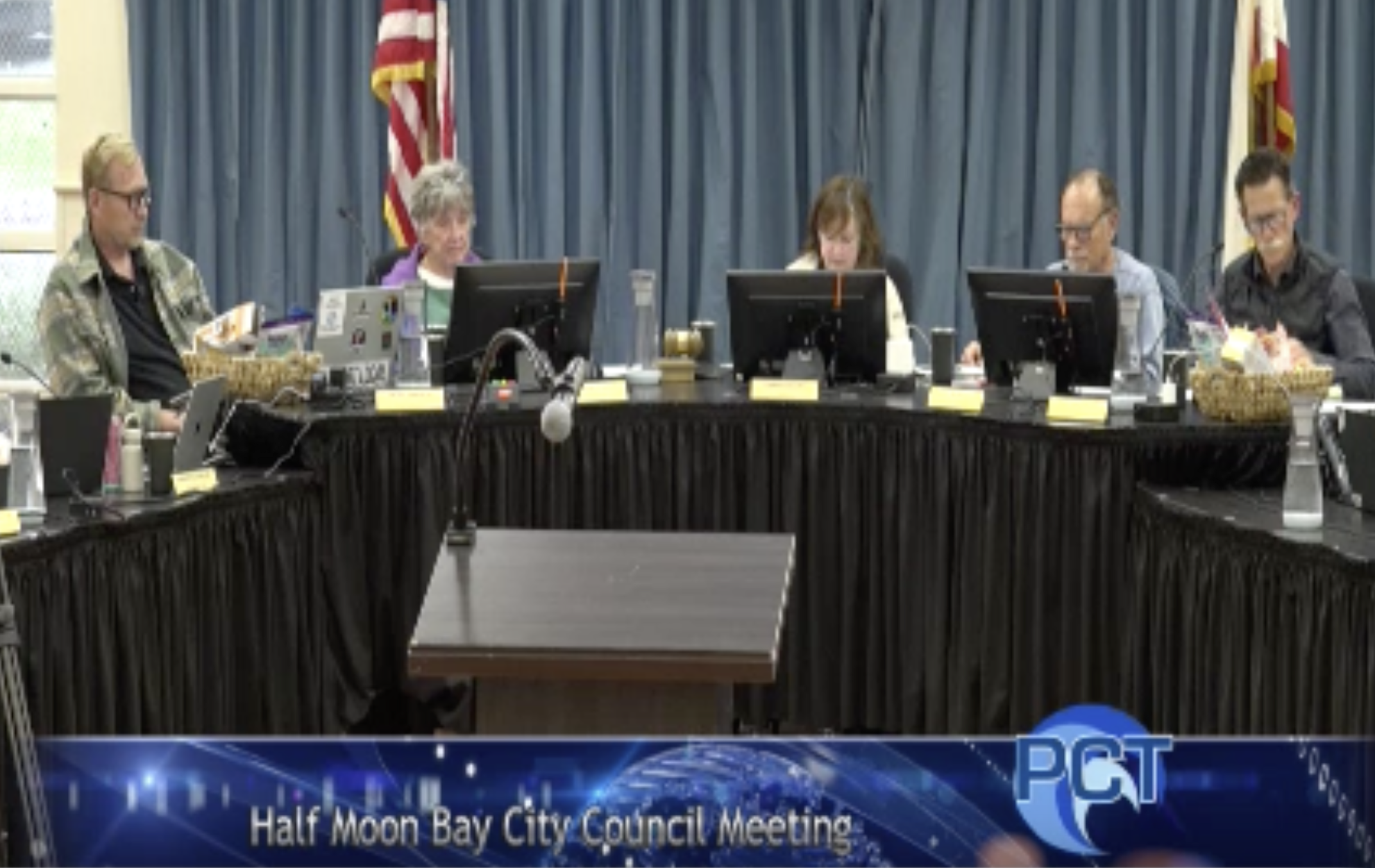
Half Moon Bay's City Council voted 3-2 to begin dismantling the coastal city's two-year-old rent stabilization and rental registration programs, then spent the rest of a nearly four-hour meeting debating what replaces them. The evening laid bare a philosophical divide: whether tenants are best protected by regulation or by direct services funded from a $2.1 million housing pot.
Rent stabilization and rental registry headed for repeal after a 3-2 first reading, with Councilmembers Brownstone and Penrose dissenting
Council directs staff to build emergency rental assistance and legal services programs using unallocated housing funds, with $100,000 proposed for Coastside Hope
Rental inspection program tabled as council members clash over whether voluntary inspections can reach the most vulnerable tenants
$25,000 LED screen purchase for World Cup watch parties delayed after all five council members request more due diligence
Two-year priorities workplan punted to subcommittee after members say the 60-item document mixes staff tasks with council goals
The End of Rent Controls
The basics: Half Moon Bay adopted its residential rent stabilization (Chapter 6.06) and rental registration (Chapter 6.04) programs in 2024 — regulatory tools designed to cap rent increases and give the city a picture of its rental housing stock. On April 21, at the direction the council gave at its March 17 meeting, Interim City Attorney Denise Bazzano brought back an ordinance to repeal both chapters outright.
Why it matters: The repeal eliminates Half Moon Bay's only regulatory tenant protections, shifting the city's entire approach from rules to services — a bet that direct spending on legal aid and rent checks will do more than caps and registries.
Where things stand: The item was introduced by title and passed on first reading. Councilmember Paul Nagengast made the motion, seconded by Mayor Debbie Ruddock. The repeal passed 3-2 (Yes: Jonsson, Nagengast, Ruddock; No: Brownstone, Penrose)
The other side: Vice Mayor Deborah Penrose delivered a sharp dissent:
"I'm saddened by tonight's action. It seems inevitable since the new council members have joined us. I'm sad that either council members here do not understand and despite being told over and over again how difficult things are for many people in our city and that they're willing to let go of the only protections that really mean anything to that community."
What's next: The ordinance requires a second reading before final adoption. If approved, it takes effect 30 days after that vote. The companion discussion on replacement tenant services — Item 11.A — immediately followed.
What Replaces Rent Controls: Rental Assistance, Legal Aid and an Inspection Fight
With the regulatory framework on its way out, the council spent roughly an hour wrestling with three service-based alternatives: emergency rental assistance, legal services, and a rental inspection program. Staff and council agreed on two of the three. The third — inspections — exposed the evening's deepest fault line.
Why it matters: The city's housing fund holds $2.1 million in unallocated dollars. How and how fast that money reaches tenants now determines the strength of Half Moon Bay's safety net.
Rental Assistance: $100,000 for Coastside Hope
Staff member Irma Acosta told the council that Half Moon Bay ran a $200,000 rental assistance program during COVID through Coastside Hope and St. Vincent DePaul, serving approximately 123 households combined. Councilmember Robert Brownstone moved quickly to propose directing $100,000 to Coastside Hope:
"We don't always have those moments where, well, we have twice as much. I really trust Coastside Hope. I'd like to give them $100,000."
Brownstone also underscored that rental distress in the community is not limited to one population.
"I hear from seniors [who are] on fixed income. The total income is Social Security and seniors. I keep reading articles that seniors are the largest growing group of homeless folks."
Legal Services: $40,000 Partnership With CLSEPA
Staff recommended continuing a legal services partnership with Community Legal Services in East Palo Alto (CLSEPA) through Coastside Hope, funding monthly tenant legal clinics at roughly $40,000 annually. Multiple public commenters backed the idea. Rocio Avila Garcia, speaking in Spanish with an English interpreter, told the council that access to rental assistance and legal support "isn't a luxury, it's a necessity" and that many families facing eviction lack legal representation while property owners have attorneys. Online commenter Cindy encouraged funding existing programs rather than "spinning up new programs that ultimately could detract from helping our community."
Council directed staff to move forward on both the rental assistance and legal services tracks.
The Inspection Standoff
The rental inspection program provoked the sharpest debate. Staff floated a voluntary inspection model, but Vice Mayor Deborah Penrose called the concept unworkable:
"I think the idea of a voluntary inspection is absurd. The problems come with the landlords who aren't doing the right thing. They're not going to volunteer to be inspected."
Penrose pressed further, tying the registry repeal directly to the inspection gap:
"How do you educate a landlord if you don't know who the landlord is? We've gotten rid of the rental registry, so we don't know who our landlords are."
She also challenged the idea that education programs could reach the most distressed renters:
"If you're living in a sublet where a whole family is living in one room, that family does not need education. That family needs help."
Councilmember Robert Brownstone recalled conditions discovered during the 2021 Half Moon Bay mushroom farm shootings:
"There were shocking substandard conditions. What I will say is a fact. Many people knew about those conditions."
City Manager Matthew Chidester suggested deeper community engagement before launching an inspection regime, proposing focus groups with landlords and tenants to gauge the scope of habitability problems. Mayor Debbie Ruddock proposed an anonymous tip line and education campaign, while cautioning against over-reliance on service providers to define the problem:
"One of the things you have to be careful of, service providers want service. They want more services and they want more services funded. So that's why it's important to get more community perspectives on the issue."
Councilmember Patric Bo Jonsson called for multilingual outreach, saying the city should utilize their new communications person.
Public commenter Judy Taylor urged the council to create a deliberative community process, recalling a task force under former Supervisor Rich Gordon that spent two years meeting biweekly to resolve contentious design review issues and achieved unanimous consensus. Commenter Nancy Fontana supported incentive-based approaches, sharing an anecdote about an Idaho program that improved rental properties in exchange for landlords freezing rent.
Decisions: Council directed staff to develop the rental assistance and legal services programs. The inspection program was tabled pending conversations with CSFA partner agencies to assess the scope of habitability issues.
Priorities Workplan Frustrates Council, Gets Sent to Subcommittee
City Manager Matthew Chidester presented a draft FY 2026-28 priorities workplan listing approximately 60 projects across six categories, color-coded by status. The document landed with a thud.
Why it matters: Without adopted priorities, staff cannot finalize the two-year budget or allocate resources to new initiatives — and the budget cycle is already underway.
Where things stand: Vice Mayor Deborah Penrose objected that the format failed to distinguish council priorities from routine staff operations:
"This is not 2026-28 city council priorities workplan. This is a demonstration of what's going on in city hall, what staff is doing."
She wanted to discuss five to 10 items and build consensus.
Councilmember Robert Brownstone noted the process was incomplete because the March 14 workshop never facilitated a final prioritization vote among members. Public commenter Harvey Rarback urged the council to elevate two long-term items that could take years but dramatically improve coastside services: formation of a water and sewer special district and a healthcare district, noting the impossibility of getting an urgent care facility without a dedicated funding source.
Decisions: Mayor Ruddock proposed — and the council agreed — to appoint Councilmembers Paul Nagengast and Brownstone as an ad hoc subcommittee to work with the city manager to separate ongoing staff work from true council priorities and bring back a reformatted document.
LED Screen for Carter Park Hits Pause
City Manager Matthew Chidester proposed purchasing eight portable LED poster boards for approximately $25,000 from the Parks and Recreation budget. The units are IP65-rated for weather, portable on wheels with flight cases, and configurable as a 16-foot-wide screen. The primary driver: the FIFA World Cup, with the first game — Mexico vs. South Africa — kicking off at noon on June 11, ruling out projection technology.
Additional planned uses include movie nights through a library licensing partnership, senior programming, corporate rentals, and community fundraisers.
The other side: Council members raised concerns about insurance liability, security at Carter Park (which lacks a security system), the park's incomplete Notice of Completion with stair lights still being fixed, parking logistics, and storage. Councilmember Paul Nagengast flagged the broader fiscal context:
"I concern when we use terms like unforeseen revenues. We're doing an organizational study where we're still in a structural deficit."
Councilmember Robert Brownstone noted the product is manufactured in China with a limited track record.
Decisions: All five council members requested more information. Staff will bring back additional details at a future meeting, targeting completion before the World Cup opener.
Minor Items
Hotel BID levy renewed unanimously (5-0, roll call) at $2 per room per night for FY 2026-27 after a public hearing with no protests filed. The BID funds tourism marketing managed by the Chamber of Commerce.
Consent calendar approved 5-0, including filing the Notice of Completion for the FY 2025-26 pavement management project, approval of March 2026 warrants, and letters opposing federal offshore oil and gas lease sales.
Cypress Point housing discovery: Scott Boulendorf of the Midcoast Community Council reported that the CEQA-exempt Cypress Point housing project, which broke ground in late December 2025, discovered asbestos requiring abatement and an underground tank with unknown contents under investigation. "There is a lesson to be taken in there somewhere," he said.
South Corridor Study postponed to a future meeting.
Public forum: Joaquin Jimenez, a candidate for San Mateo County Supervisor District 3, spoke about food insecurity, noting one in six county residents is on SNAP as the federal government cuts the program. Taylor Tong of Pacific Coast Television promoted Coastside Live, a free community event for local artists.
Planning Commission recently approved a Verizon cell tower and heard a presentation from the Coastside Land Trust; council plans to invite the Land Trust CEO to a future meeting.