
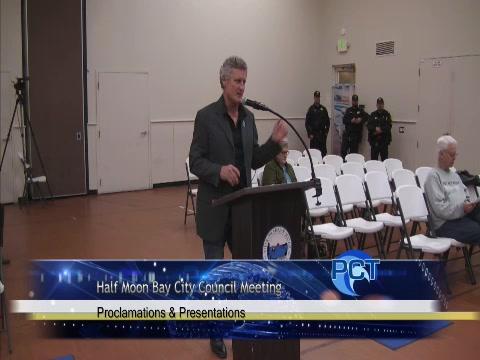
Half Moon Bay Replaces 35-Year-Old Safety Plan in Unanimous Vote
City Council • Half Moon BayNovember 18, 2026
Locunity is an independent informational service and is not an official government page for this commission. All information is sourced from public footage and an analysis of official agendas with the aid of responsible, fact-checked AI. to report an error or omission.
Half Moon Bay retired a Safety Element written in 1991 and adopted a 2026 rewrite that governs how the city plans for evacuation, wildfire, flooding and shoreline risk. Council's Nov. 17, 2026, meeting ended in four 5-0 roll calls, including a new immigration-interaction policy under SB 580 and a local emergency proclamation ahead of El Niño storms.
- 2026 Safety Element adopted 5-0, adding an erosion amendment and a five-year review cycle
- Residents pressed for ICE hotline posters and a public statement; council later adopted its SB 580 policy 5-0
- Local emergency proclaimed 5-0 for El Niño season, giving the city manager emergency contracting power
- E-bike ordinance introduced 5-0 with 15 mph and 10 mph trail limits
- Single audits accepted after staff acknowledged missed oversight of a $1.5M ARPA pass-through
Safety Element Gets First Rewrite Since 1991
Why it matters: The Safety Element is the General Plan chapter that sets the city's framework for hazards. The 2026 version gives future councils a list of actions to prioritize on evacuation, fire, flood and shoreline risk.
Where things stand: Consultant Aaron Pfannenstiel of Atlas Planning Solutions, part of the Placeworks team on the Peninsula Resilience Planning Project (PREP), walked council through changes made since a joint study session. New actions include ember-resistant retrofits, landscape guidance that balances fire risk against shade, a stream gauge on Pilarcitos Creek, debris and vegetation management, and annual coordination with the owners of Pilarcitos Dam.
Council members focused on evacuation planning, CAL FIRE's high-hazard designation of downtown, flooding and debris, and the sheer number of feasibility studies in the document.
Pfannenstiel said neighborhoods with only one way in or out need a different approach. "We need to probably call evacuations a lot sooner than we would normally do that," said Pfannenstiel, Consultant, Atlas Planning Solutions. He stressed that plans must be practiced because "evacuations are ultra-dependent on the situation."
Councilmember Robert Brownstone pointed to existing utility capacity: "If a power pole falls over, who better than PG&E who has that expertise to deal with it quickly?"
Studies, not mandates: The Planning Commission added feasibility studies on an undergrounding assessment district, risk along evacuation routes, eligibility for FEMA's Community Rating System and joining the Fire Risk Reduction Communities list. It also added a five-year review. Pfannenstiel said the items were framed as feasibility studies to avoid committing staff time and money. That framing keeps the council's options open, but it also means none of these items has funding yet.
The other side: Jimmy Benjamin, public commenter, argued the document conflicts with the Local Coastal Program on erosion. "The safety element needs to deal with erosion more effectively than it does now," said Benjamin. He also proposed evacuation alerts that can be targeted to specific addresses.
Staff said erosion is covered by other codes but agreed to amend Policy SEP 1.8. The policy now reads "prioritize development in stable geological areas, i.e., outside of landslide prone areas and areas subject to high rates of erosion."
Decisions and stakeholder impacts: Council adopted the resolution by roll call. For: 5 (Brownstone, Jonsson, Nagengast, Penrose, Ruddock). Against: 0. Absent: 0. The resolution includes a CEQA common-sense exemption and a late-added finding on the local hazard mitigation plan, a change driven by Cal OES. Residents in single-access neighborhoods and downtown are most directly affected by the evacuation and fire provisions. Shoreline property owners gain a sharper erosion standard for future development.
What's next: The five-year review sets the next formal checkpoint. The feasibility studies await future council prioritization.
Residents Demand Visible Stand on ICE Arrests
Why it matters: A coordinated group of speakers described fear in the community over immigration enforcement. Their comments framed the council's later vote on a state-mandated policy.
Where things stand: During Public Forum, Joanne Rakowski, a member of Coastside Faith in Action speaking for herself, cited county arrest data. "As of yesterday, there were 47 arrests so far in November," said Rakowski. She asked the city to post San Mateo County rapid-response hotline posters in all city offices and spaces, as an exception to the city's no-notices policy.
Joaquin Jimenez of Joaquin Murrieta Social Media criticized the council's silence. "Nothing has been said from you, not a statement, not on social media, not in our local newspaper," said Jimenez.
Ruby Salazar of the Youth Leadership Institute said "a lot of my young people that I work with on the coast side have uplifted their concerns about their family members being really scared about going to school." Marcela Contreras, speaking for Tres Amigos, asked for seminars on protecting employees and said the business would post the hotline information.
The other side: Nancy Fontana, public commenter, supported posting but warned that signs on public buildings raise First Amendment viewpoint-neutrality risks. "I hope you can do it, but be careful how you do it," said Fontana.
Council response: Council members were receptive. "I think it's worth considering, reconsidering policy about posting those posters on city properties," said Mayor Debbie Ruddock. Councilmember Patric Bo Jonsson backed promoting the posters downtown. Vice Mayor Deborah Penrose asked the city manager and city attorney to review sign policies, and the manager agreed to look at it for the next meeting.
The SB 580 policy: Later in the meeting, Julissa Acosta, interim economic and community vitality manager, and Irma Acosta, interim management analyst, presented a policy based on the Attorney General's model. Acosta said the city previously had no policy governing interactions with immigration authorities. The state deadline is Jan. 1, 2027.
Under the policy, public areas stay open. Staff will not consent to entry into non-public areas, or provide access to records, without a judicial warrant or court order reviewed by the city attorney. The policy also requires logging, training, notices and annual database audits, with the first audit due by March 31, 2027.
"Half Moon Bay is the first one across the finish line, so staff gets some kudos for that," said the City Attorney. "I think it's more useful than just some sort of performative designation," said Ruddock, who also urged a press release.
Decisions and stakeholder impacts: Council adopted the policy by roll call. For: 5 (Brownstone, Jonsson, Nagengast, Penrose, Ruddock). Against: 0. Absent: 0. The city manager may make administrative amendments, but the city attorney said those must stay within the model policy.
What's next: The sign-policy review is expected at the next meeting.
Emergency Declared as El Niño Storms Approach
Why it matters: The proclamation needed a four-fifths vote. It lets the city sole-source emergency contracts and positions the city for reimbursement eligibility as storms and king tides arrive.
Where things stand: City Manager Matthew Chidester cited state and county proclamations and listed local preparation. That work includes ditch clearing, pre-filled sandbags, upgrades to the Emergency Operations Center, satellite internet, interagency coordination and beach alert signage. "We may actually be able to, on an emergency basis, close the beaches," said Chidester.
The resolution authorizes negotiated emergency contracts under Public Contract Code 20168 and 22050 and names the city manager as authorized agent. It requires review every 60 days and does not change dollar thresholds. The CEQA exemption falls under Guidelines Section 15269.
Council members asked about volunteer KEEP emergency groups, contractors, Caltrans and FEMA recordkeeping. Ruddock raised price gouging. The mayor had also flagged a beach hazard statement earlier in the evening, with 13- to 17-foot waves.
The other side: Benjamin supported the proclamation but warned that emergency work should not bypass coastal permit processes or worsen erosion. He urged the city to "use that authority judiciously."
Decisions and stakeholder impacts: The proclamation passed by roll call. For: 5 (Brownstone, Jonsson, Nagengast, Penrose, Ruddock). Against: 0. Absent: 0. Contractors may see faster, non-competitive awards, and beachgoers could face closures.
What's next: Council must review the emergency every 60 days.
E-Bike Rules Set Trail Speed Limits
Where things stand: Matt Nichols, management analyst, Public Works, presented amendments to Chapter 10.30 of the municipal code. The changes define e-bikes as bicycles and update impoundment language. They set speed limits of 15 mph on trails paralleling Highway 1 and 10 mph on the Coastal Trail and Poplar tributary. Riders must also slow to 10 mph when passing pedestrians or near parking lots and beach access points, consistent with AB 2346.
Staff consulted State Parks, County Parks, Coastside Land Trust and the golf links. Nichols said other land managers indicated "if we were to pass a 10-mile-an-hour speed limit on the Coastal Trail, they would also do the same." A State Parks decision depends on filling a district supervisor vacancy.
Enforcement gap: Chidester said the Sheriff's Office will enforce only on city-controlled sections. The Sheriff's Office has ordered e-bikes with COPS grant funds for education-first patrols. "State parks does have its officers," noted Brownstone. Penrose proposed that the city use COPS grant money to buy bike bells for deputies to hand out.
The other side: Benjamin raised concerns about e-bikes turning at dusk on Kehoe Avenue and about sensitive habitat along access routes. "I'm really concerned about the impact that they will have on those habitats," said Benjamin. Ruddock shared the nighttime crossing concern. The city attorney said that issue falls outside this ordinance.
Decisions and stakeholder impacts: Council introduced the ordinance by roll call. For: 5 (Brownstone, Jonsson, Nagengast, Penrose, Ruddock). Against: 0. Absent: 0. Pedestrians gain slower shared trails. Riders face a patchwork of rules until other land managers act.
What's next: The ordinance returns for adoption at a future meeting.
Audits Flag ARPA Oversight Lapses
Where things stand: Federal rules require a single audit when an entity spends more than $750,000 in federal funds. The city passed a $1.5M county ARPA grant for 555 Kelly through to Mercy Housing, then failed to obtain Mercy's 2023-24 single audit in time. The city also classified nonprofits at the Opportunity Center as vendors, but auditors deemed them subrecipients, which carries monitoring duties. The artifact notes no misspending was found.
Ken Stiles, finance manager and interim admin services director, said "a part of the audit process was to develop something called a corrective action plan," and that new procedures are in place. Councilmember Paul Nagengast asked for a standard operating procedure in case staff changes. Ruddock's verdict: "So staff bad, but Mercy bad."
"I do think it's really, really important that the proper audits be done, especially with the proliferation of nonprofits," said Fontana.
Decisions and stakeholder impacts: Council accepted both audits unanimously by voice vote. Nonprofit partners receiving pass-through funds should expect closer monitoring.
Minor Items
- Q1 finances: Transient occupancy tax (TOT) hit about $3M, including roughly $2M in one-time delinquent collections. Staff expect reserves to stay fully funded at $12.5M despite a projected $1.7M deficit. The report and roughly $26M in capital project carryforwards were approved unanimously.
- AI policy: Council received the revised policy. Public commenter Evelyn urged that "prompts are data" and asked for risk-based approvals and coverage of council use.
- Flock cameras: The license-plate reader contract expired on the 28th, units are decommissioned and the last data expires Nov. 27.
- AI bots and minutes: The city attorney said SB 1159 will define a "person" under the Brown Act as a human starting Jan. 1, 2027. Ruddock suggested a future agenda item on aliases in public comment.
- Housing fines: Rocío Ávila, a member of the Affordable Housing Committee, asked who would pay possible state fines after the 555 Kelly vote and requested concrete short-term solutions.
Looking Ahead
The Planning Commission recommended the updated ADU ordinance for first reading on Dec. 1. The Bicycle Pedestrian Advisory Committee reviewed the scope of a $220,000 bicycle master plan update, funded by a $200,000 grant and a $20,000 city match, and recommended Alternative A for Highway 1 between Highway 92 and Miramontes Point Road.