
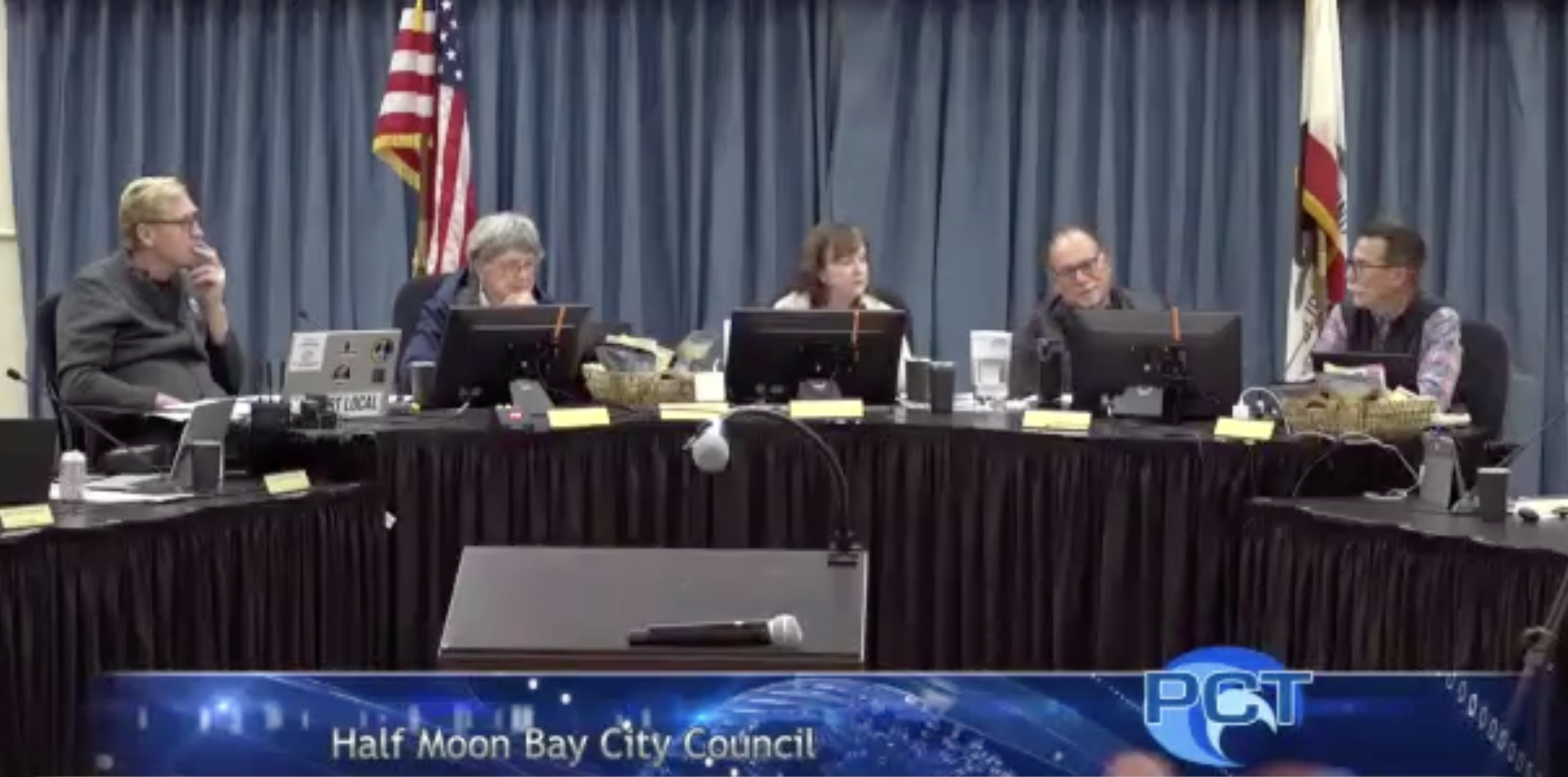
City Council - Mar 04, 2026 - Meeting

City Council - Mar 04, 2026 - Meeting

City CouncilHalf Moon BayMarch 4, 2026

Sources:

Locunity is a independent informational service and is not an official government page for this commission.We use AI-assisted analysis and human editorial review to publish information.

Reserves Restored, Nonprofits Refunded as Half Moon Bay Charts Fiscal Recovery

Half Moon Bay's City Council marked a financial turning point March 4, unanimously replenishing the city's reserves to 50% of operating expenses after hotel tax revenue beat projections — then pivoted to restoring safety-net nonprofit funding, debating an encampment enforcement ordinance, and hearing impassioned pleas from residents to preserve rent stabilization ahead of a March 17 showdown.

  • Council adopts budget amendment restoring $12.1 million in reserves as projected deficit shrinks from $4.5 million to $1.8 million

  • $63,000 directed to restore full funding to seven partially cut safety-net nonprofits serving dental, mental health, youth, and homelessness needs

  • Residents deliver passionate defense of rent stabilization ahead of March 17 policy decision, warning of working-class displacement

  • Council signals support for encampment enforcement ordinance modeled on county's Hopeful Horizons framework, with environmental and private-property amendments

  • Flock license plate reader system faces scrutiny after resident cites Mountain View cancellation, AG lawsuit, and class-action suit

  • SB 707 forces meeting overhaul by July 1 — mandatory Zoom access, Spanish agenda translation, and chamber technology upgrades


Deficit Shrinks, Reserves Rebuilt to 50%

Why it matters: For the first time since the pandemic gutted Half Moon Bay's tourism-dependent budget, the city's economic reserves are fully funded — a $12.1 million cushion that more than triples the standard 16% best-practice benchmark, reflecting the city's unusual vulnerability to volatile hotel tax revenue.

Where things stand: Finance staff presented a mid-year revenue picture that exceeded expectations. Transient Occupancy Tax (TOT), or hotel tax, is now projected to end the year at $9.9 million — $1.2 million above the budgeted $8.6 million — with month-over-month gains reversing a multi-year slide. Measure R sales tax revenue is tracking projections.

"We forecast TOT out on a monthly basis for the months that we have ahead of us that we don't know yet. We take what we did last year for the exact same month — using that methodology, our estimate for this year, we think we're going to end the year around 9.9 million," said Ken, finance staff.

Property tax numbers are complicated by the vehicle license fee dispute between San Mateo County cities and the state, with a timing difference inflating current-year figures by roughly $600,000. On the expenditure side, departments are trending below 50% spent at midyear, primarily due to salary savings, and no expenditure increases were requested.

City Manager Matthew Chidester cautioned against treating the remaining $1.6 million in unassigned fund balance as spending money.

"Often this is the time of year where you look at that unassigned fund balance and you think about what else could we be spending some of those funds on some one time projects? I'd be cautious about thinking about spending much of that because that may help us in the next fiscal year continue to keep our budget balanced as we hone in on our on our revenues and expenditures and try to get back to a structurally balanced budget and not have to touch reserves again," he said.

Chidester emphasized the reserve level is deliberate: "Best practice for general fund reserves is 16%. That is what the best practice says a city should have. As a smaller city, we're a little more volatile."

Councilmember Robert Brownstone provided historical context on how far the city has come:

"Back in 2021, we had what, a 5 to 6 million dollar loss of revenue, mostly from hotel tax and a few other things. That's money that just disappears. It just doesn't sort of come back."

Decisions: The council adopted the budget amendment resolution on a 5-0 roll call vote (Yes: Brownstone, Jonsson, Nagengast, Penrose, Ruddock). The five-year forecast projects a $1.8 million deficit for FY 2026-27, down from $4.5 million projected in June 2024. Priority setting is scheduled for March 14.


Council Restores $63K to Safety-Net Nonprofits

The basics: Half Moon Bay's Community Services Financial Assistance Program funds nine nonprofits in a cohort model covering childcare, dental care, mental health, homelessness services, and more. The program grew from $100,000 to $300,000 over the years but was cut to less than $250,000 in the current fiscal year due to budget constraints. Two agencies — Abundant Grace and Coastside Hope — received their full requests, while the remaining seven received only 40–50% of prior funding levels.

Why it matters: The cut left gaps in frontline services at a moment when federal funding instability and SNAP benefits pauses are squeezing the same populations these nonprofits serve.

Where things stand: Community Services Analyst Julissa Acosta presented the mid-year update, highlighting successes including increased collaboration among the nonprofits and Coast Pride securing $1.7 million in state funding for the Alcove youth mental health program. The program also coordinated emergency response during the 2023 shooting and floods.

Spandan Chakrabarti, Director of Development for Sonrisas Dental Health, told council that dental disease is the leading cause of school absences and work absences among underserved communities, citing 784,000 California school days lost annually to dental pain and asking for full funding restoration.

Rocio, a public commenter speaking through an interpreter, shared a family member's difficulty accessing Coastside Hope rental assistance, noting the requirement to have an eviction notice before receiving help, and asked for more compassionate eligibility criteria.

Councilmember Patric Bo Jonsson advocated for restoring funding as finances allow. Vice Mayor Deborah Penrose went further:

"I said I would double the amount. I think we are making cuts that are egregious, and we're cutting funding and considering cutting funding to the people that [need it most]."

The mayor's county play: Mayor Debbie Ruddock raised a structural question — whether the city should advocate with San Mateo County for adequate mental health service funding from property taxes before supplementing with local dollars. She noted 6–7% of local property taxes go to county mental health programs.

"Our taxpayers shouldn't have to pay twice for mental health services. They should get what they need, but the right agency should be paying for it and we should know what they need," she said.

Decisions: Council reached consensus on three directions: restore $63,000 immediately to bring all seven partially funded nonprofits to prior levels, continue the nine-agency two-year cohort model, and investigate county mental health spending to ensure adequate return of local tax dollars. A formal resolution returns March 17 on the consent calendar.


Residents Draw Line on Rent Stabilization

Why it matters: With rents averaging over $4,000 — double the national average — and a formal policy decision expected March 17, the rent stabilization debate is shaping up as the most contentious issue of the council term. Three residents used the public forum to deliver a coordinated, emotional appeal to preserve protections.

Where things stand: Willa Chapman, a 35-year resident, argued the city either values its working class or it doesn't. She dismissed landlord threats to leave as hollow and issued a stark warning about one of the policy alternatives:

"The decision to hand over the issue of renters to nonprofits, I believe not only shirks your responsibility, but in so doing will expose many of our renters to incredible personal dangers. Deportation, detainment, arrest, separation from family."

Chapman cited FBI raids on nonprofit records under the current administration as the basis for her concern. She also urged the council to investigate whether algorithmic rent-setting tools are inflating local rents, referencing San Francisco's 2024 ordinance (Section 3710C) outlawing such devices.

Joaquin, resident, told council that rent control is the closest the community can get to keeping people in Half Moon Bay and challenged members to reflect on whether they serve the community or special interests.

Rocio, speaking through a Spanish interpreter, noted average rents exceed $4,000 and pleaded with council to reject "option number three" — the elimination of protections — saying it would force essential workers, teachers, and seniors out of the city.

What's next: City Manager Matthew Chidester confirmed the rent stabilization item returns at the March 17 meeting.


Council Weighs Encampment Enforcement Ordinance

The basics: The county's Hopeful Horizons ordinance provides a framework for cities to address encampments on public property. It requires shelter availability before enforcement, uses a 72-hour notice escalation process, and allows criminal citation only if individuals refuse services. Redwood City adopted the ordinance and has not had to cite anyone because engagement succeeds before the enforcement stage.

Why it matters: Half Moon Bay currently lacks any codified enforcement tool for encampments. The ordinance would be the city's first, potentially reducing costly creek cleanups — the city conducted approximately eight encampment cleanups and removed RVs from three locations in 2025, collecting over 10,000 pounds of trash — while requiring shelter availability as a precondition.

Where things stand: Community Services Analyst Julissa Acosta reported that Coast House shelter currently houses 54 adults and 10 children with recommended 120-day stays extendable if housing or employment is pending. City Manager Matthew Chidester provided historical context:

"In 2017, when I arrived to the city, we had a massive encampment issue behind Safeway — 80 people at one point living back there. And we spent 18 months doing all the work to work with the individuals back there."

He noted the situation has dramatically improved, though remaining individuals tend to have more significant challenges.

Councilmember Patric Bo Jonsson described extensive personal observations of encampments near Safeway and Pilarcitos Creek:

"I've seen a lot of needles, I've seen a lot of things of drug paraphernalia in there. I've seen weapons in there. I've seen they're chopping trees down. They're just ruining that whole area."

Mayor Debbie Ruddock advocated for the ordinance with amendments addressing environmentally sensitive habitat areas and waterway protections under the Local Coastal Program.

"The encampments in these areas are violating the law, many laws. And that's something people in the community can't do. And we shouldn't allow it to happen for certain specified populations. Otherwise, why have any rules at all," she said.

Councilmember Robert Brownstone framed the ordinance as enabling institutional credibility:

"The more you have a really solid standardized process, the more you can get grants and people are willing to invest, because then you have metrics to show this works this way."

Sid Young, a MWSD director speaking as an individual, drew on volunteer experience at Glide Memorial and homeless count work. He noted homelessness spans Seattle to San Diego and supported including private-property provisions like Millbrae's post-Grants Pass ordinance. He observed that displacing encampments from one creek location causes migration to another.

Vice Mayor Deborah Penrose advocated for a safe parking program and fencing along Purissima Creek. Chidester reported that fencing permits from Safeway to the footbridge near Burger King were recently approved and will go to bid in coming months. Community engagement yielded over 100 responses prioritizing housing affordability, better outreach training, access to mid- and long-term housing options, and exploration of safe parking.

The Denise Bazzano, interim city attorney noted that Millbrae's ordinance addresses private property, a provision the current county framework does not include.

What's next: No formal action was taken. Discussion will continue at the March 14 priority-setting session.


Flock Surveillance System Under Growing Pressure

A public commenter, Paul , presented updated research on Flock license plate reader systems, reporting that Mountain View's city council voted to terminate its Flock contract on Feb. 24 after discovering 250 unapproved agencies made over 600,000 searches of its database. Santa Clara County also stopped using its Flock systems, affecting Cupertino and Los Altos Hills. The California Attorney General filed suit against El Cajon for violating state law prohibiting sharing of ALPR data with out-of-state agencies, and law firm Gibbs Mara filed a class-action suit against Flock for illegal data collection and sharing. Paul urged the council to agendize a formal review with city attorneys.

Sid Young offered a counterpoint, suggesting the council wait for local effectiveness data before making a judgment.


New State Law Forces Meeting Overhaul

Interim City Attorney Denise Bazzano and City Clerk Maggie Rodriguez presented the implications of SB 707, which modernizes the Brown Act. Effective July 1, the law requires mandatory two-way audiovisual or telephonic public participation for all council meetings, real-time captioning, agenda translation into Spanish, an accessible meeting webpage, and outreach to groups that don't traditionally participate. For officials' remote participation, just-cause circumstances limit usage to five meetings per year for bodies meeting twice monthly. Staff is evaluating technology upgrades for the multi-use chamber and developing outreach strategies leveraging nonprofits, the school district, and social media. The law sunsets Jan. 1, 2030.

Sid Young asked whether, as a public official on MWSD, she must announce her capacity every time she speaks at public comment or just once per meeting — a question that will apply to many local officeholders under the new rules.


Minor Items

  • Consent calendar approved unanimously (items 8A–8F minus 8D); item 8D (Stone Pine Cove grant transfer) was pulled by staff for additional information.

  • Marjorie Ruiz of PG&E Government Affairs reminded council of a reliability update commitment from January and offered ongoing engagement, especially for areas south of town.

  • Ann Maury asked council to endorse a second swimming pool at the new high school aquatic complex; the school district has committed $13–14 million for one pool, and County Supervisor Ray Mueller reportedly said he would help fund a second if council endorsed the concept.

  • A representative from Visit California invited the community to a grand opening in their new space on April 2.

  • Recreation Commission explored school facility partnerships at a recent meeting; the Bicycle Pedestrian Advisory Committee has an e-bike discussion scheduled for Thursday.

Reserves Restored, Nonprofits Refunded as Half Moon Bay Charts Fiscal Recovery | City Council | Locunity