
City Council - Mar 16, 2026 - Meeting

City Council - Mar 16, 2026 - Meeting

City CouncilHalf Moon BayMarch 16, 2026

Sources:

Locunity is a independent informational service and is not an official government page for this commission.We use AI-assisted analysis and human editorial review to publish information.

Council Sets Ten Priorities as Record Turnout Demands Flood Fixes and Downtown Protections

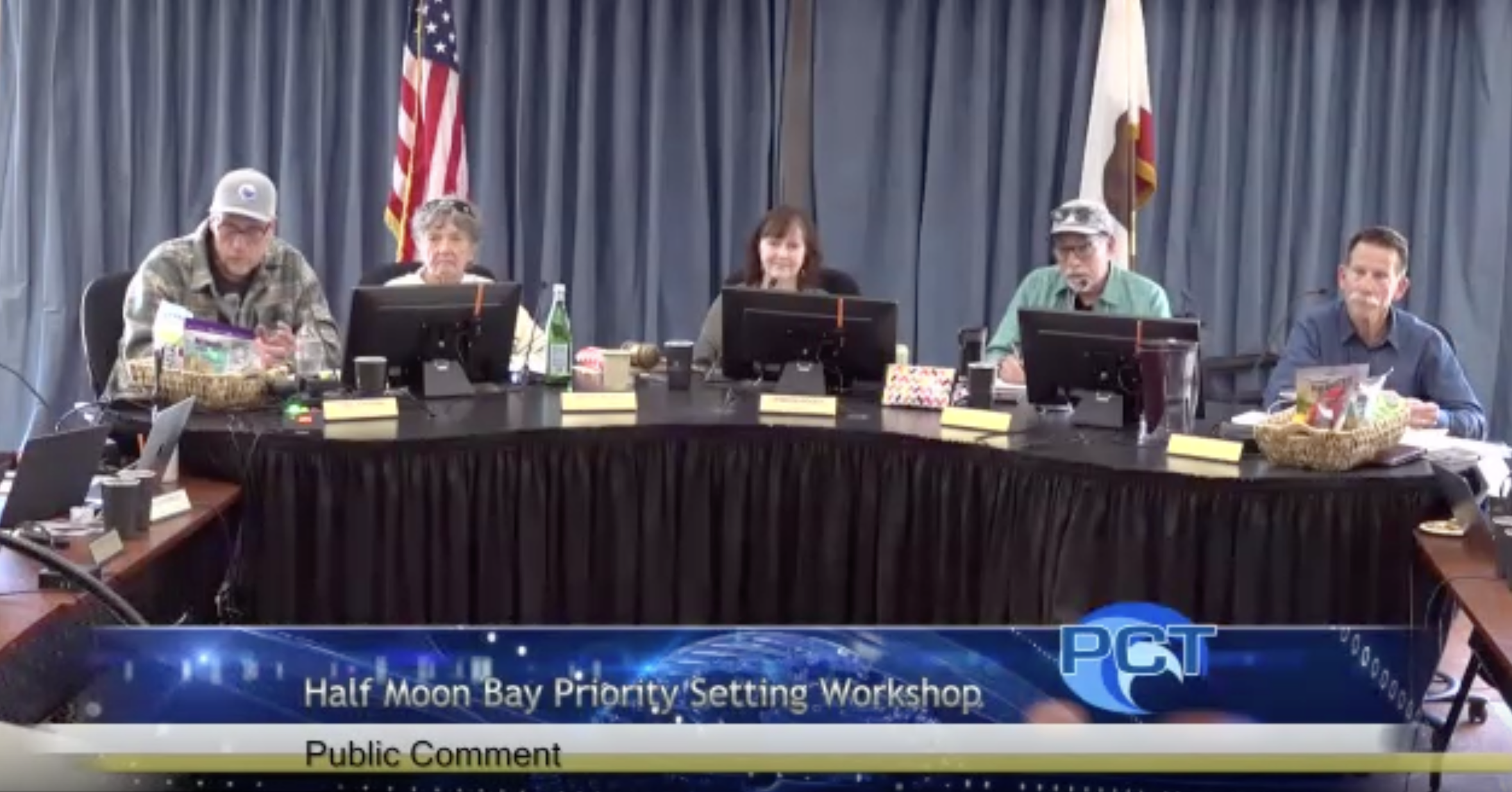
Half Moon Bay's City Council held its largest-ever priority-setting workshop Saturday, March 16, drawing roughly 20 public speakers who delivered urgent testimony on flooding, wildfire preparedness, a community pool, and protecting Main Street from chain stores — all while staff warned that a $1.8 million structural deficit and 30% workforce vacancy rate will force hard trade-offs in the coming budget year.

  • Council reaches consensus on ten new FY 2026-27 priorities including sewer-water consolidation, a citywide stormwater master plan, emergency evacuation planning, and a formula business ordinance

  • Pullman Ditch residents describe active flooding emergency — nine events in five years, a ditch that's doubled in depth, and water inside homes — pushing council to fund both targeted fixes and a $250,000 master plan

  • Mayor threatens litigation against county if evacuation planning doesn't advance this year, as Cal Fire maps redesignate much of east Half Moon Bay as very high fire hazard

  • Downtown merchants rally against chain stores, warning that formula retailers would inflate rents and hollow out Main Street's identity

  • All five council members back exploring a unified coast-side water and sewer authority, citing a recent court ruling and drought risks

  • Families and swim advocates win a council letter of support for community pool access — explicitly without financial commitment — ahead of the high school pool rebuild

  • Staff reports 40% turnover in two years and 70-plus active special projects, framing every new priority as a direct trade-off against existing work


Flooding Emergency Pushes Council Toward Dual Stormwater Strategy

Why it matters: Residents along the Pullman Ditch and Kehoe watercourse are experiencing accelerating erosion and repeated flooding that FEMA maps — last updated in the 1980s — do not reflect, leaving properties unprotected and homeowners without clear paths to relief.

Where things stand: A procession of affected homeowners delivered some of the workshop's most urgent testimony. Brent Simmons, a public commenter, described the Pullman Ditch deepening from three feet to six feet in just six years, with a neighbor finding six inches of water inside their house. John Rossi, a public commenter, reported nine flooding events in five years and said a bypass design is the best near-term option, with a property owner at 2800 willing to cooperate and community members willing to contribute financially.

Joe Farrell, a public commenter, traced the problem to a 2008 city council decision that redirected 648,000 gallons per day into Pullman Ditch despite engineering warnings. Jimmy Benjamin, a public commenter on the Kehoe watercourse, told the council that honoring the California Coastal Act on hydrology is "not discretionary" and that last year's priority designation had produced "no meaningful planning activity."

The other side: Councilmember Paul Nagengast pushed back against a broad master plan.

"I worry about a big master plan, the cost, and then it takes time. And there is some urgency, I think, on us right now," he said, recommending focused retention-basin approaches on the Pullman and Kehoe watersheds first.

Vice Mayor Deborah Penrose argued a comprehensive plan is ultimately necessary to support water recycling goals.

Decisions: Council reached consensus on a dual approach: near-term, focused projects on the Pullman and Kehoe watercourses, plus initiating a broader citywide stormwater master plan with an RFQ seeking consultants versed in green infrastructure practices. The interim city engineer estimated $250,000 for the initial master plan scope.

What's next: Staff will incorporate the stormwater work into the draft FY 2026-27 work plan and issue an RFQ for consultant services.


Mayor Threatens County Litigation Over Stalled Evacuation Planning

Why it matters: New Cal Fire maps designate a substantial portion of Half Moon Bay east of Main Street — including areas near Amesport Landing — as very high fire hazard, yet the city has made no meaningful progress on evacuation planning since discussions began in 2015.

Where things stand: Kerry Burke, a public commenter and Community Emergency Response Team (CERT) leader at Amesport Landing, reported that insurance premiums for her development have increased nearly three- to fourfold. Her HOA is proactively converting siding, screening vents, and removing vegetation, but she called for city coordination on new state Zone 0 regulations.

Mayor Debbie Ruddock did not mince words:

"If the other agencies of the county is not going to step up and step up like this year, then I think we should consider litigation."

She cited increasing risks from wildfire, earthquake, erosion, and potentially mass civil unrest.

Councilmember Robert Brownstone proposed a different approach, suggesting the city leverage its large CERT community to help neighbors fireproof homes cooperatively.

"I'd like to see that effort not so much focused on compliance issues and people getting cited, but where the community comes together and helps each other," he said.

Decisions: Council reached consensus to elevate emergency preparedness and evacuation planning as top priorities.


Downtown Merchants Push to Ban Chain Stores Before Rents Spike

Why it matters: Half Moon Bay's locally owned Main Street businesses generate critical transient occupancy tax and sales tax revenue; advocates warned that without a formula business ordinance, corporate chains could outbid independent shops and ultimately leave behind vacant storefronts.

Where things stand: Amber Stowe, a public commenter, argued that Half Moon Bay's unique local businesses are the reason visitors choose it over other downtowns and that chains would drive rents sky-high. Colleen Henney, representing the Half Moon Bay Downtown Association, cited San Luis Obispo as a cautionary tale:

"My business would not survive those rent levels," she said.

Rick Hernandez, a Planning Commissioner, noted that the Streetscape Master Plan approved in July 2024 was "the single most requested item from the written comments of your listening sessions" and urged rapid implementation.

Decisions: The formula business ordinance received broad support from council members during deliberation and was affirmed as a priority. Council also approved pursuing a downtown information kiosk (estimated at $10,000–$50,000), elevated a consolidated downtown parking study, and reaffirmed support for wayfinding signage and the banner program.


Council Unanimously Backs Exploring Coast-Side Water-Sewer Consolidation

The basics: Half Moon Bay's sewer system is currently managed through a joint powers authority with three separate agencies — an arrangement multiple council members described as dysfunctional and outdated, particularly given growing pressure to develop water recycling capacity.

Why it matters: A recent court ruling interpreted the sewer system as a single system, providing legal momentum. Meanwhile, drought risks from a potential super El Niño period make recycled water infrastructure increasingly urgent.

Where things stand: Chad, a public commenter, urged the council to leverage a recent settlement with other sanitary district parties to pursue a combined authority. Vice Mayor Deborah Penrose put it bluntly:

"It's absurd to have a sewer system which is separated from a water system when what we really need to be doing is collecting our water that has been recycled by our sewer agency and using that recycled water."

Mayor Debbie Ruddock called the current Joint Powers Authority (JPA) "an anachronism" and "a relic." Staff noted this is primarily an advocacy and partnership effort initially — meetings with legislators, county supervisors, and partner agencies — rather than a heavy staff lift.

Decisions: All five council members gave consensus to make consolidation a top priority.


Families Win Pool Endorsement — Without a Dollar Attached

Why it matters: The Half Moon Bay High School pool is being rebuilt, creating a narrow window for the city to negotiate community access through an MOU with the Cabrillo Unified School District.

Where things stand: A half-dozen speakers — parents, swim advocates, and the Parks and Recreation Commission Chair Hilary Stamper — urged action. Anjuli Gupta, a public commenter and mother, framed it as a safety imperative, noting drowning is the leading cause of death for children under four and that swim lessons reduce risk by 88%. Another public commenter, noted the high school pool water is too cold for young children.

Decisions: Council agreed to issue a letter of support endorsing community pool access. Both Mayor Debbie Ruddock and Vice Mayor Deborah Penrose explicitly clarified the letter carries no financial commitment. Councilmember Robert Brownstone supported the approach:

"We could have a sentiment. This is not an endorser of any financial commitments whatsoever."


$1.8M Deficit and 30% Vacancy Frame Every Priority Decision

The basics: The city adopted a budget in June projecting 36% reserves; revised figures now show reserves at 50% — about $12 million — hitting the policy target for the first time. But the first draft of FY 2026-27 projects a $1.8 million deficit.

Why it matters: Conservative revenue assumptions exclude $700,000 in disputed vehicle license fees that San Mateo County cities are contesting with the state, and also account for losing golf fees when an agreement expires in September. Combined with 40% staff turnover in two years and roughly 30% current vacancies, the deficit constrains every new initiative.

City Manager Matthew Chidester framed the challenge directly:

"We've had 40% of our staff turnover in the last two years. The five years prior to that we had almost no turnover."

He noted staff are stretched across more than 70 special projects beyond routine operations, with Public Works operating on just five field staff.

Mayor Debbie Ruddock described the broader economic outlook as "precarious" given tariffs, geopolitical instability, and potential recession, urging continued conservative budgeting. Councilmember Robert Brownstone offered a counterpoint of progress, celebrating that "in only a year and a half, we've cut our budget deficit by almost 60%."

What's next: An organizational study underway may reshape staffing structure. Staff will develop a draft work plan quickly to inform the upcoming budget process.


E-Bike Safety Gains Momentum After Fatal Collisions

Why it matters: An e-bike collision in Burlingame killed a pedestrian, and the victim's family retained Cotchett, Pitre & McCarthy to sue — signaling a litigation wave that could hit coastal cities without enforcement frameworks.

Vice Mayor Deborah Penrose called for DMV-style registration and licensing, saying education alone is insufficient:

"Unless we register and require a license for e-bikes and e-scooters, any kind of electric vehicle that can run on our streets, until we get them to the DMV and get them licensed, we're not going to solve the problem."

Mayor Debbie Ruddock noted the Burlingame firm has pledged to "continue to litigate this way until the state and local governments start dealing with e-bikes." Councilmember Paul Nagengast acknowledged the county had difficulty with its ordinance but supported bringing something forward. The item received strong council consensus.


Vice Mayor Champions Mixed-Income 'Social Housing' Model

Vice Mayor Deborah Penrose argued for examining affordable housing "in a venue which includes low income, middle income housing together so that we're not just exclusively working on low income." She cited creative models from other parts of the country that build mixed-income communities to reduce income segregation.

Mayor Debbie Ruddock agreed, using the term "social housing" where market-rate units help subsidize low-income units. Staff pointed to the Creekside development north of the community center as a local precedent for mixed-income projects. Two senior residents — Miguel and Belinda — highlighted a painful gap: longtime local seniors struggle to get into affordable housing while outside applicants are admitted, underscoring the need for local preference policies.

Council reached consensus to include integrated affordable housing as a priority approach going forward.


Rent Stabilization Reaffirmed as Ongoing Priority

Eric DeBode, a public commenter, urged support for the rental registry and rent stabilization, calling data collection and renter education critical. Ruiz Acosta, speaking through a translator, described how hotel, housecleaning, and restaurant workers face rising rents but are passed over for housing. Councilmember Robert Brownstone made it a top priority:

"There's a lot of folks in our community who are constantly faced with tough decisions about being able to afford rent, afford to pay for food and avoiding homelessness."

The program was reaffirmed as a continuing priority.


Coastal Access Routes: Branding for Grant Dollars

Mayor Debbie Ruddock proposed bundling coastal trail improvements, access roads along Kelly Avenue, Poplar Beach, Redondo Beach Road, and Miramontes Point Road, and potential trail extensions into a single branded Coastal Access Routes Improvement Program. Drawing on her experience at the state Coastal Conservancy, she explained that "people like to give money to programs" — and that branding makes projects more competitive for Prop 4, Coastal Conservancy grants, and other state funding. The initial lift involves cataloging existing capital improvement projects under the umbrella rather than creating new ones. Council reached consensus.


Minor Items

  • Council Rules of Decorum: The interim city attorney and Chidester reminded the public and council to respect time limits and avoid applause or booing, citing deteriorating meeting conduct ahead of two contentious sessions in the coming week.

  • Internet redundant loop: Council gave consensus to advocate for a second internet connection point for the coast to prevent future outages.

  • Healthcare district monitoring: Council agreed to continue monitoring developments at the local healthcare district.

  • ADU fast-tracking: Removed from the new priority list as it is already underway in the implementation plan update.

  • Sign maintenance and CLT parking signage: Folded into existing work streams; staff directed to pursue.

  • Record public turnout: Chidester noted this was the highest public participation for a priority-setting session in city history: "I think we had more people at this priority setting session from the public than we've ever had before, which is promising."

Council Sets Ten Priorities as Record Turnout Demands Flood Fixes and Downtown Protections | City Council | Locunity