
City Council - Apr 07, 2026 - Meeting

City Council - Apr 07, 2026 - Meeting

City CouncilHalf Moon BayApril 7, 2026

Sources:

Locunity is a independent informational service and is not an official government page for this commission.We use AI-assisted analysis and human editorial review to publish information.

Council Approves $770K Coastal Zoning Overhaul, Defers EV Purchase Over Budget Fears

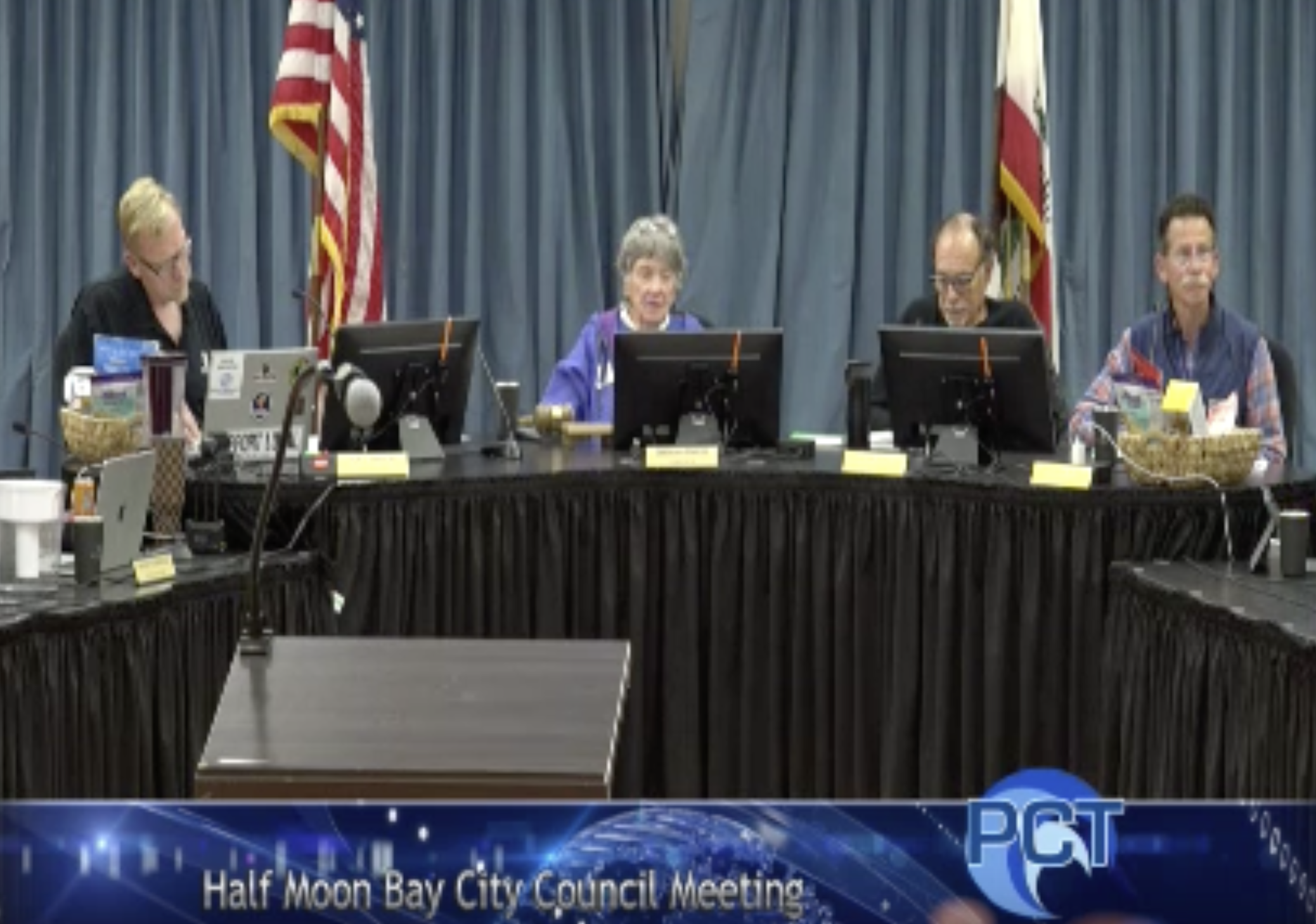
Half Moon Bay's City Council unanimously green-lit a sweeping rewrite of the city's coastal zoning code, accepted a tourism report showing rising hotel occupancy, and gave National Night Out its biggest policy endorsement in a decade — but pumped the brakes on a $41,697 electric vehicle purchase, signaling that even pre-budgeted spending faces scrutiny during a deficit year. Vice Mayor Deborah Penrose presided with Mayor Debbie Ruddock absent.

  • $769,946 contract awarded to overhaul the city's Local Coastal Program zoning code, funded mostly by a $500K Coastal Commission grant, with a December 2027 deadline

  • Hotel tourism marketing report shows coastside occupancy up 4% and international influencers flocking to the new California Welcome Center; public hearing set for April 21 on continuing the $2/room/night assessment

  • $41,697 Hyundai Ioniq 5 purchase deferred to next fiscal year as Council cites deficit, pending contract negotiations, and personnel study

  • National Night Out block parties get green light — including Moonridge — with $150 gift cards, no spending caps, and a new neighborhood contest

  • Downtown gallery owner flags representation gap after the Downtown Association ends monthly merchant meetings, leaving non-Heritage District businesses without a forum

  • City pursues $950K in trail and bike-ped grants, including a $750K coastal trail overlay and a $200K bike-ped master plan update


Coastal Zoning Code Gets Its Biggest Rewrite in Years

Why it matters: Half Moon Bay is one of a handful of California cities located entirely within the coastal zone. The Local Coastal Program implementation plan — the rulebook governing permits, development, and land use — is getting a complete overhaul that will touch nearly every property owner and builder in town.

Where things stand: Council voted 4-0 to award Miller Planning Associates a contract not to exceed $769,946, including a 10% contingency, to rewrite the implementation plan and related sections of the municipal code. Community Development Director Leslie Lako told Council the project is backed by a $500,000 Coastal Commission grant awarded in July 2025, with the city contributing roughly $269,000 — including $200,000 previously set aside by Council and $161,000 in staff labor match. The RFP drew only two proposals; Miller Planning Associates was selected for its deep coastal zone experience and its partnership with M Group, which already works with the city.

Consultant Martha Miller of Miller Planning Associates joined via Zoom to field questions about artificial intelligence. Councilmember Paul Nagengast asked whether AI would play a role in the rewrite. Both Lako and Miller explained AI is useful for summarizing surveys and meeting notes but cannot write the nuanced, community-specific zoning language the project requires.

Councilmember Robert Brownstone praised the bespoke nature of the work.

"I just can't imagine a more customized kind of document than a local coastal plan. And the Coastal Commission goes over with a fine tooth comb," he said.

A public commenter, Evelyn D'Souza, asked whether AI could model future coastal conditions — a question staff acknowledged but did not elaborate on. Lako noted that faster, more targeted rezonings required by the state's Housing and Community Development department under Housing Element Program 1:1 were pulled out of this project to ensure those deadlines are met separately.

Decisions: Passed 4-0 (For: Brownstone, Nagengast, Jonsson, Penrose; Absent: Ruddock). Completion is targeted for Dec. 31, 2027.


EV Purchase Stalls as Council Balances Climate Goals Against Deficit

The basics: Staff proposed replacing a 2010 pool car — the city's second-oldest fleet vehicle, with 33,500 miles and a laundry list of problems including rat-damaged wiring, airbag recalls, and faulty brake lights — with a 2026 all-electric Hyundai Ioniq 5 at $41,697.04 from Hyundai of San Bruno.

Why it matters: The California Air Resources Board requires 75% fleet electrification by 2035. This purchase would have dropped the city fleet's greenhouse gas output from 41 to 37 metric tons annually. But the deferral signals Council's willingness to delay even pre-budgeted capital spending during tight fiscal times — a pattern likely to recur as budget season approaches.

Where things stand: Interim Public Works Director Todd Seeley made the case for a 10-to-12-year replacement cycle as municipal best practice.

"The easiest way to keep O and M down for the entire city fleet is to get onto a 10 to 12 year replacement cycle," he said.

He also noted that CARB prohibits hybrid vehicles as replacements, ruling out cheaper alternatives like a hybrid Camry that Councilmember Robert Brownstone had floated.

The other side: Every councilmember raised objections. Vice Mayor Deborah Penrose questioned the price tag for a vehicle primarily used for code enforcement.

"We're going to buy a brand new car, fancy car, cute little Hyundai Ioniq or whatever it is just to do code enforcement … it seems like a big expense right now. When we're in a deficit situation," she said.

Councilmember Nagengast tied the purchase to larger fiscal unknowns:

"I would feel more comfortable waiting till we know — there's contract negotiations this year. We know the Matrix is also looking at personnel."

Councilmember Patric Bo Jonsson questioned whether the mechanical issues truly warranted replacement given the low mileage.

City Manager Matthew Chidester acknowledged the majority's preference to defer, noting the funding would roll over. But he defended staff's approach:

"Part of the reason Todd is here is he has experience managing a large municipal fleet and he's trying to bring best practices to us so that we're not shortcutting something by dragging it out a year and it costs us more down the road."

What's next: Staff will return with more education on fleet replacement cycles, CARB requirements, and used EV market analysis. An F350 replacement request is also expected next year.


Hotel Tourism Assessment Advances After Strong Occupancy Year

Why it matters: Hotels generate roughly 95% of Half Moon Bay's $8.7 million transient occupancy tax — about 40% of the city's annual operating budget. The $2/room/night assessment funds the marketing that keeps those visitors coming.

Where things stand: Chamber of Commerce CEO Krystlyn Giedt presented the 2025 annual report showing coastside occupancy rose 4% to 61%, with Half Moon Bay occupancy up 6% to 60% and an average room rate of $308/night. The Chamber consolidated two part-time contractor roles into one full-time Visit Half Moon Bay coordinator, saving $20,000 while gaining hundreds of additional productive hours. Media results jumped: 85 quality articles (up from 71), 17 media visits (up from seven), and expanded social media presence on TikTok, BlueSky, and Threads. A five-year strategic marketing plan from Noble Studios is being implemented by Crucial Creative.

The Chamber's new California Welcome Center designation — one of only 23 statewide — is drawing international attention.

"Even just as we speak, our Visit Half Moon Bay coordinator is out entertaining some travel influencers from Italy. And at the end of last week, he was showing some travel influencers from Korea," Giedt reported.

A meeting planner familiarization trip is planned for May to jumpstart corporate group bookings, which remain sluggish due to tech layoffs.

Councilmember Jonsson praised the new downtown visitor center. Councilmember Robert Brownstone requested copies of the annual report and strategic plan to better understand the marketing investment.

Decisions: Passed 4-0. A public hearing on continuing the assessment for FY 2026-27 is set for April 21, 2026.


National Night Out Gets First Policy Review in a Decade

Why it matters: The community-police engagement event draws about 500 residents annually across 20-30+ block parties, with the city providing $150 gift cards per party. This was the first formal Council policy discussion of the program in 10 years.

Where things stand: Staff sought direction on several questions: whether to continue sponsorship, whether to cap the number of events, whether to include the Moonridge neighborhood (which sits outside city limits), and whether to tighten gift card accountability. Annual gift card costs range from $3,000 to $6,000.

The debate centered on two fault lines — alcohol and geography. Councilmember Nagengast pushed for an acknowledgment form and questioned using city funds for alcohol purchases.

"I don't think we should use city funds for people to buy alcohol with," he said, and also questioned spending on parties outside city limits.

Vice Mayor Deborah Penrose fired back, arguing the program's value lies in its low-key, neighborly character.

"My feeling is that it's okay for the city to give away something every now and then and that what we get back from it is all of the public goodwill and the public being proud to be part of a city that does something like this for them," she said.

Councilmember Jonsson made the case for Moonridge inclusion on equity grounds.

"The reason why I'm including Moonridge is, number one, the kids that are out there. Number two, we're going to have police out there and firefighters. You want communities to engage with firefighters, police officers, city managers," he said, also proposing a best block party contest.

Decisions: The majority (Penrose, Brownstone, Jonsson) directed staff to use an affirmative acknowledgment stating what gift cards should be used for — supplies, decorations — rather than listing prohibited items. Moonridge stays in (3-1, Nagengast dissenting). No cap on events. City Manager Matthew Chidester suggested having public safety agencies judge the block party contest. This was an informational item; no formal vote was taken. The next National Night Out is Aug. 4, 2026.


Downtown Merchants Sound the Alarm on Representation Gap

Marianna Stark, principal of M. Stark Gallery at 727 Main Street, used the public forum to alert Council that the Downtown Association has discontinued its monthly merchant meetings — the only venue where non-Heritage District businesses could engage with city staff and elected officials.

"Now that the meetings have been discontinued, there is no forum for non Heritage District merchants to meet with city staff and elected officials," Stark said.

The Downtown Association's mission covers only the historic Main Street area, despite branding itself as "Downtown Half Moon Bay." Stark requested the city create an alternative — a regular email newsletter, quarterly meetings, or an official committee — and thanked staff for prioritizing kiosk signage in MacDutra Plaza for 2026. Businesses on Main Street north of the Heritage District, South Main, Church Street, and other commercial corridors are currently unrepresented.

Also during public comment, Joaquin Jimenez, a candidate for San Mateo County Supervisor District 3, advocated for revitalizing the coastside's agricultural economy. He noted over 2,000 acres of unfarmed land and described his organization Ranchos Ambenito's 76-acre farmer training lease in Half Moon Bay, proposing a slaughterhouse and dairy farm to add value to local production.


Minor Items

  • Consent calendar passed 4-0, including approval of meeting minutes from four March special and regular sessions, and a $46,014 contract with Ganey Science for CEQA environmental review of proposed development at 1049 Railroad Avenue.

  • Coastal trail grants: Staff is applying for a $750,000 CCAG TDA Article 3 capital grant to overlay more than a mile of deteriorating coastal trail from Seymour Bridge to Marada Beach using a glass-grid asphalt technique — far cheaper than the $10 million full-depth reclamation alternative. State Parks has committed $35,000 toward the 10% match. A separate $200,000 planning grant would fund a bike-pedestrian master plan update. Applications are due April 16.

  • Friday Night Live proclamation: Council recognized April as California Friday Night Live Month, honoring the Youth Leadership Institute's local anti-vaping program at Half Moon Bay High School. Aleli Cuenca Kang, Bay Area director of programs at YLI, described classroom presentations, youth-produced public service announcements, and a first-of-its-kind healthy alternatives pledge.

  • Chamber proclamation: Council honored the Half Moon Bay Coastside Chamber of Commerce for its new downtown facility and designation as one of 23 California Welcome Centers statewide. Kristalyn reported 55 visitors on the center's first regular day.

  • Commission report-outs were moved to the beginning of the meeting as a new experiment to reach a wider audience. The Parks and Recreation Commission discussed FIFA World Cup activities, Poplar Beach volleyball courts, and 2026 priorities. The Planning Commission allocated six Measure D residential units and approved a self-storage facility at 215 San Mateo Road; it also recommended shortening the Measure D allocation-to-transfer timeline to 30-60 days. BPAC finalized draft trail speed limit amendments (Municipal Code Section 1031.40) and appointed new youth member Angele Garnier.

  • E-bike safety: Councilmember Nagengast reported attending the League of Cities transportation policy committee meeting in Costa Mesa focused on e-bike safety legislation in Sacramento. He plans to bring state-level updates when the issue comes before Council. Vice Mayor Penrose interjected that licensing is the only solution. BPAC's muni code amendments on trail speed limits are expected before Council after legal review.

  • Closed session: No reportable action. Nagengast recused from item 4C.