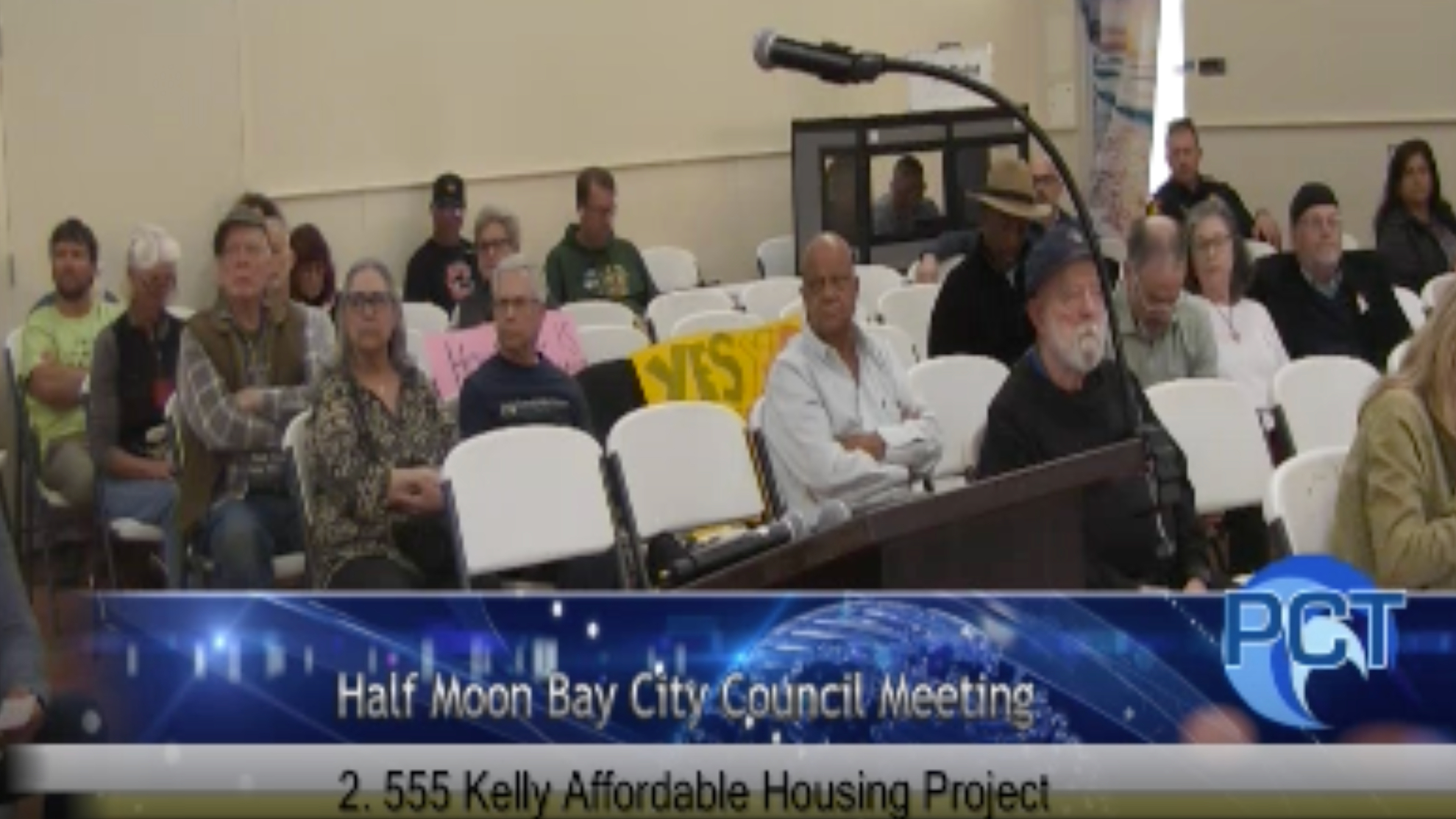
City Council - Apr 28, 2026 - Special Meeting
City Council • Half Moon BayApril 28, 2026
Locunity is a independent informational service and is not an official government page for this commission.We use AI-assisted analysis and human editorial review to publish information.
Council Advances 99-Year Lease for Senior Farmworker Housing After Marathon Hearing
Half Moon Bay's City Council voted 4-1 to introduce an ordinance approving a 99-year ground lease and suite of agreements with Mercy Housing for a 40-unit senior farmworker affordable housing project at 555 Kelly Avenue — the city's most significant housing action since the 2023 mass shooting. The five-hour special meeting drew roughly 30 public speakers, exposed unresolved questions about earthquake risk on city land, and set a December 2028 financing deadline.
40-unit senior farmworker housing project clears first reading, 4-1, with Councilmember Nagengast the lone dissent
Council and Mercy negotiate December 2028 hard deadline for securing remaining tax credits and county funds
Earthquake insurance standoff unresolved: Mercy declines catastrophic-loss liability beyond insurance proceeds, leaving city exposed on its own land
Roughly 30 speakers pack special hearing; overwhelming majority support the project, citing farmworker dignity and state housing compliance
$2M state grant agreement continued to May 5 alongside the ordinance's second reading
Prevailing wage protections added after former San Mateo mayor flags contractor with $1M+ in wage violations
A Promise Kept — and a Risk Assumed
Why it matters: The 555 Kelly project is the centerpiece of Half Moon Bay's response to the January 2023 mass shooting that killed seven farmworkers. The state Department of Housing and Community Development has already cited the city for noncompliance with housing law, and failure to advance affordable units could trigger lawsuits and loss of state grant eligibility.
The basics: The project would place 40 units — three studios, 34 one-bedrooms, and three two-bedrooms (including one manager's unit) — on city-owned land leased to Mercy Housing California for 99 years at $1 per year. All units except the manager's would be restricted to households earning 30% or 50% of area median income, with rents around $350 per month thanks to a county operating subsidy. A 55-year affordability covenant runs with the property, with provisions to adjust to low-income levels after year 55. Tenant preference tiers prioritize Half Moon Bay senior farmworkers first, then coastside, then countywide residents.
Where things stand: Interim City Attorney Denise Pisano walked the council through the Affordable Housing and Property Disposition Agreement, ground lease, regulatory agreement, and memorandum of ground lease — documents revised since a March 18 study session. Key changes included swapping references from "Director" to "City Manager," adding ICE/immigration access protections, and clarifying that the on-site community-serving space must be available at least 16 hours per week for the general public.
"The proposed AHPDA and the ground lease are drafted to run sequentially. Initially, the AHPDA would be the controlling document … during the pre-development period," said Pisano.
During deliberation, the council and Mercy agreed to several additional revisions: a termination date of Dec. 31, 2028 for the AHPDA (with a meet-and-confer provision 90 days prior); periodic ground-lease review every seven years; mandatory prevailing wage language; city council consultation rights on city manager decisions; seven-year record retention with audit-at-any-time rights; surrender provisions requiring return of keys and passcodes; and a disability definition aligned with Government Code Section 12926.
Mayor Debbie Ruddock also secured language requiring the full council — not just the city manager — to review and approve the sublease for the community-serving space.
"I would actually like language that says the city, not the city manager, but the city will review and approve the sublease for the community serving space," she said.
Decisions: Vice Mayor Deborah Penrose moved to introduce the ordinance on first reading, including all revisions negotiated during the meeting. The motion passed 4-1 (For: Brownstone, Jonsson, Penrose, Ruddock; Against: Nagengast; Absent: 0).
Councilmember Paul Nagengast, the sole no vote, acknowledged the project's importance but said he could not support the agreements as drafted.
"I hope the agreements are solid and I will continue to promote safety, but I can't get there," he said.
What's next: The ordinance's second reading is scheduled for the May 5 meeting, to be brought as a regular agenda item rather than on consent. A potential referendum could still challenge the ordinance before it takes effect.
The Money Question: A Deadline for Financing
Why it matters: Without a hard deadline, the city risked tying up public land indefinitely while Mercy pursued competitive state and federal financing — a process that can stretch years in affordable housing.
Where things stand: Mercy has committed approximately $2.7 million in Infill Infrastructure Grant funding and more than $13 million in Joe Serna farmworker grant money from HCD, plus a $2 million state appropriation from Sen. Josh Becker that the city would administer as a pass-through. Two critical funding pieces remain: San Mateo County affordable housing funds (a Notice of Funding Availability expected to open within two months) and Low Income Housing Tax Credits, which Mercy plans to apply for in early 2027.
City Manager Matthew Chidester explained that Mercy cannot pursue the remaining sources until the city agreements are in place — the county previously told Mercy to return once documentation was finalized. Mayor Debbie Ruddock and Councilmember Paul Nagengast both pushed for a date certain rather than an open-ended timeline.
"It seems like we get in this forever do loop. We were increasing NAS because we're still trying to find the financing, and if we don't have the financing, when does it end?" Nagengast asked.
After discussion, Mercy accepted Dec. 31, 2028 as the termination date. Ruddock also asked Mercy to confirm whether Half Moon Bay qualifies for the rural set-aside in the tax credit program, which Mercy agreed to investigate.
The other side: Planning Commissioner Rick Hernandez, speaking in a personal capacity during public comment, warned that the project's cost of $1.4 million per unit compares unfavorably to $800,000 for comparable local projects and questioned competitiveness for remaining funding.
Earthquake Risk: The Unresolved Standoff
Why it matters: The 555 Kelly site sits in a high-liquefaction zone. Without earthquake coverage, a major seismic event could leave the city holding a damaged building on its own property with no funds to demolish or repair it.
Where things stand: Ground lease Section 13.1 provides that if insurance proceeds are insufficient to restore the property after damage, either party may terminate the lease — effectively leaving the city with the wreckage. Mayor Debbie Ruddock pressed hard for Mercy to either carry earthquake insurance or accept full restoration liability.
"If you're not going to have things like earthquake insurance … you need to change the language to say they will be liable for any and all damages irrespective of insurance coverage," Ruddock said.
Mercy's counsel responded that earthquake insurance would cost approximately $200,000 per year and that the affordable housing industry standard is not to carry it. Requiring full restoration beyond insurance proceeds, counsel argued, would make the project unfinanceable because lenders would not accept the risk. The building would be engineered to withstand a 7.0 earthquake per California building codes.
After a recess to negotiate, Mercy held firm. Ruddock expressed strong disagreement but ultimately voted to advance the ordinance with the issue flagged as unresolved.
A second unresolved provision — a referendum indemnification clause — was deemed legally impractical by the city attorney's office.
The Community Speaks: Farmworker Dignity vs. Project Concerns
Why it matters: Roughly 30 public speakers turned out for this special meeting — an extraordinary volume for Half Moon Bay — reflecting the deep emotional and political stakes of a project rooted in the 2023 tragedy.
Where things stand: The overwhelming majority of speakers supported the project. Representatives of Coastside Faith in Action, the Housing Leadership Council of San Mateo County, Peninsula for Everyone, Puente de la Costa Sur, and the Ayudando Latinos A Soñar (ALAS) farmworker program urged the council to move forward without further delay. Several Spanish-speaking farmworkers addressed the council through an interpreter, describing years of waiting for safe, affordable housing.
Dr. Belinda Hernandez-Arriaga, Founder and Executive Director of ALAS described four years of advocacy and said many seniors are homebound and counting on this housing. Joaquin Jimenez, a former councilmember and former ALAS staff member, spoke publicly on the project for the first time, invoking the 2023 shooting and farmworkers' contributions to a $120–$150 million annual agricultural economy.
Evelyn Stivers, executive director of the Housing Leadership Council of San Mateo County, praised the staff work and called 555 Kelly a great site, offering technical assistance and urging approval.
Jordan Grimes of Peninsula for Everyone referenced the HCD violation letter and the governor's statements, urging the council not to let the perfect be the enemy of the good.
The other side: A smaller but vocal group of opponents raised concerns. Mike Ferreira criticized the 99-year lease and called the finding of a "major transit stop" — the basis for the project's density bonus — "bearing false witness." Sandy Vela argued 555 Kelly is ineligible for the density bonus and urged a referendum. Sid Young said the units are too small (411–955 square feet) and parking inadequate, with only 17 on-site spaces.
Rick Bonilla, former San Mateo mayor and Housing Leadership Council chair, supported the project but flagged that a potential contractor, Precision General Commercial Contractors, has $1.078 million in prevailing wage violations — a warning that helped prompt the council to add mandatory prevailing wage language to the agreements.
Council Deliberation: Confidence and Caution
Vice Mayor Deborah Penrose, who moved to introduce the ordinance, expressed trust in Mercy's track record.
"I feel confident that Mercy is not in the business of spending two or three years on a project which they don't think is going to go through. I think they'd have told us early on that it wasn't feasible," she said.
Councilmember Patric Bo Jonsson voted yes but registered discomfort with the density bonus foundation.
"I'm in favor of this project in many ways, but I'm a little disappointed on how we got here with no transit stop and how it became a bonus density building based on something that we don't even have," he said.
Councilmember Robert Brownstone, attending remotely, expressed confidence in the developer.
"I trust that we really have a really good developer here that will follow up and get the funding," he said.
Minor Items
$2M state grant agreement (Becker funds): Continued to the May 5 meeting by unanimous vote (5-0), to allow the grant pass-through to align with the ordinance's second reading.
What's Next
The ordinance returns for second reading on May 5. The council also expects to take up the $2M state grant agreement at that meeting. Mercy Housing will pursue San Mateo County affordable housing funds when the upcoming NOFA opens and plans to apply for Low Income Housing Tax Credits in early 2027 — all under a Dec. 31, 2028 deadline.