Rwanda Elected to Lead 134-Nation G77 Bloc as Leaders Demand Multilateral Overhaul
Group of 77 • United NationsSeptember 25, 2026
Locunity is an independent informational service and is not an official government page for this commission. All information is sourced from public footage and an analysis of official agendas with the aid of responsible, fact-checked AI. to report an error or omission.
The 50th annual ministerial meeting of the Group of 77 and China opened Sept. 25 at the United Nations with a blunt message from every keynote speaker: the international order built after World War II no longer reflects the power, population, or priorities of the developing world, and reform is overdue. Rwanda was elected by acclamation to chair the bloc in 2027 — a year that will include a pivotal SDG Summit and the start of the process to select the next UN Secretary-General.
Rwanda elected by acclamation to chair the 134-member G77 bloc in 2027, giving it an outsized role during the SDG Summit and Secretary-General selection
Secretary-General António Guterres delivers final G77 address, calling for $4 trillion more per year for developing countries and an end to "plundering" of critical minerals
Uruguay's chair frames the meeting around legitimacy, declaring multilateralism cannot mean defending a system that distributes power unequally
General Assembly President warns only 36% of SDG targets are on track and ODA fell a record 23% in 2025
Burkina Faso and Congo ministers demand shift from aid to partnership, citing the Sahel confederation as a model of autonomous capacity
Uruguay Sets the Tone: "Not Asking for Permission"
Why it matters: As the 2026 chair of the world's largest negotiating bloc of developing nations, Uruguay's framing shapes the ministerial declaration and the G77's unified position heading into a critical stretch of UN negotiations before 2030.
Where things stand: Minister of Foreign Affairs Mario Lubetkin of Uruguay opened the meeting with a direct challenge to the multilateral status quo. "Defending multilateralism does not mean championing the status quo," he said. "A system which distributes representation and resources unequally, as well as decision-making capacity, sees its legitimacy eroded."
Lubetkin insisted developing countries must be rule-makers, not rule-takers: "Developing countries must participate in developing rules. They must not simply adapt to decisions adopted without them."
On financing, he called for a fairer financial architecture, effective debt crisis responses, and upheld ODA commitments. He also addressed the boundaries of South-South cooperation: "South-South cooperation complements, it cannot replace North-South cooperation. Neither can it stand in for the obligations of developed nations."
Lubetkin acknowledged this will be Secretary-General António Guterres's last year, and flagged the 2027 selection process, noting that under General Assembly Resolution 79/327, the process must work toward "equal and fair distribution in terms of the gender and geographical balance."
He closed with a declaration of agency: "Today, the Global South is not asking for permission to participate in the building of the future. We provide solutions. We are the bedrock of the international system."
Guterres's Last Stand: Four Pillars of Justice
Why it matters: In what he called his final address to the G77 ministerial, Secretary-General António Guterres laid out a legacy agenda organized around financial, climate, technological, and institutional justice — setting benchmarks the bloc will use to evaluate his successor.
Where things stand: Guterres opened with a stark assessment of the financing gap: "Developing countries are drowning in debt. They need an additional $4 trillion per year to achieve the SDGs." He urged multilateral development banks to aggressively scale up investment and pointed to the Sevilla Platform, the Borrowers Platform, and the UN Framework Convention on International Tax Cooperation as tools that need to be fully activated.
On climate, Guterres called for tripling adaptation finance and "far greater resources for loss and damage — accessible, predictable, and at the scale required." He drew attention to a stark investment disparity: "Africa has 60% of the planet's best solar potential, but receives just 2% of global clean energy investments." He also demanded justice in the management of critical minerals, declaring, "No more plundering, no more exploitation."
On institutional reform, he challenged the foundations of the postwar order directly: "The United Nations Security Council and the Bretton Woods institutions were created before many of your countries became independent. These systems do not reflect the voice, the influence, and the economic and political power that developing countries in particular now yield."
He also called for an independent international scientific panel on AI, a Global Dialogue on AI Governance, and a Global Fund for AI Capacity Development — framing technology governance as a justice issue for the Global South.
"While this is my last meeting with your Ministerial Group as Secretary-General, I will always stand with you in your quest for justice, development and peace," he concluded.
GA President Sounds the Alarm on SDG Backsliding
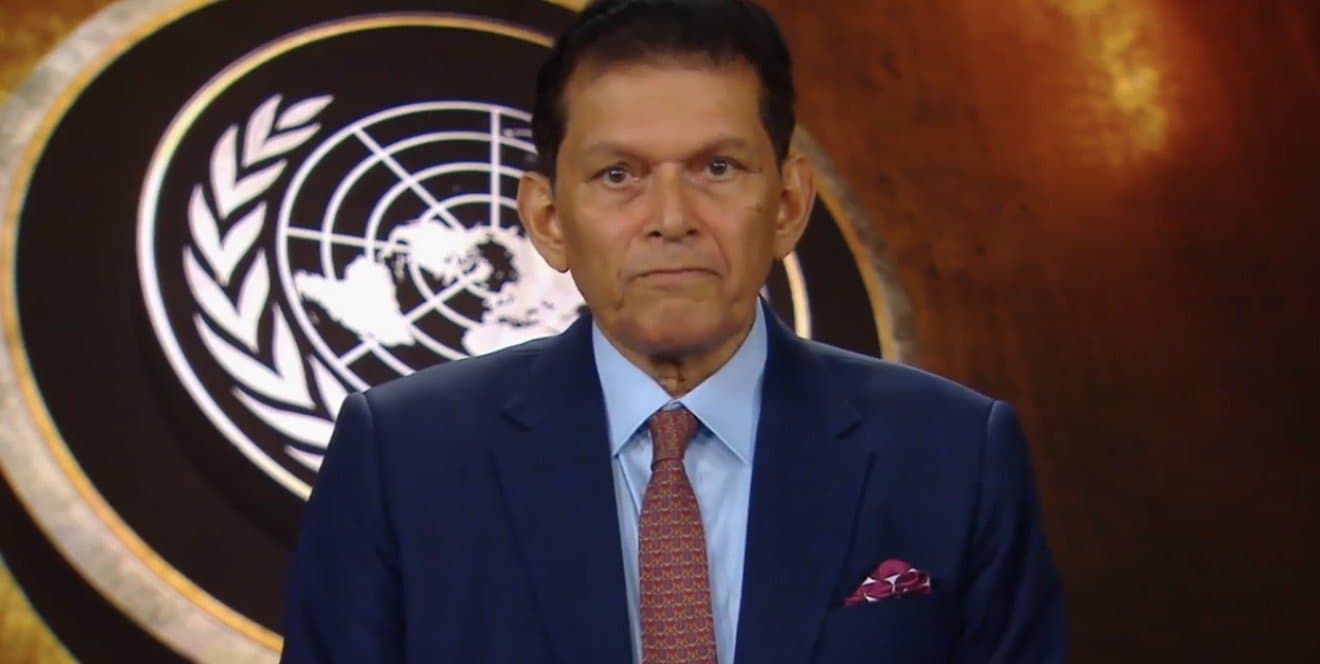
The basics: General Assembly President Khalilur Rahman delivered a pre-recorded video message laying out the data behind the urgency.
Why it matters: Rahman's statistics frame the 2027 SDG Summit as a potential last-chance assessment for the 2030 Agenda — and his warning about collapsing development aid adds financial urgency.
Where things stand: The numbers were stark. "Only 36% of SDG targets with available trend data are on track, or making moderate progress," Rahman said. "Nearly half, 49%, are moving too slowly, and 15% have slipped below their 2015 baselines." He added that "Official Development Assistance fell by a record 23% in 2025."
On climate, he warned: "Under existing policies, we are on track for up to 2.8 degrees Celsius of warming this century, far beyond the 1.5-degree threshold we pledged to pursue." He cited a glacier disaster affecting Nepal and China as evidence of cascading risks already materializing.
Rahman also called for inclusive AI governance, urging that rules must ensure "AI narrows rather than widens the digital divide." He highlighted Bangladesh's contribution of over 200,000 peacekeepers and called for expanded South-South cooperation and special support for least developed countries, landlocked developing countries, and small island developing states.
Rwanda Takes the Gavel for 2027
Why it matters: Under the G77's rotating chairmanship system, it was the African Group's turn. Rwanda will hold the gavel during the 2027 SDG Summit and the process to select the next UN Secretary-General — giving a single developing country disproportionate influence over both processes.
Decisions: The ministerial meeting elected Rwanda by acclamation, with no objections raised among the 134 member states. Minister for Foreign Affairs Olivier Nduhungirehe of Rwanda accepted, noting the country's founding role in the bloc: "As a founding member of the Group of 77 in Geneva on 15th June 1964, Rwanda has always been a strong supporter of the vision, principles, and objectives of the Group of 77."
He pledged to lead with accountability: "I pledge my government's full commitment to discharge its obligations and responsibilities with honor, integrity, and in a manner worthy of the trust of the member states."
What's next: The formal handover ceremony from Uruguay to Rwanda is scheduled for early January 2027.
Ministers Push for Post-Aid Partnership Model
Why it matters: The interactive dialogue on "The Global South and the Future of Multilateralism" moved beyond rhetoric into specific governance proposals, revealing how developing countries are repositioning themselves as co-creators of international rules rather than recipients of aid.
Where things stand: The Minister of Foreign Relations of Burkina Faso outlined four priorities: reforming the international financial system for equitable access, reforming global governance to reflect Southern realities, preserving sovereignty and territorial integrity, and — most pointedly — a call to "move from a logic of aid to a logic of partnership based on co-creation, mutual respect, shared responsibility, and the end of dependency relationships."
He cited a specific model: "The experience of the Confederation of Sahel States and its 3 member states demonstrates that unity and pooling capacities can strengthen our autonomy and our ability to act."
The Minister of Foreign Affairs of the Republic of Congo emphasized multilateralism as an essential necessity and highlighted the peace, security, and development priorities of President Denis Sassou Nguesso. Congo also used the floor to campaign for a concrete goal: "We reiterate our interest and seek the support of the Group of G77 and China in our ambition to become a member of the Security Council as a non-permanent member for the period 2030-2031."
Guatemala's representative began a statement but the session concluded before the full remarks were delivered.