
Grass Valley Appoints Gammelgard as City Manager After Nationwide Search
City Council • Grass ValleySeptember 23, 2026
Locunity is an independent informational service and is not an official government page for this commission. All information is sourced from public footage and an analysis of official agendas with the aid of responsible, fact-checked AI. to report an error or omission.
The Grass Valley City Council wrapped up a months-long leadership search Tuesday night, unanimously tapping Police Chief Alex Gammelgard as the city's permanent city manager on a six-year, $279,500-a-year contract. The council also backed a $55 million dam safety project seeking state grant dollars, and heard from a homeowner who told them she's gone 166 days without running water.
Police Chief Gammelgard named permanent city manager in a 5-0 vote after a nationwide search that drew 73 applicants; he must now appoint a new police chief
Council backs NID's $55M Scotts Flat spillway replacement with a resolution supporting a Proposition 4 grant application to offset ratepayer costs
Homeowner returns a second time to plead for help after 166 days without water service over a disputed meter placement
Residents question wildfire funding for an outside nonprofit before the city's own prevention programs are fully resourced
State transit funding cuts flagged as Nevada County begins rethinking bus and Dial-A-Ride services
Gammelgard Gets the Job — and a Six-Year Contract
Why it matters: The appointment ends a leadership vacancy that forced Gammelgard to serve simultaneously as police chief and interim city manager — a dual role that drew both praise for his work ethic and criticism over accountability concerns. His six-year term will outlast several current council members' seats, locking in the city's executive leadership well beyond the next election cycle.
Where things stand: City Attorney David Ruderman laid out the contract terms: a six-year, at-will appointment at $279,500 annually, CalPERS retirement at the 2.5% at 55 classic formula, deferred compensation through 457 and 401 plans, standard benefits, and provisions allowing outside activities like nonprofit board service. The agreement includes a standard 90-day post-election prohibition on removal plus an additional 90-day limitation on without-cause termination.
Ruderman made one point explicit: "When Mr. Gammelgard assumes the duties of city manager, he will no longer be the police chief, and it will be incumbent upon him to appoint that police chief in consultation with the city council according to the rules of our municipal code."
The search process was extensive. A consulting firm screened 73 qualified applicants. Seven finalists were interviewed, and three advanced to panel interviews that included community leaders. Mayor Hilary Hodge described the process as deliberate and transparent: "The leadership that Alex has shown, the transparency, his willingness to collaborate with community members is something that this community has wanted for a really long time."
The other side: Public comment was sharply divided. Cameron Brady, a Grass Valley resident and business owner, praised the council's diligence, said he had read the full contract, and called it a great deal for the city. Robin Galvin Davies, Executive Director of the Grass Valley Downtown Association and the Greater Grass Valley Chamber of Commerce, participated in the community panel interviews and expressed strong support for the choice.
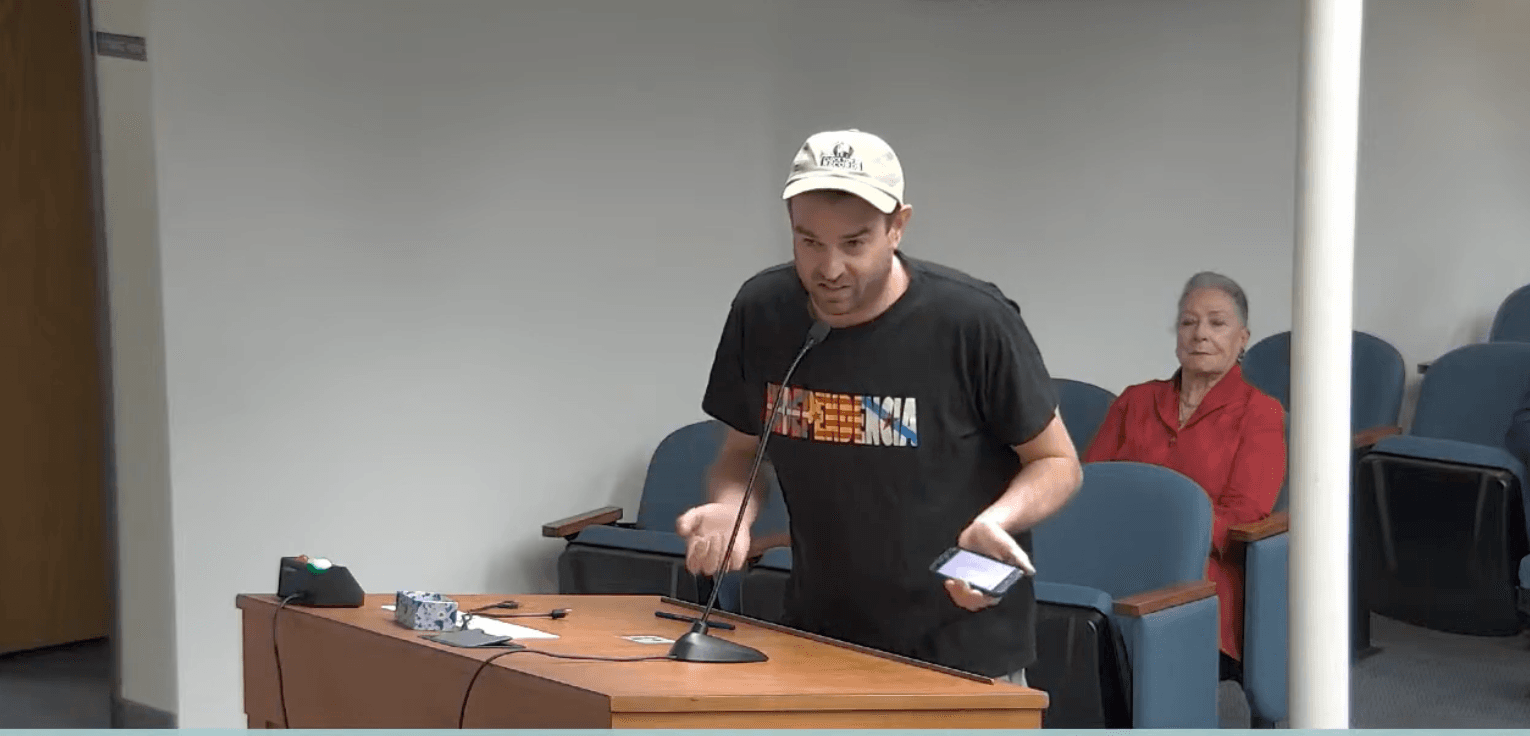
But a public commenter named Kyle Heise urged the council to delay the vote, raising concerns about the dual police chief/city manager arrangement, contract protections that could limit the next council's authority, and police oversight. "You're basically removing the capacity of the public to check the city police officer," Kyle said. "I just think that's a very basic checks and balances thing that you guys are kind of overlooking."
Matthew Coulter was more pointed, sarcastically criticizing the appointment as nepotism and accusing council members of enabling insiders.
Decisions: All five council members made personal statements before the vote. Councilmember Jan Arbuckle admitted she initially doubted the value of community panel interviews: "I didn't think that that was necessary and I was wrong. And I am so happy that we did because all it does is confirm our decision that we made the right decision." Vice Mayor Haven Caravelli said: "I truly believe that we came to an agreement here with the best candidate possible." Councilmember Joseph Bonomolo praised Gammelgard's work ethic, saying his peers recognize the energy he brings. Councilmember Tom Ivy offered brief supportive remarks.
The motion passed 5-0 (For: Caravelli, Arbuckle, Bonomolo, Ivy, Hodge; Against: none; Absent: none).
Gammelgard himself struck an emotional note: "It's not just because it's a job. It's because we love this community and we could do these jobs in other places. And there's a reason why we chose Grass Valley and Western Nevada County as our home."
What's next: Gammelgard must appoint a new police chief in consultation with the council. The timeline for that appointment was not specified.
$55 Million Spillway Project Seeks State Grant Dollars
The basics: The Scotts Flat Dam spillway, originally built in the 1940s and modified in the 1960s, must be replaced under orders from the Federal Energy Regulatory Commission (FERC) and the state Division of Safety of Dams. The Nevada Irrigation District asked Grass Valley for a resolution of support to strengthen its application for Proposition 4 dam safety and climate resilience grant funding.
Why it matters: The $55 million price tag will ultimately be borne by NID ratepayers — who already face rate increases starting in January 2027 — unless external grants reduce the burden. The project is also a dam safety imperative: the existing spillway lacks proper underdrains, is deteriorating, and cannot handle the flows regulators now require.
Where things stand: Gabe Aranow, Director of Engineering for the Nevada Irrigation District, told the council the existing spillway has a maximum recorded flow of 6,000 cubic feet per second. The new design will handle 24,000 CFS. Construction is scheduled from summer 2027 through the end of 2029, with NID Campground 1 closed during active construction.
Aranow explained why the project accelerated: "After 2017, a lot more scrutiny was put on dam and spillway-related projects. And so this project was known for a while that it was needed, but it came to the fore and now we're replacing it under their regulatory authority." He added: "Our project estimate is $55 million, and that illustrates the magnitude of the work we have there and part of the reason that we're pursuing grants and coming to you for support."
The 2017 reference points to the Oroville Dam spillway crisis, which prompted statewide regulatory tightening of dam safety inspections and standards.
Greg Jones, Assistant General Manager of the Nevada Irrigation District, emphasized the fiscal stakes for ratepayers: "Every dollar that we do receive from external funding such as this Prop 4 will then help offset future repair costs in the coming years." NID is also on a list for a $5 million Department of Energy grant.
A public commenter asked about El Niño weather risks during the construction period and how residents could submit supporting comments. Mayor Hodge underscored the broader challenge: "Our rural community realizes that oftentimes we have crumbling infrastructure that a population rate hike or tax doesn't quite cover the construction of where it might in other larger populated areas. And so we apply for grants in order to get support for projects like these."
Decisions: The resolution passed 5-0 (For: Caravelli, Arbuckle, Bonomolo, Ivy, Hodge; Against: none; Absent: none).
166 Days Without Water: Homeowner Returns to Plead for Help
A resident named Alyssa returned to the council for the second consecutive meeting to report that she still has no water at her property — 166 days and counting. She told the council that the city's proposed water meter location is more than 150 feet from her home, which would require trenching across a city sewer line and through neighbors' front yards. City fees for the connection exceed $14,000.
Alyssa noted that hundreds of Grass Valley neighbors have water meters on their own property and called the proposed arrangement unreasonable. She asked the mayor, council, and new city manager to intervene.
No council members responded during the public comment period.
Wildfire Funding Questions
Two residents pushed back on the idea of directing Measure B funding to COAD, an outside nonprofit involved in wildfire prevention, before the city's own community risk management department is fully resourced.
Edward Peavy asked whether the city's existing wildfire prevention staff has adequate funding, equipment, and personnel. A public commenter named Kyle echoed those concerns and referenced a recent County Board of Supervisors meeting where cost-saving measures appeared to be deprioritized.
No council action was taken; the comments were made during general public comment.
Minor Items
Consent calendar adopted 5-0 with no items pulled.
Closed session on labor negotiations produced no reportable action.
Councilmember Ivy reported that Pioneer Community Energy is expanding its territory by roughly 100%, which could slightly lower electricity costs, and that Nevada County Transportation Commission transit services face declining state funding in coming years. A proposed city-county arrangement would trade street sweeping of Ridge Road for snow removal services.
Vice Mayor Caravelli promoted Sierra Harvest's Food Fight event.
Mayor Hodge highlighted the Yuba River cleanup, which drew more than 300 volunteers across 22 sites, and promoted the upcoming Magical Evening on Mill event.
Robin Galvin Davies promoted an Oktoberfest chamber mixer on Oct. 1 and the annual Grass Valley Brew Fest on Oct. 3.