
Grass Valley Council Clears Old Bank Lot Split, Then Waives Appellant's Fee
City Council • Grass ValleySeptember 29, 2026
Locunity is an independent informational service and is not an official government page for this commission. All information is sourced from public footage and an analysis of official agendas with the aid of responsible, fact-checked AI. to report an error or omission.
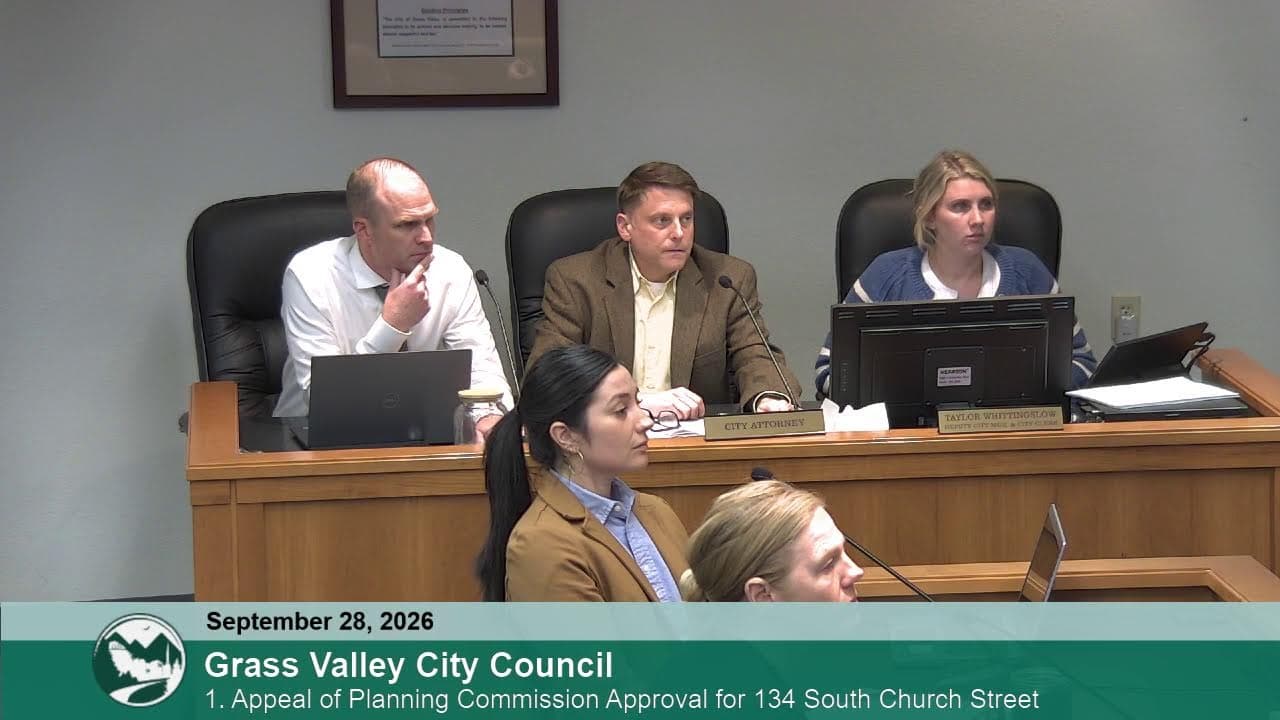
A three-member Grass Valley City Council on Sept. 28, 2026, denied neighbors' appeal of a plan to split the vacant former Bank of America site at 134 South Church Street into a parking lot and an office building. The council upheld the Planning Commission's approval with a new permit safeguard. It then took a separate vote to waive the appellant's $820 fee, after officials acknowledged that a staff-report error had fueled the dispute.
- Appeal denied: Council upholds a 2-lot map and 2 commercial condos at the former bank. The vote was For: 3, Against: 0, Absent: 2.
- New Condition 7: Any private parking lot on Parcel 1 now needs a use permit.
- City eyes Parcel 1 for public parking to meet downtown demand.
- Neighbors warn of an unsafe South School Street exit, rising traffic and light glare.
- Elks Lodge 538 secures access commitments for its alley.
- $820 appeal fee waived despite a warning from the city attorney about setting a precedent.
1 Big Thing: Old Bank Split Survives Appeal
The basics: A tentative parcel map is the first step in dividing land. It sets lot lines but approves no construction. Owner Cameron Brady applied on June 4 to split the property, Assessor's Parcel Number (APN) 008-370-010. Parcel 1 would be a parking lot only. Parcel 2 would hold the 1975 building, divided into two commercial condominium units for offices.
Why it matters: The decision clears the way to reuse a downtown building that now sits vacant and chained off. It also creates a standalone lot that the city has said it may buy for public parking.
Where things stand: The Planning Commission's July 21 hearing was canceled for lack of a quorum. The commission approved the map on Aug. 18. Steve Enos, a land use planner of 35 years, filed the appeal on Aug. 31. Owners of the historic Coleman House and Donation Day House joined him.
Associate Planner Vanessa Franken responded to all eight appeal points. She called the concerns about development standards, circulation, lighting and use permits valid but premature, because no development proposal exists yet. "This application is for a tentative map. It is just a preliminary map. This is step 1," said Franken.
Franken also disclosed the city's own interest in the site. "It was intended and shared for transparency that the city is interested in Parcel 1 as a parking lot," she said. She noted the owner could still sell the parcel to someone else.
Staff recommended approving the map as modified. The changes included corrected findings, a fix to a clerical error and a new Condition 7. That condition requires any future use of either parcel to obtain whatever permits or entitlements the city would normally require. "Any private party would have to go through a use permit process," a city staff member said. Staff added that a city purchase would also need council approval of both the use and the acquisition, with notice to neighbors. The proposed offices on Parcel 2 are allowed by right and need no further use permits.
The City Attorney described the practical effect: "That condition would not allow Parcel 1 to be used under Mr. Brady's ownership as a parking lot unless he came back and asked for a use permit."
The other side: Enos argued that the commission relied on false findings about lighting, access and traffic. He asked the council to send the item back to the commission. Still, the appellants did not oppose the project itself. "We support this project, we support this reuse, we support the city buying half of that lot and turning it into a public parking lot," said Enos.
Kevin Nelson of Nelson Engineering represents the applicant. He said the planned legal and financial offices would generate less traffic than the bank and its drive-through. He accepted Condition 7 and urged the council to deny the appeal rather than restart the cycle.
Councilmember Jan Arbuckle rejected a remand. "I do not want to see this going back to the Planning Commission because it was our Planning Commission that set it back this far," said Arbuckle. She said sending the item back would be unfair to Brady and could add months of delay.
Decisions and stakeholder impacts: The council adopted staff's recommendation on a voice vote with no opposition recorded. The vote was For: 3, Against: 0, Absent: 2. Councilmember Joseph Bonomolo was absent with an injury. Vice Mayor Haven Caravelli recused herself because she owns nearby property.
Brady gets his entitlement without another commission round. Neighbors gain a guarantee of notice and review before Parcel 1 becomes any kind of parking lot. The city keeps an acquisition path open.
What's next: Traffic, circulation, lighting and development standards will be reviewed when a formal development proposal is submitted. A city purchase of Parcel 1 would require a separate council action.
Neighbors Map Out the Fights Still Ahead
Why it matters: Staff deferred traffic and access issues to future review. The concerns residents raised Sept. 28 are effectively a preview of the next hearing.
Traffic and safety: Enos called the site's exit onto South School Street "100% unsafe." He described a one-way street with parking on both sides, used by children walking to the bus. "There is no sight distance," said Enos.
Public commenter Matthew Coulter said South School Street has become a main route between West Main and Neal streets since the Mill Street development changed traffic patterns, partly because of Google routing. "Every morning there's a traffic jam on that block of that street," said Coulter. He urged making the street one-way or removing parking, and he warned that pedestrians are especially at risk this time of year.
Stacy Lajones, co-owner of the Donation Day House, described rising traffic and rude driving. Enos also noted that the city's new parking map advertises free parking on Neal and South School streets. He asked for residential parking permits and enforcement.
Arbuckle called Enos' traffic concern valid. She also pointed out that the lot has long served as informal parking. "And it has always been when the bank was closed or if the guy wasn't looking, everybody parked there," she said.
Elks access: Gary Nowak of Auburn Grass Valley Elks Lodge 538 said the lodge has had open access to the alley and lot since 1975. It uses that access for food deliveries, maintenance and trash pickup. "That alleyway is crucial to our business model," said Nowak.
The lodge had hired attorney Chuck Farrar to explore a prescriptive easement, a legal right gained through long-term use. It dropped that effort because a public city lot would create a public easement anyway. Nowak said the lodge is satisfied that proposed landscaping blocking its doors was removed. He asked that service vehicles be able to exit through Parcel 2 onto Neal Street.
Nelson pledged two-way driveways and access for both parcels. "There will be reciprocal easements benefiting both parcels 1 and 2 to be able to use those driveways, entrances in and out," said Nelson.
Disputed easement: Staff said Coleman House owner Mark Mason had repeatedly claimed an easement but never produced documents. Nelson said an ALTA survey, a detailed boundary survey used in property transactions, and a title report show no such easement. He offered to review Mason's paperwork quickly. "I didn't have anyone that was going to represent me, and I felt uncomfortable about turning over my paperwork," said public commenter Mark Mason, who agreed to hand the paperwork over.
Lighting: Enos cited a 42-foot pole shining into Coleman House bedrooms. Nelson put the pole at 28 feet. He said the applicant would lower it to the ordinance maximum, which he believed is 20 feet. A council-side speaker said a lighting condition would be premature now but welcomed the applicant's willingness to work with neighbors.
Supporters: Public commenter Mark Hauser praised the development team's track record. "We have an opportunity to take an old building and bring it back to life," said Hauser. Tim Brady, a builder with 50 years in Grass Valley, tied the plan to downtown parking pressure from Mill Street. "The success of that development has led to a need for more parking," said Brady.
A Fee Waiver, an Apology and a Precedent Warning
Why it matters: The city code refunds appeal fees only when an appeal succeeds. The council waived the fee anyway, and the city attorney warned that future appellants may cite the decision.
Where things stand: The staff report mistakenly said the city had received a use permit application rather than a tentative map. "When the term use permit was put in a document instead of tentative parcel map application, that was likely the impetus for the start of this appeal," said Lajones.
Franken apologized. "I do take full responsibility for that," she said. Mayor Hilary Hodge noted that the 103-page packet contained the typo, which she and the public both missed. She also apologized for the commissioners' no-show in July: "I will apologize on behalf of the planning commissioners who were not here," said Hodge.
Enos raised broader process complaints. He said appellants received the hearing procedures only that morning, that his public records requests went unfulfilled within the required 10 days and that he was denied extra speaking time on behalf of absent neighbors. "There's an issue of fairness here. Staff gets as much time as they want. We get cut off at 7 minutes," said Enos. Appeal fees equal 20% of the original application fee under the city's fee schedule.
Hodge pressed the question. "But given that there was some confusion, and that was on our part, can we refund the fee based on that, even if we don't uphold the appeal?" she asked.
The other side: The City Attorney said the code allows no refund unless an appeal is sustained, though the council has authority to waive fees. "It's meant to ensure that the taxpayers of Grass Valley who pay into the general fund aren't subsidizing an appeal in a land use case," the City Attorney said. "But I do think it is important to understand that actions that you take do serve as a precedent."
A staff member added that the appeal went well beyond the wording error. "There were a number of other issues raised that caused extensive staff time, well in excess of the amount of the fee, just for the record," the staff member said.
Decisions and stakeholder impacts: Hodge said the situation "was a pretty big misunderstanding, and it kind of seems like a raw deal." A councilmember moved to waive the fee "in the name of good faith for this neighborhood." The motion passed on a voice vote with no opposition recorded. The vote was For: 3, Against: 0, Absent: 2 (Bonomolo absent, Caravelli recused).
Enos recovers $820. The general fund absorbs the cost of an appeal that staff said consumed far more time than the fee covered.
What's next: Watch whether future appellants cite this waiver, and whether the city tightens staff-report review or the timing of hearing materials.
Minor Items
- Agenda approved: The vote was For: 3, Against: 0, Absent: 2, with only three members seated.
- Quorum strain: An absence and a recusal left three members to decide the appeal alone.
Looking Ahead
Neighbors near South School and Neal streets should watch for a formal development proposal at 134 South Church Street, or a council item on buying Parcel 1. Either would reopen the traffic, lighting and access questions the council deferred.