
Airport License Plate Reader Policy Tightened as Labor Deals Advance
Government Audit & Oversight Committee • San FranciscoNovember 5, 2026
Locunity is an independent informational service and is not an official government page for this commission. All information is sourced from public footage and an analysis of official agendas with the aid of responsible, fact-checked AI. to report an error or omission.
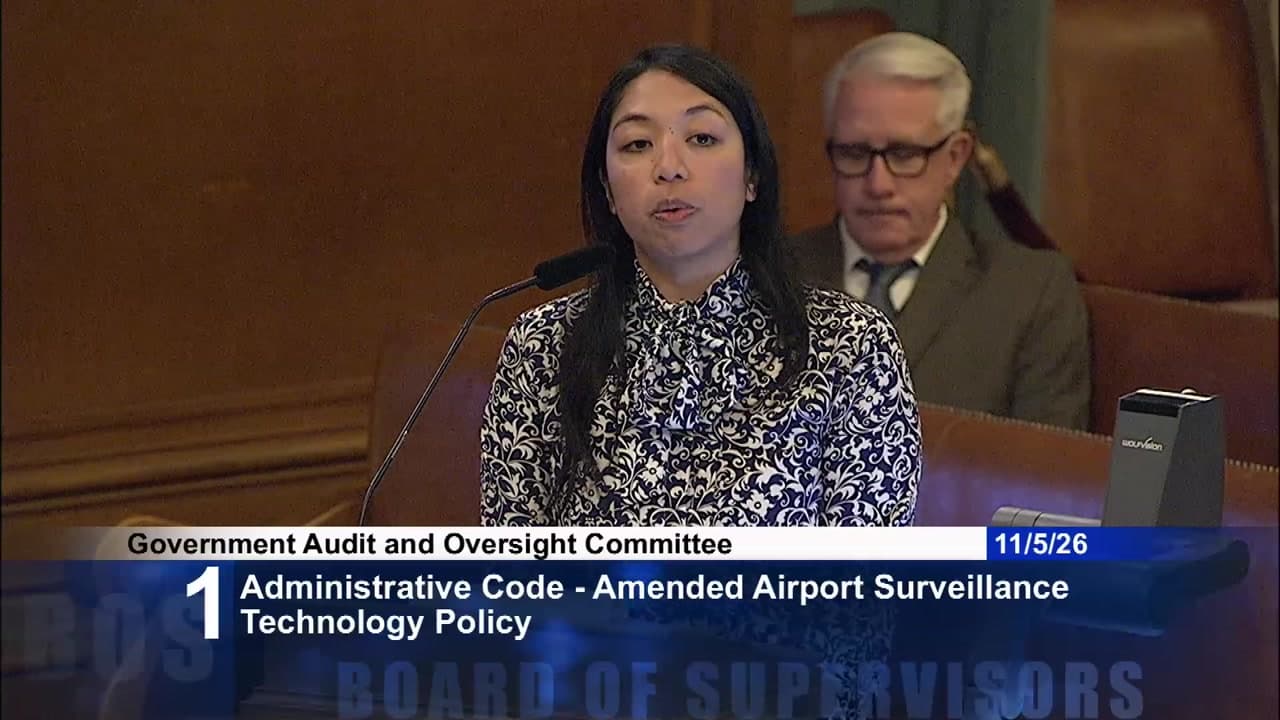
San Francisco International Airport is moving toward parking where your license plate is your ticket, and supervisors made sure that convenience comes with limits. At its Nov. 5, 2026, meeting, the Government Audit & Oversight Committee voted 3-0 to amend the airport's surveillance technology policy so law enforcement can get plate data only for active criminal investigations. The committee also forwarded eight labor ordinances that lock in raises and layoff protections for city workers.
- Airport plate-reader expansion amended, forwarded 3-0 with tighter police data-sharing language
- Eight labor ordinances advance: 12% raises over four years, no layoffs through June 2029
- Golden Gate Park paid parking enforcement cameras head to the full Board
- Ethics Commission website change for campaign disclaimers sent to the Board
- Self-checkout staffing ordinance delayed to Nov. 19, 2026
Plates Become Permits at the Airport
The basics: Automated license plate readers, or ALPR, are cameras that capture and read vehicle plates. San Francisco departments adopt policies governing surveillance tools like ALPR by ordinance, which is why the airport's plans came before the committee.
Why it matters: The airport wants to replace physical parking permits with plate-based access. That trades plastic credentials for a stream of vehicle data, raising questions about who sees it, how long it is kept and when police can get it.
Where things stand: The airport asked to add its PARKS replacement project to its surveillance technology policy, along with new ALPR uses: credential-free entry, digital virtual permits, length-of-stay and payment verification, and mobile enforcement. The policy also covers the airport's Ground Transportation Management System and Park Assist.
Airport staff presented their own wording changes to narrow law enforcement access. "The airport only shares information with law enforcement partners when there is a legitimate investigative active criminal investigation need," said Diana Bollock, airport presenter.
Privacy on the record: Vice Chair Jackie Fielder pressed staff on "how is it possible to ensure that personally identifiable information is fully protected," and asked why plate data would be kept 18 months on production servers and 4.5 years in the cloud.
Guy Clark, of the airport's IT division, answered that plate numbers are public information and that access to DMV records, which tie plates to owners, is restricted to staff whose jobs require it. He framed the technology as relatively low-risk. "I would put it on the lower end of the surveillance technology spectrum," Clark said.
On retention, Bollock pointed to the city's standardized five-year retention period for payment records. "We wanted to standardize it because these are part of processed payments through the parking system," Bollock said.
Decisions and stakeholder impacts: The committee approved the amendments 3-0, then voted 3-0 to forward the amended ordinance to the full Board with a positive recommendation (For: Committee Chair Stephen Sherrill, Vice Chair Fielder, Supervisor Alan Wong; Against: 0; Absent: 0). No members of the public spoke.
Travelers and permit holders get faster, paperless entry. In exchange, their plate data will sit on airport systems for years, with police access confined to active criminal investigations. Fielder's questions put retention and DMV access on the record, but neither changed in the final vote: the only amendment narrowed law enforcement sharing.
What's next: The ordinance goes to the full Board of Supervisors.
City Labor Deals Lock In Raises Through 2031
Why it matters: These ordinances set pay and job security for a wide swath of city workers and shape payroll costs for years. The no-layoff guarantees run through June 30, 2029, and contract terms run through June 30, 2031.
Where things stand: Ardis Graham, Employee Relations Director at the Department of Human Resources, presented items 5 through 12 together. They include seven memorandum of understanding (MOU) amendments covering:
- Machinists Union Local 1414
- Operating Engineers Local 3 supervising probation officers
- Teamsters Local 856 units and building inspectors
- Transport Workers Union Local 200 and Local 250A units
The eighth is the annual ordinance setting pay for unrepresented city employees, who do not belong to a union.
Deal terms: The union extensions mirror five extensions the city adopted earlier: labor-management committees, no-layoff provisions through June 30, 2029, and contract terms extended through June 30, 2031. "It's 12% over 4 years, or about 3% a year," Graham said. Unrepresented employees would receive a 1% wage increase.
Graham said three more MOUs are expected, signaling that the city is extending contracts union by union on a common template rather than reopening full bargaining.
Decisions and stakeholder impacts: The committee forwarded all eight ordinances 3-0 to the full Board with a positive recommendation as committee reports (For: Sherrill, Fielder, Wong; Against: 0; Absent: 0). Supervisor Wong asked to join as a sponsor. "I'd like to add my name to — as a supporter of these MOUs, as a co-sponsor," Wong said. No one spoke during public comment.
Covered union members get predictable raises and protection from layoffs through mid-2029. Unrepresented staff get a smaller 1% bump. The no-layoff guarantees also limit the city's flexibility to cut staff in a downturn through June 2029.
What's next: The ordinances head to the full Board, and three more MOU extensions are expected to follow.
Golden Gate Park Rangers Get Plate Readers
Why it matters: The Recreation and Park Department says paid parking revenue in Golden Gate Park will fund youth sports, after-school and senior programs. Plate-reading cameras on ranger vehicles are how it plans to enforce payment.
Where things stand: Christine Nath, Chief Information Officer of San Francisco Recreation and Park, called the policy amendment small. She said it uses the same technology and data policies as SFMTA parking control officers and implements paid parking the Board authorized in July 2025. "This technology will solely be used to enforce paid parking in Golden Gate Park," Nath said.
Nath described outreach through a website, contact with park permittees and tenants, and signage at park entrances. Implementation is planned for the start of the new year.
Decisions and stakeholder impacts: With no committee questions or public comment, members voted 3-0 to send the item to the full Board as a committee report (For: Sherrill, Fielder, Wong; Against: 0; Absent: 0). Park visitors who drive will face camera-based enforcement. Recreation program users stand to benefit from the revenue.
Ethics Prepares for Required .gov Move
Why it matters: San Francisco campaign ads and electioneering materials must include disclaimers that point to sfethics.org. A state deadline means that address will change, and the city's code needs to keep up.
Where things stand: Grace Huang, of the Office of Board President Rafael Mandelman, explained the state requirement. "Under a 2023 state law, cities and counties must transition to a .ca.gov website or a .gov website domain by January 1st, 2029," Huang said. The Ethics Commission plans to move in 2027 and unanimously approved the ordinance 5-0 on Sept. 11, 2026.
Rather than write a new address into law, the ordinance lets the Ethics Commission designate the website used in disclaimers.
Supervisor Wong asked whether Ethics should have similar flexibility over other disclaimer language: "What if we let ethics have more flexibility in just designating that as opposed to just having this written in stone?" Michael Canning, of the Ethics Commission, said that was not needed. "The other language usually harmonizes pretty well with what's required in state law already," Canning said.
Decisions and stakeholder impacts: Canning also thanked Mandelman's office for sponsoring the ordinance during public comment. The committee forwarded the ordinance 3-0 to the full Board with a positive recommendation (For: Sherrill, Fielder, Wong; Against: 0; Absent: 0). Campaigns and committees will need to watch for the new designated address before the 2027 switch.
Minor Items
- Self-checkout staffing ordinance continued: The committee voted 3-0 to delay to Nov. 19, 2026, a Labor and Employment Code proposal. It would set minimum staffing where self-service checkout is used, impose item limits and penalties, give the City Attorney enforcement authority and let the Office of Labor Standards Enforcement write rules. Committee Chair Sherrill noted that Board President Mandelman and others had been working on it. "There's been a request to continue this item to the next GAO meeting, which I am inclined to agree with," Sherrill said. No one spoke during public comment.
Looking Ahead
The self-checkout staffing ordinance returns to the committee Nov. 19, 2026. The airport and Rec and Park surveillance policies, the Ethics disclaimer ordinance and the eight labor ordinances now move to the full Board of Supervisors, with three more MOU extensions expected to follow.