
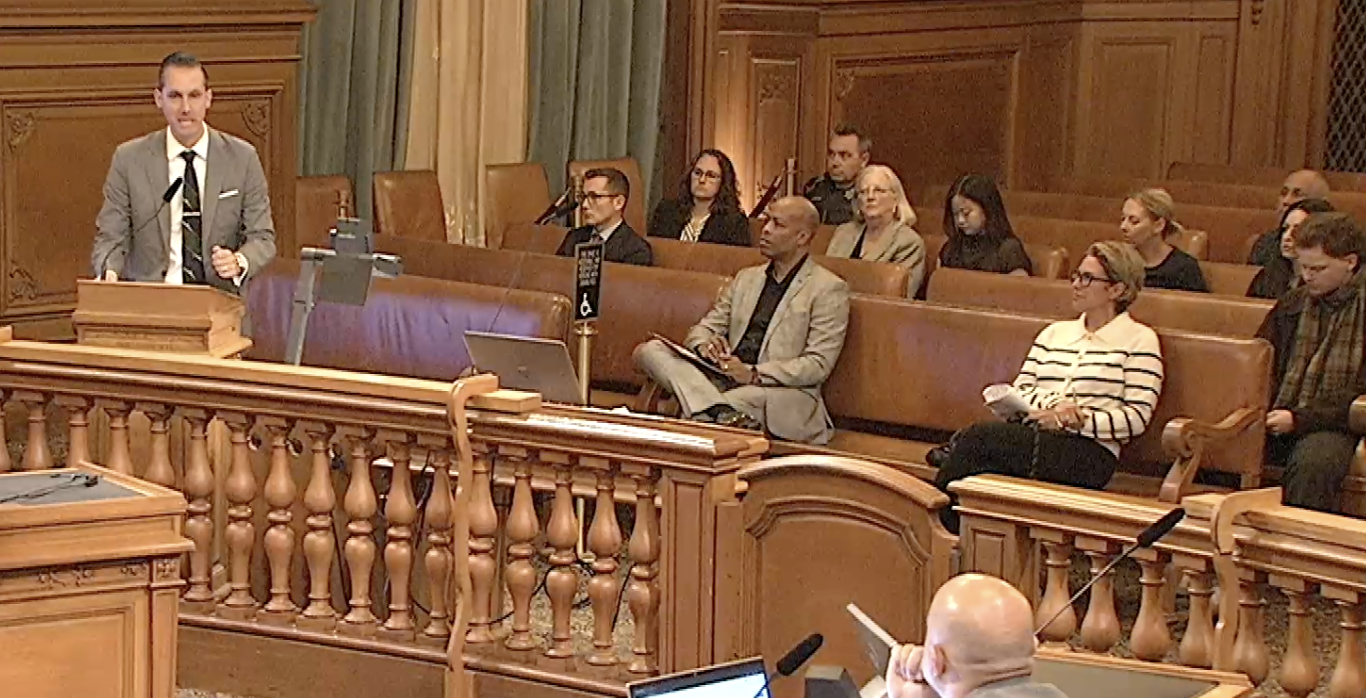
Government Audit & Oversight Committee - May 21, 2026 - Regular Meeting

Government Audit & Oversight Committee - May 21, 2026 - Regular Meeting

Government Audit & Oversight CommitteeSan FranciscoMay 21, 2026

Sources:

Locunity is a independent informational service and is not an official government page for this commission.We use AI-assisted analysis and human editorial review to publish information.

SF's Stalled "Dog Court" Gets a Restart Date as Bite Cases Pile Up

The San Francisco Government Audit & Oversight Committee spent the bulk of its May 21 meeting drilling into a public safety gap hiding in plain sight: for nearly a year, the city has had no process to adjudicate vicious and dangerous dog cases, leaving dozens of bite victims and dog owners without recourse. The mayor's office promised a July restart, but supervisors pressed hard on whether the fix is durable — and whether hearings alone are enough.

  • 66 dangerous-dog cases backlogged after nearly a year without hearings; mayor's office commits to July restart with a new hearing officer

  • Over 1,000 dog bites reported since July 2025, with the Tenderloin accounting for more than a quarter of incidents

  • Public Works gains drone and camera powers to catch and fine illegal dumpers $1,000 per incident, with plans to publicly shame violators

  • Seven city settlement items forwarded to the full board without discussion


A Year Without Dog Court

The basics: San Francisco's vicious and dangerous dog hearing process — sometimes called "dog court" — is the legal mechanism the city uses to hold owners of dangerous dogs accountable. Because dogs are legally property, the city cannot restrict or remove a dangerous animal without a formal adjudication. The Department of Police Accountability took over the hearing officer role in 2018 after a civil grand jury found inconsistencies in the prior system.

Why it matters: Since July 2025, no hearings have been held. That means 66 cases are ready for adjudication with no path forward, 1,027 dog bites were reported in the past year, and victims, neighbors, and responsible dog owners have been stuck in limbo.

Where things stand: The breakdown traces to DPA's budget. "Since 2020-21, DPA has experienced a 40% reduction in its staffing. In the past year alone, we've lost four positions," said Paul Henderson, Director of the Department of Police Accountability. DPA had operated the hearing function under a $100,000 interdepartmental work order with no formal MOU. Requests for two dedicated VDD positions in 2023-24 were denied; DPA gave four months' notice before walking away from the role.

SFPD Officer Greg Sutherland, the city's vicious and dangerous dog officer, put numbers to the crisis: "As of last year, I had 1,027 bites forwarded to my office. So far this year, we've had 445 bites reported to me as of this morning. And I have 66 cases ready for a hearing." He has 15 additional cases in preparation. Sutherland attributed the surge partly to pandemic-era dogs that were poorly socialized during lockdowns, and estimated that 20–30% of cases involve repeat-offender dogs.

Vice Chair Mahmoud zeroed in on the geographic concentration, citing data from Tenderloin Station: "In the last few months of 2025, over a quarter of all reported dog bite incidents took place in the Tenderloin." Mahmoud said parents had shown him photos of children's bite injuries and pushed presenters to think beyond adjudication: "A lot of this that we're talking about is treating the symptom. The dog is already a problem. How, in your opinion, what is the role of animal care and control in preventing this from happening?"

The Fix — and Whether It Will Stick

Stephen Betts, the mayor's chief of public safety, announced the restart plan: "I'm happy to announce that we do have a medium to long term solution that will go live in July." Under the arrangement, SFPD Police Commission staff will handle administrative and clerical duties — work they already have relevant skills for — while a new hearing officer will be hired as a Prop F bring-back position housed at DPA. The position will be funded through an existing roughly $100,000 general fund allocation that flows through the Department of Public Health. The hearing officer could hold approximately three hearings per week.

Chair Stephen Sherrill pressed on succession planning, asking what happens if the single hearing officer leaves. Betts said the system is now designed to survive turnover: "If this person decides to leave, we have the core system already set up so we can hire someone new to do it."

Stakeholder Voices: A National Model at Risk

Sally Stevens, chair of SF Dog (San Francisco Dog Owners Group), praised the hearing process as a pioneering framework: "People came from all over to study how San Francisco dealt with bites, and our dog court process became a model for how cities can deal with problem dogs." She urged dedicated funding and continuing education for hearing officers.

Virginia Donahue, executive director of Animal Care and Control, emphasized that euthanasia outcomes are well under 10% of cases and that the hearing process is the only legal mechanism for restricting dangerous animals. "The dog is legally property. I cannot take your property away from you unless I can say that it's a public safety emergency," she said. Donahue also flagged widespread underreporting of bites: "I have all this data on how many bites are reported, but I am very sure that's not all of the bites that happen."

Three members of the public testified. A dog bite victim accused SFACC of deliberately withholding the attacker's contact information from victims and raised unresolved complaints at the Sunshine Ordinance Task Force. Ati Soleimani, a service dog owner, described a March 2023 unprovoked attack by an unneutered pit bull on her service dog at Golden Gate Dog Park that resulted in emergency surgery — and said the attacking dog's owner refused to provide contact information. Michelangelo Torres, chair of the San Francisco Animal Commission speaking in a personal capacity, confirmed community members are asking when hearings will resume and urged a swift restart.

Decisions: The hearing was filed on a 2-0 vote (For: Sherrill, Mahmoud; Absent: Supervisor Fielder) after the mayor's office committed to the July timeline.

What's next: The new hearing officer is expected to begin holding approximately three hearings per week once seated in July, working through the 66-case backlog. The committee signaled it will monitor whether the Prop F position and existing funding prove sustainable.


Cameras and Drones Take Aim at Illegal Dumping

Why it matters: Illegal dumping is a persistent quality-of-life problem across San Francisco. The committee approved amendments to two existing surveillance technology policies under Administrative Code 19B, giving Public Works its first real-time enforcement tools.

Where things stand: The first amendment expands the department's drone policy — originally approved in 2021 — to allow drones to identify illegal dumping refuse and to support public education. Drones have previously been used for hillside inspections at Filbert Street, O'Shaughnessy Boulevard, and Montgomery Street. The second amendment renames the Automated License Plate Reader policy to the "Illegal Dumping Camera System" policy, authorizing a comprehensive system combining video cameras with pan-tilt-zoom capabilities and ALPRs to capture license plates at dumping hotspots.

Esther Lee, Government Affairs Liaison for San Francisco Public Works, laid out the deterrence strategy: "We want violators who dump garbage in San Francisco or violators who come to San Francisco to dump their garbage on our streets to know that with this technology we will catch you, we will fine you, and we will publicly shame you."

Ramses Alvarez, Community Engagement Manager for Public Works, explained the enforcement pipeline: camera evidence is tied to a registered license plate owner, who receives a $1,000 fine — the automatic maximum. For San Francisco property owners who don't pay, the department starts a lien process against their property. Enforcement against out-of-city violators remains a gap that the department acknowledged.

Chair Sherrill pressed on that gap, asking Public Works to report back: "Going forward, as we see the results come in, I think we'd all like to be kept in the loop if actually we're seeing a lot of out of towners and if we need to adjust as needed." Data retention follows citywide policies: 30-day raw data retention, access limited to specific employees, and no external sharing except case-by-case with city departments for criminal charges.

Decisions: The ordinance was forwarded to the full board with a positive recommendation on a 2-0 vote (For: Sherrill, Mahmoud; Absent: Supervisor Fielder). No public comment was received.


Minor Items

  • Items 3–9: City settlements. Seven ordinances and resolutions authorizing settlements of lawsuits and unlitigated claims against the city were forwarded to the full board with a positive recommendation (2-0) without discussion.