
Government Audit & Oversight Committee - Mar 19, 2026 - Regular Meeting
Government Audit & Oversight Committee • San FranciscoMarch 19, 2026
Locunity is a independent informational service and is not an official government page for this commission.We use AI-assisted analysis and human editorial review to publish information.
SF Launches Citywide Women's Agenda as Survivors Demand More Resources
The San Francisco Board of Supervisors' Government Audit and Oversight Committee convened March 19 for a marathon session that put gender equity squarely at the center of city policy. Six departments unveiled coordinated commitments under a first-of-its-kind Women's Agenda, while domestic violence survivors and advocates delivered urgent testimony exposing a system stretched far beyond its means.
City's first Women's Agenda advances to full board, with six departments committing to track gender-specific outcomes across health, safety, civic leadership, and economic mobility
Victim Rights office wins authority to raise private donations for survivor housing, legal counsel, and direct aid amid a $1.1 million budget crunch
Survivors and advocates sound the alarm: DV and human trafficking are SF's only rising violent crime categories, yet the city spends roughly $1 million a year on DV legal services for 15,000 annual incidents
SFO's patented virtual queue for Uber/Lyft drivers clears committee, potentially converting a staging lot into $1–2 million in annual parking revenue
Public Works slashes ADA permit reviews from months to 30 days, but disability access engineering team has been cut nearly in half
A Women's Agenda for an Entire City
Why it matters: San Francisco has the worst racial birth outcome disparities in California for Black women, women earn 78 cents for every dollar men earn, and domestic violence remains the leading cause of family homelessness. Until now, no coordinated accountability framework existed to track those outcomes across every city department.
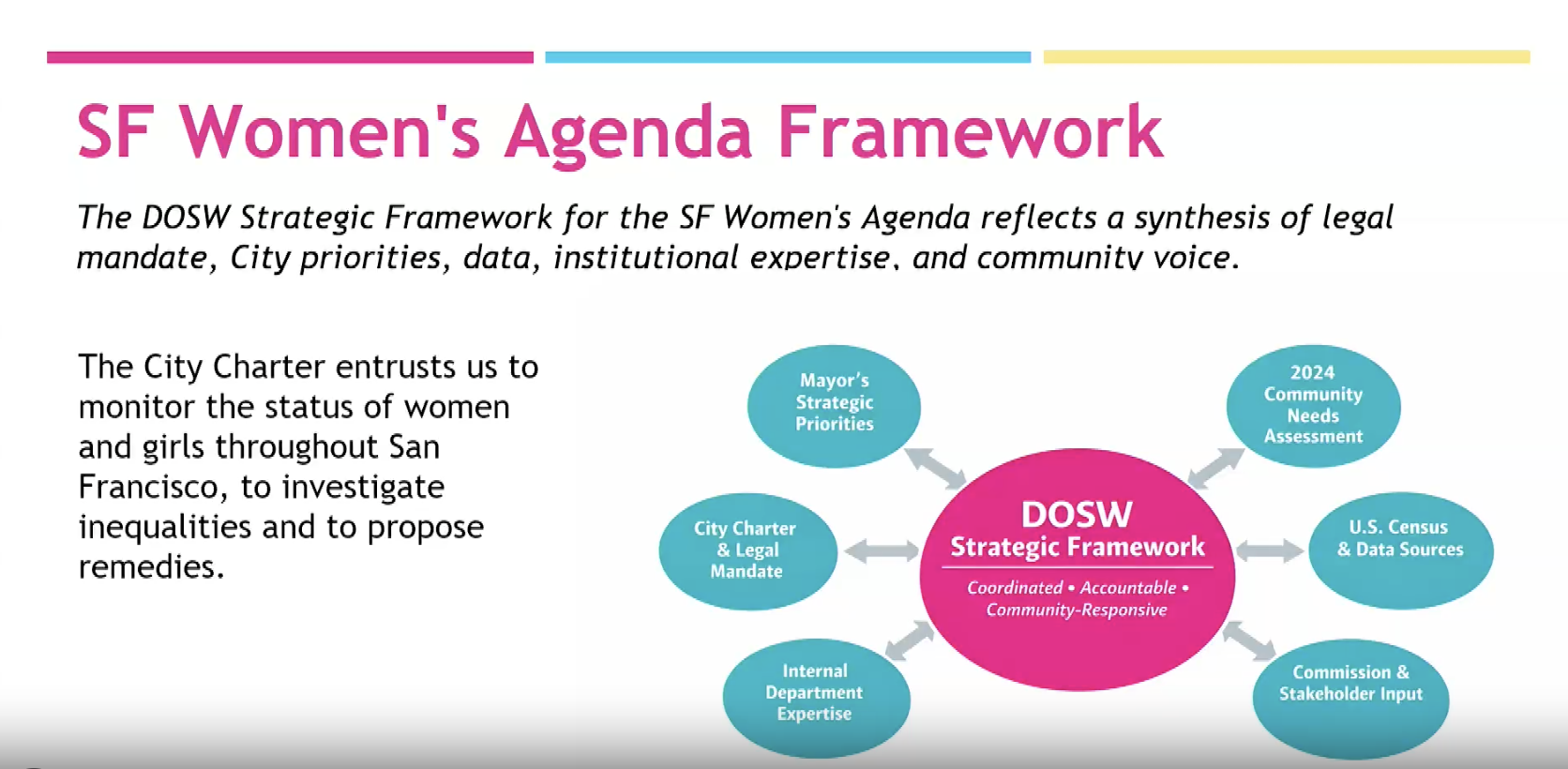
Supervisor Myrna Melgar introduced a resolution calling on the mayor to issue an executive directive establishing a citywide Women's Advancement and Gender Equity Action Plan—the first of its kind for San Francisco. The plan is organized around four pillars: health, safety, civic leadership and community engagement, and economic mobility and security.
"The face of poverty in California is a woman. It is usually a Latina woman with kids in poverty. 78 cents for every dollar a man's make is what is made by a woman," said Supervisor Melgar.
Executive Director Diana Aroche of the Department on the Status of Women, appointed in October 2025, framed the initiative as belonging to every department, not just hers: "This is not the Department on the Status of Women's Women's Agenda. This is the city and county of San Francisco's women's agenda."
What Six Departments Brought to the Table
Where things stand: Each department presented specific commitments:
Department of Public Health Director Tsai reported $20 million in annual maternal health spending but acknowledged worsening preterm birth rates for Black communities. The department's Strong Starts initiative targets those disparities, and Supervisor Melgar pressed the director on what structural relationship exists between the Commission on the Status of Women and the Health Commission to maintain ongoing accountability.
Deputy Director Julia Sabori of the Mayor's Office of Housing and Community Development outlined 39 gender-based violence grants totaling $9.37 million and announced $30 million from Proposition A bonds for two new transitional housing developments: San Francisco Safe House (23 units) and Friendship House (36 units)—59 new units dedicated to survivors.
Policy Director Jenny Lam of the Department of Early Childhood reported record enrollment exceeding 10,000 children in city-funded early learning programs and 72% preschool enrollment citywide, compared with 44% statewide. "Since the launch of the Department of Early Childhood, salaries have rose an average of 47% of the city's highest need programs," she said.
Executive Director Mouli Tubenyo of the Human Rights Commission described a joint task force examining conditions at the women's jail facility. Director Ioanna Pena of the Office of Economic and Workforce Development outlined the Council on Citywide Workforce Alignment. And Director Ivy Lee of the Mayor's Office for Victim Rights described state-level legislation with Assemblymember Catherine Stephany to allow felony charges for repeat criminal protective order violations in domestic violence cases.
Advocates Turn Out in Force—With Warnings
The other side: More than a dozen public commenters spoke in strong support, but several carried sharp warnings about whether the framework would endure without institutional independence for the Department on the Status of Women.
Carol Ito, a former commissioner on the Status of Women first appointed in 1989, cautioned that five prior administrations maintained DOSW as an independent entity and questioned why the current administration merged it under the Human Rights Commission. Dr. Kathryn Kenley Johnson, a retired SFSU gender policy researcher, echoed the concern, warning that without charter protection for the department and commission, the partnerships demonstrated at the hearing would lose their authority.
Shelter advocates from Community Forward San Francisco turned out as a bloc. Olivia Hoffman of Community Forward SF and the SF Women's Housing Coalition presented survey findings from over 400 unhoused women: 74% experienced violence while unhoused, and violence for women on the streets is "expected and constant, not episodic." Danielle Threadgill, a 13-year veteran working with unhoused women, said a one-size-fits-all shelter system causes harm and that women want women-only spaces, private rooms with lockable doors, and staff accountability. Devona Talbott, a case manager, reported that 61% of women prefer women-centered shelter spaces, but only a small fraction of beds are designed for them.
Chelsea Leonard of San Francisco Safe House described women as the fastest-growing homeless population receiving less than 5% of funding, and shared that a client told her she would rather sleep on the street than enter a co-ed shelter due to the risk of sexual assault.
Indigenous leaders also spoke. April McGill, Executive Director of the American Indian Cultural Center and a family member of an MMIP victim, advocated for a healing center for Indigenous women and girls. Morning Star Gali, Executive Director of Indigenous Justice, called for sustained funding and Indigenous-led solutions to the MMIP crisis. Beverly Upton, Executive Director of the San Francisco Domestic Violence Consortium, representing 17 agencies and roughly 50 sibling organizations, credited collective work with reducing the city's DV homicide rate by 95% but warned that services struggle to stay afloat year after year.
Supervisor Melgar also pushed departments to incorporate transit safety for women and engage with SFUSD and City College on harassment in schools: "One of the things that I hear about often is public safety for women in our public transportation systems. Harassment, physical assault, things that prevent now, especially that we have free for kids."
Decisions: The resolution was forwarded to the full board with a positive recommendation, 3-0 (Supervisor Danny Sauter, Supervisor Stephen Sherrill, and Supervisor Melgar voting yes; Chair Jackie Fielder excused).
What's next: The resolution calls on the mayor to issue an executive directive establishing the Women's Agenda as a formal, citywide accountability framework led by the Department on the Status of Women.
Victim Rights Office Wins Fundraising Waiver as DV Legal Aid Crisis Deepens
Why it matters: The Mayor's Office for Victim Rights operates on roughly $1.1 million annually—yet San Francisco records an estimated 15,000 domestic violence incidents per year. The city allocates about $1 million for DV legal services total. Peer-reviewed research shows legal aid is the only intervention proven to reduce county-level DV rates.
Director Ivy Lee of the Mayor's Office for Victim Rights presented a resolution seeking a six-month behested payment waiver to solicit donations from individuals, nonprofits, and foundations. The three fundraising priorities: homelessness prevention and urgent housing for survivors at imminent risk, right to counsel for domestic violence survivors, and UBI-style direct aid for mothers and children.
Director Lee disclosed that Stout Financial, a global consulting firm whose prior analysis established the national right to counsel for tenants, is conducting a pro bono return-on-investment study on what right to counsel for DV survivors would mean for San Francisco: "We sought out the services of Stout Financial, which is a global financial consulting firm, to run a return on investment analysis of what it would mean to the city in cost savings if we actually implemented the right to counsel for DV survivors."
Survivors Tell Their Stories
A public commenter named Brielle, a domestic violence survivor, described being choked, threatened with a rifle, and then arrested by police who assumed she was the aggressor. She went to 15 organizations and could not find legal help.
Adrienne from Open Door Legal cited Compstat data showing DV and human trafficking are the only rising violent crime categories in San Francisco. Sierra Sparks, also of Open Door Legal, noted that 43% of families entering homelessness are fleeing violence and that DV causes 80% of women's homelessness, citing per-person costs of $30,000 in police response, $50,000 in health care, and $62,000 in shelter.
Supervisor Stephen Sherrill called the waiver "a no brainer" but emphasized that the bigger takeaway is the need to permanently fund legal services, expressing eagerness for the ROI study.
Supervisor Melgar noted the irony that the city sources other public safety priorities differently: she wished victim services did not depend on private fundraising during a budget crisis.
Decisions: The resolution was amended per Chair Fielder's request to add reporting requirements—specifically that the office report donations to the board within 60 days of expiration, including, "to the extent known," any third-party recipients. It passed unanimously as amended, 3-0 (Sauter, Sherrill, Melgar; Fielder excused), and was forwarded to the full board.
What's next: The Stout Financial ROI analysis on right to counsel for DV survivors is underway and could establish a national model for prevention-based investment in victim services.
SFO's Patented Virtual Queue Targets Airport Congestion and Revenue
The basics: Under San Francisco's Chapter 19B surveillance technology ordinance, SFO presented a new virtual vehicle queue system—patented by the airport in fall 2025—that manages how Uber and Lyft drivers access airport staging lots.
Why it matters: Currently, TNC drivers circulate airport roads seeking entry to three staging lots, creating significant congestion and public safety hazards on South Airport Boulevard. The virtual queue notifies drivers when lot space is available, eliminating the need for constant physical presence.
Guy Clark, SFO's cybersecurity and compliance manager, explained that drivers register via a portal providing their legal name, a selfie photo, and their TNC profile, enabling identity verification and active-driver status checks. Suspended or deactivated drivers can be excluded in real time.
Project Manager Dushan Singh noted the underlying QTrack software is already used by the Rent Board and Assessor's Office.
Key benefits: one lot of 150 spaces can be converted to revenue-generating parking, estimated at $1–2 million annually, and driver identity verification prevents account sharing.
Supervisor Melgar raised concerns about worker welfare, noting the staging lots serve as de facto rest areas for drivers: "I understand that we're not their employer. But you know, the airport has always been sort of like a really good employer." Staff confirmed the 60-minute dwell time policy remains unchanged but acknowledged the airport does not have an employer relationship with TNC drivers. The system includes data deletion rights for inactive drivers.
Decisions: Forwarded to the full board, 3-0 (Sauter, Sherrill, Melgar; Fielder excused), with no public comment.
DPW Cuts Permit Times Dramatically, but Staffing Gaps Remain
Why it matters: Disability access permitting is the top complaint from small businesses in San Francisco. Public Works presented dramatic reforms—but also revealed that the team responsible for ensuring compliance has been cut nearly in half.
Supervisor Sherrill led the hearing, motivated by overlapping concerns from small business owners and from San Francisco's aging and disabled communities.
Development Permits Manager Deborah Lutzky detailed the transformation: the department transitioned to Bluebeam electronic plan review, enabling 12 agencies to review concurrently instead of sequentially, with 30-day interagency review service-level agreements. "Originally before the implementations we were seeing three to nine months for review cycles. Now we're down to 30 days. Completeness reviews were up at 102 days, now they're down to 20 days," she said. Resubmittals dropped by 50%, and first-pass completeness rose from 1% to 37%.
Legislative changes under Permit SF also eliminated duplicative permits for minor work—door actuators and wheelchair lifts under four inches no longer require separate DPW permits.
Disability Access Coordinator Kevin Jensen, a licensed architect with 30 years at the city, revealed that his team has been reduced from four licensed engineers to two, with one rotation and one recently approved hire. He noted San Francisco's national reputation in the field: "New York City revamped their compliance entirely and looked around the country for jurisdictions that were doing things that they liked and they landed on San Francisco."
Supervisor Sherrill probed whether the city could move toward self-certification to speed approvals further. Staff explained the city bears liability for right-of-way work, making pre-construction review critical. Sherrill also questioned whether the 30-day shot clocks are truly experienced by applicants as single periods or as stacked sequential reviews: "A business owner might expect one month and then I'm going to go. But the reality is it's like no, it's four one-month periods stacked on top of each other."
Decisions: The hearing was continued to the call of the chair for further examination, 2-0 (Sherrill, Sauter; Fielder and Melgar absent). No public comment was received.
What's next: The committee will revisit ADA permitting at a future hearing, with open questions about self-certification, Prop H compliance, and whether staffing levels can sustain the improvements.
Minor Items
Settlement items (Items 5–13): Nine settlement items—26 ordinances and 3 resolutions authorizing the settlement of lawsuits and unlitigated claims against the city—were forwarded to the full board without discussion, 2-0 (Sherrill, Sauter; Fielder and Melgar absent).
Chair Fielder excused: The committee voted 3-0 to excuse Chair Jackie Fielder from the meeting. Supervisor Melgar sat in for the chair.
Quote lightly edited for clarity. Review original transcript for full quote.