Government Audit & Oversight Committee - Sep 17, 2026 - Regular Meeting
Government Audit & Oversight Committee • San FranciscoSeptember 17, 2026
Locunity is a independent informational service and is not an official government page for this commission.We use AI-assisted analysis and human editorial review to publish information.
Grand Jury Exposes Accountability Gaps Across Jails, Homelessness, Emergency Systems
The San Francisco Board of Supervisors' Government Audit and Oversight Committee spent nearly four hours Thursday hearing five civil grand jury reports that painted a picture of a city making do — with offline sirens, paper-based jail records, fragmented wildfire management, and a half-billion-dollar homelessness system that can't connect the dots on safety failures. All five sets of board responses were forwarded to the full board, but the committee largely deferred implementation to city departments rather than mandating specific changes.
Grand jury finds decade of capital neglect has left SF jails reliant on paper records and a "making do" culture, with the new jail management system delayed to mid-2027
Board declines to require public safety data for HSH's $500M nonprofit portfolio despite emotional testimony from the sister of a man found dead — the fourth undiscovered death at the same building
SF's outdoor warning sirens have been offline since 2019; restoration would cost ~$20M while Alert SF reaches only a fraction of residents
Four agencies manage Glen Canyon vegetation without coordination, where eucalyptus — rated the most flammable tree species — dominates the canopy
Committee forwards retirement board campaign disclosure rollback without recommendation after retiree groups warn of dark money risks
City settles five-year federal lawsuit over airport worker healthcare rules for $0
A Decade of 'Making Do' in SF Jails
The most extensive presentation of the day came from Margaret Keane, chair of the San Francisco Civil Grand Jury team. Keane detailed conditions in San Francisco's jails since the 2015 decision not to build a new facility — a choice she said has led to capital starvation, dangerous overcrowding at booking, and a staff culture defined by workaround after workaround.
The basics: County Jail 1 simultaneously serves as the city's booking facility, release point, and transit hub, creating what the grand jury described as dangerous conditions. The jail management system remains paper-based, and jail capital needs are classified as "emerging" — meaning they fall outside the city's 10-year capital plan entirely.
Why it matters: While the current incarcerated population is down following the Kowalchik court ruling, bookings are surging. "Jail bookings are way up. The number of people in the jail is down who are kept, but the number of people who come into the jail — arrested, brought to the county jail, processed, booked, fingerprinted — is way up," said Keane. She warned that four months of declining population data is premature for pulling back on capital planning, noting bookings are at their highest since August 2019.
Where things stand: The grand jury found staff across the system repeatedly told investigators the same thing. "We interviewed a lot of people and we'd say, how can you do this? And we heard that over and over: 'We make do,'" Keane said. The report highlighted increasingly complex health needs driven by fentanyl and co-occurring mental health conditions, late-night releases near drug markets that heighten relapse risk, and a booking operation that has never been designed for the volume it now handles.
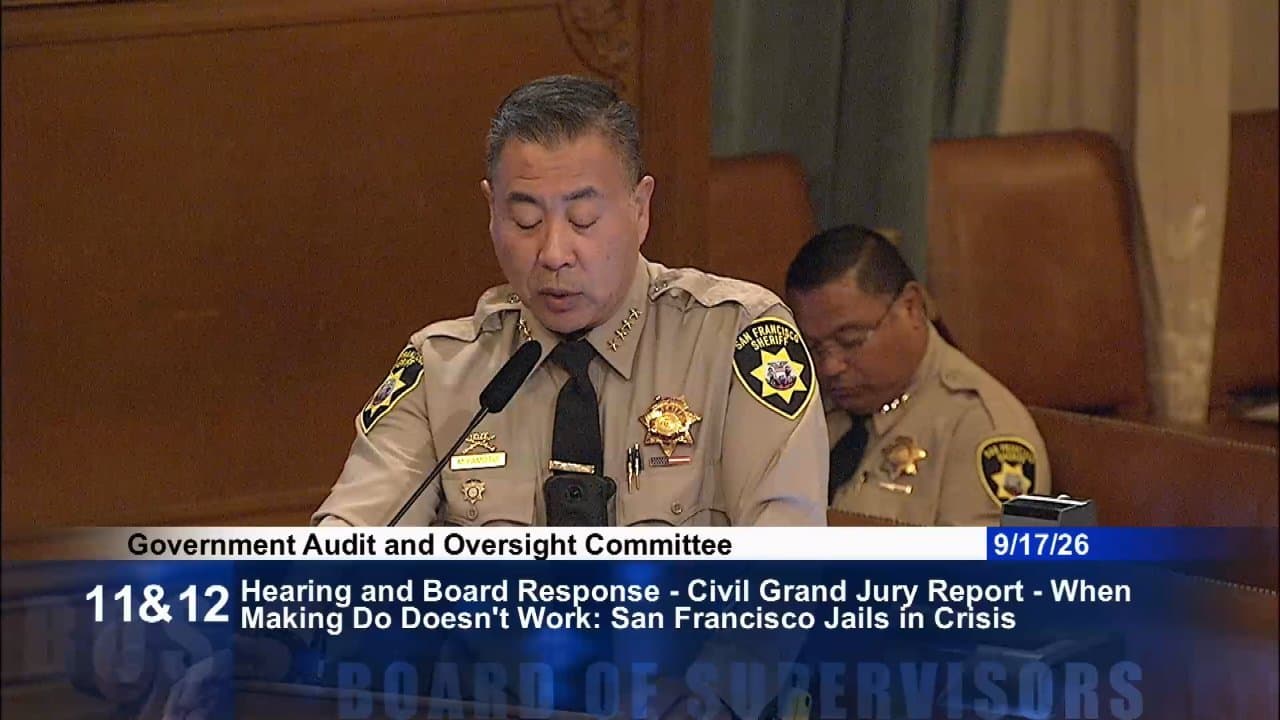
Sheriff Paul Miyamoto confirmed the new jail management system will miss its September 2026 target date. "We have a possible go-live date of April or May 2027. But realistic, if there are any hiccups, would be an end date of July 2027," Miyamoto said. On the positive side, he reported operational improvements: "In the first quarter here for this fiscal year, we had zero facility lockdowns where everybody had to go back and get locked down."
Vice Chair Jackie Fielder conducted extensive questioning on capital needs, food quality, family visitation, tablet resources, and discharge planning. Matthew Puckett, Deputy Director of the Mayor's Budget Office, defended the existing capital planning process but acknowledged ongoing investment needs.
Decisions: The committee amended and forwarded the board's response resolution to the full board, 3-0 (For: Sherrill, Fielder, Wong; Against: none). All supervisors committed to inspecting San Francisco and San Bruno jail facilities by June 2027. The hearing itself was continued to the call of the chair — a signal that the committee intends to revisit jail conditions.
Josh Jacobo of Nuestra Causa urged the committee to engage the sheriff's oversight board, noting that the mandated inspector general position has been vacant for over a year.
What's next: The full board will take up the response resolution. All supervisors are expected to complete jail inspections by June 2027, and the board urged the sheriff and DPH to jointly analyze barriers to meeting inmate treatment needs.
Board Declines Public Safety Dashboard for HSH's $500M System
Grand jury Investigation Committee Chair Gary Hsueh presented "At Scale At Risk," a report examining data and oversight gaps in HSH's roughly $500 million annual nonprofit contract system. The jury made three core asks: use data for portfolio benchmarking, include safety as a measured outcome in contracts, and strengthen the Homelessness Oversight Commission's independent role.
Why it matters: Hsueh cited the November 2025 death of Eric McCain at Jazzy Collins Apartments — the fourth person found decomposed at the same building — as evidence that critical incident report data was not being aggregated to identify patterns.
"For three to happen is tragic enough, but for a fourth to happen and for someone not to connect the dots from those three prior incidents and investigate it, I think is a disservice," Hsueh said.
Where things stand: HSH collects extensive data on critical incidents and provider performance but, the grand jury found, does not use it effectively for benchmarking or public accountability. Hsueh framed public transparency as essential to rebuilding trust:
"I think public visibility of HSH and their progress on safety is going to go a long ways in re-establishing that public trust."
The other side: Sophia Kittler, Budget Director in the Mayor's Office, acknowledged the need for improvement but pushed back on making granular CIR data public. "The more granular public information we make available, the less trust there can be between what looks like a public shaming and the necessary partnership that we need between our nonprofit partners and providers in the city," Kittler said. Emily Cohen, Deputy Director for Communications & Legislative Affairs for the Department of Homelessness and Supportive Housing (HSH), noted that CIR analysis had already led to the creation of an anti-violence and weapons policy.
The most powerful testimony came from Aisha McCain, Eric's sister, who addressed the committee carrying her brother's ashes.
"Critical incident reports are obviously not being looked at because if they were, my brother would not be the fourth person found decomposed in Jazzy Collins apartments," she said.
Decisions: The committee amended and forwarded the board's response to the full board, 3-0. The response partially agreed with the grand jury's findings, declared a CIR dashboard already implemented internally, but declined to mandate public access, safety standards in contracts, or contract consent calendar recommendations — instead deferring those decisions to the department.
What's next: The grand jury had urged the board to align safety standards with Mayor Lurie's ongoing contract reprocurement process. Whether HSH acts on those recommendations without a board mandate remains an open question.
Offline Sirens, Underfunded Alerts: Two Reports on Emergency Gaps
The committee heard two related grand jury reports on San Francisco's emergency warning infrastructure — one on the physical siren system that has been offline since 2019, the other on the digital Alert SF system that reaches only a fraction of the city's population.
The Sounds of Silence: $20M Sirens Gathering Dust
Rob Chancellor, grand juror, presented findings on the outdoor public warning system, noting that the sirens have consumed DEM staff capacity for years without progress on either restoration or retirement. Mary Ellen Carroll, Executive Director of the Department of Emergency Management, estimated a full replacement at approximately $20 million.
Supervisor Alan Wong challenged the jury on the value of siren redundancy, noting that he personally runs along the Great Highway Trail without his phone. "I actually never bring my cell phone or any technology with me. And many other people just don't have cell phones," Wong said. Chancellor responded by raising the question of how people would react to a siren they might hear once in a generation, and the risk of "milling" behavior — people standing around trying to figure out what the sound means.
The committee's board response partially disagreed with some grand jury findings, agreed with others, and declared one recommendation on hardware removal already implemented. All responses were adopted 3-0.
Fog of Warning: Alert SF's Reach Problem
A companion report examined digital alert systems. Alert SF has stabilized at about 76,000 subscribers in a city of more than 800,000 — far short of adequate coverage. Jackie Thornhill, Communications Manager for the Department of Emergency Management (DEM) reported that the department conducted over 60 in-person community events to grow subscriptions and launched a WhatsApp channel that has reached 62,000 subscribers, effectively doubling opt-in reach.
The grand jury recommended citywide standards for alert messaging, including resolution/closure messages, multilingual content, and protocols for wireless emergency alerts. Vice Chair Jackie Fielder asked about ADA compliance; Thornhill confirmed DEM relies on its vendor, Everbridge.
Decisions: The board's response agreed that Alert SF is underfunded — the department has only $10,000 in non-personnel funds for digital advertising — but declined the grand jury's budget recommendation, deferring resource decisions to the annual budget process. Both responses were amended and forwarded 3-0.
Four Agencies, Zero Coordination: Glen Canyon's Wildfire Risk
Grand juror Rick Carroll presented "Red Flag Warning," a report documenting fragmented vegetation management across Rec & Park, DPW, PUC, and the San Francisco Unified School District in Glen Canyon — where eucalyptus dominates the canopy.
The basics: Eucalyptus is rated the most flammable tree species on a 1-to-10 scale. "One being most flammable to 10 being least flammable, it is a 1. The same as dry grass — has very oily leaves that can burst into flames," Carroll said. The 1991 Oakland Hills fire derived 70% of its energy from eucalyptus.
Why it matters: DPW's "worse first" maintenance policy has resulted in virtually no work in its steep Glen Canyon sector. Meanwhile, the Urban Forestry Council — which had coordinated agency efforts — was dissolved June 30, 2026, leaving a gap. Rec & Park has the smallest urban forestry budget at $6.1 million despite managing potentially 80% of the city's canopy. The school district, by contrast, has innovatively brought in goats for vegetation management and communicates directly with Cal Fire.
Decisions: Supervisor Alan Wong proposed board responses that partially disagreed with the grand jury's finding of "material wildfire danger citywide" while agreeing on the need for better inter-agency coordination. The amended resolution was forwarded 3-0.
Retirement Board Disclosure Rollback Sent Forward Without Endorsement
Grace Huang, legislative aide in President Mandelman's office, presented an ordinance to repeal campaign registration, disclosure, and reporting requirements for candidates seeking election to the Retirement Board, Health Service Board, and Retiree Healthcare Trust Fund Board. The Ethics Commission found the program generated minimal activity since 2018: only seven candidates ever registered, only one raised money — a total of $78.60 — and no third-party spending was reported.
The other side: Vice Chair Jackie Fielder raised concerns about eliminating Form 700 disclosure requirements for boards overseeing billions in assets. "I definitely have concerns over that. Seeing that this retirement board — their jurisdiction is over billions of dollars, I do think it makes sense to have them file Form 700s," she said. Michael Canning, Policy and Legislative Affairs Manager at the Ethics Commission, suggested Form 700 filing could potentially be retained through a separate code section. Deputy City Attorney Brad Russi confirmed that assuming-office and annual Form 700 obligations would still apply.
Fred Sanchez, president of Protect Our Benefits and a retired San Francisco Fire Department deputy chief, argued the boards overseeing retirement and healthcare funds are prime targets for dark money and urged maintaining current guardrails. Dr. Teresa Palmer, board member of Protect Our Benefits and a retired Laguna Honda physician, echoed those concerns.
Decisions: Chair Stephen Sherrill initially moved for a positive recommendation but withdrew. "In light of the questions from my colleagues, I think I might withdraw my motion to forward this with positive recommendation. Instead make a motion to forward to the full board without recommendation," he said. The item was forwarded without recommendation, 3-0.
City Settles Airport Healthcare Lawsuit for $0
Sophie Marie, Chief of Staff in President Mandelman's office, presented amendments to the Healthy Airport Ordinance as part of a settlement resolving a 2021 federal lawsuit brought by Airlines for America. The amendments replace tiered healthcare expenditure rates with a single rate, create an alternative compliance path, and set hours-based coverage thresholds.
Deputy City Attorney Brad Russi confirmed the settlement requires the board to adopt these specific amendments. The settlement is for $0, with each party paying its own costs. Both the ordinance amendments and the settlement authorization were forwarded to the full board with positive recommendation, 3-0, with no public comment.
Minor Items
Film Commission behested payment waiver: The committee unanimously approved a six-month waiver allowing Film SF to solicit in-kind marketing support from San Francisco Travel Association and local hotels, which are classified as restricted sources because they obtain film permits through the commission. Ike Kwan of SF Travel spoke in support. Forwarded 3-0.
Grand jury introduction: Ed Cooper, foreperson of the 2025–2026 civil grand jury, framed all five reports around a common principle: "Each report starts from the same premise that San Franciscans are entitled to know whether the city systems are doing what they're supposed to do." Chair Sherrill estimated the jury invested at least 500 hours across the reports.
All votes throughout the four-hour meeting were unanimous, 3-0.