
Supervisors Subpoena Domus, Co-op Boards After Western Addition Hearing No-Shows
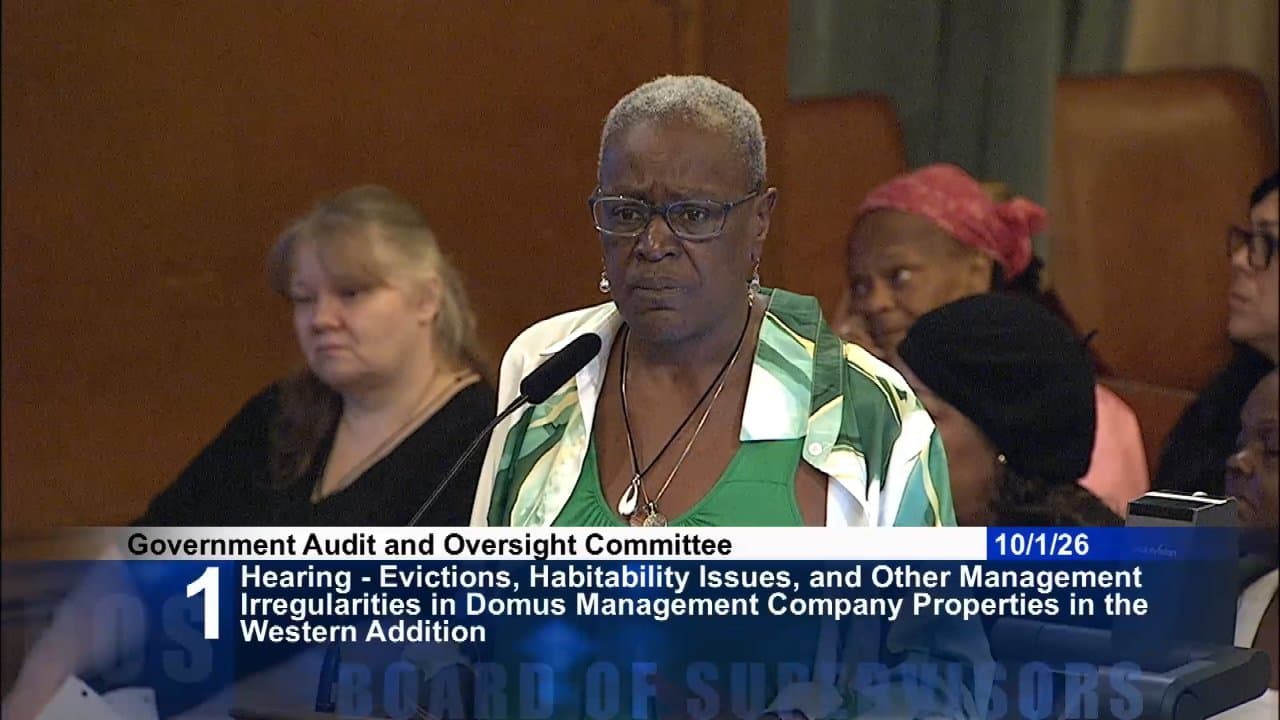
Government Audit & Oversight Committee • San FranciscoOctober 1, 2026
Locunity is an independent informational service and is not an official government page for this commission. All information is sourced from public footage and an analysis of official agendas with the aid of responsible, fact-checked AI. to report an error or omission.
Not one manager, owner or board invited to explain evictions and conditions at three Western Addition affordable housing complexes showed up. So on Oct. 1, 2026, San Francisco's Government Audit and Oversight Committee voted 2-0 to compel them, using subpoena power the board rarely exercises, and set a continued hearing tentatively for Dec. 3. Over more than two and a half hours, residents of Martin Luther King/Marcus Garvey Square, Thomas Paine Square and Amel Park described disputed ledgers, refused rent, unrepaired units and a city government that mostly lacks the authority to intervene.
Subpoenas approved 2-0 for Domus Management, two co-op boards, Allen CDC officers and attorney Mercedes Gavin
Tenant lawyer says King Garvey ledgers claim up to $47,000 against $6,000 eviction notices
Thomas Paine residents describe absent security, refused rent and staff break-ins
King Garvey shareholders cite 80 building complaints and a new $59M loan signed without a quorum
Amel Park families face eviction over an undocumented HUD subsidy claim
City agencies say they can't enforce: the Human Rights Commission can only mediate, and Domus won't engage
Empty Chairs, Then Subpoenas
Why it matters: Domus Management has run all three complexes since 2024. All three receive HUD Project-Based Rental Assistance, which leaves San Francisco with little direct oversight. Subpoenas give the city its most direct leverage yet.
Where things stand: Supervisor Bilal Mahmood, District 5, represents the Western Addition and led the hearing, though he does not sit on the committee. He said at the outset that the hearing would end with subpoenas for any party that declined to appear. Those who did not appear included Domus, the MLK/Marcus Garvey co-op board, the Amel Park board and Allen Community Development Corporation, which declined through attorney Vernon Goins. The Department of Building Inspection, HUD and the California Affordable Housing Initiatives were also absent.
HUD is out of reach. "We cannot issue subpoenas to federal departments," said Mahmood.
Mahmood framed Domus as the common thread among the three properties but not the only culprit. "Domus is hardly the only bad actor, nor are they alone to blame for the difficulties residents at their properties have been facing," he said. He called the subpoenas one of the first the body has issued in some time.
Public commenters pushed hard for the step. "Do not accept an empty chair. Vote the subpoenas, compel the ledgers, the recertification logs, the board solutions, the legal fees charged to the cooperative," said Malik Washington, a journalist who has covered King Garvey since April.
Decisions and stakeholder impacts: Supervisor Alan Wong said resident testimony was enough for him. "What I've heard from you directly is a pattern of mistreating people and mismanagement of the property. And I'm going to support the motion for a subpoena," he said.
Supervisor Stephen Sherrill, District 2, the committee chair, moved the subpoenas under Board Rule 3.3.1 and credited Mahmood with driving the effort. "The actions we're about to take will not be the last actions," Sherrill said.
The subpoenas compel the following parties to appear:
Domus: Anthony Sandoval and Christine Mason
Attorney: Mercedes Gavin
MLK/Marcus Garvey board: Linda Yokum, Sean Kim, Amelia Penat and Lavonne McIntosh
Allen CDC officers: Rev. Cecil Williams Jr., Alice Johnson, Nicole Acker and Bobby Sisk
Amel Park board: Ezra Mozgan
Vote on subpoenas 2-0-1 (For: Sherrill, Wong; Against: none; Absent: Fielder). A second motion, to continue the hearing to the call of the chair, passed by the same 2-0 margin.
What's next: The continued hearing is tentatively set for Dec. 3. Residents and advocates expect the subpoenaed parties to answer for ledgers, evictions and repairs.
The Ledger Gap
The basics: An unlawful detainer is an eviction lawsuit. It typically follows a 3-day notice to pay or quit. For now, subsidized housing gets a 30-day notice instead.
Where things stand: Tuesday Thornton, a staff attorney with the Eviction Defense Collaborative, represents two King Garvey tenants. The noticed amounts in her cases were about $5,000 and $6,000, but the property's ledgers claim far more, including debts that predate Domus.
"In one of my cases, the plaintiffs are claiming that the tenant owes like $47,000, even though the notice amount is only $6,000," Thornton said.
She said Domus itself conceded the point in a meeting. "Christine Mason, who is a property manager at Domus, or operations manager, I believe, stated that Domus did not have the records to back up the arrears that were in these ledgers," Thornton said.
The count of eviction cases varies by source:
Thornton: estimated 10 to 13 unlawful detainers
Supervisor Bilal Mahmood, District 5: cited eight
Malik Washington: said nine were filed May 1
Thornton also disputed what the co-op's attorney told Mahmood's office. She said she had received no settlement offers in either of her cases, and Open Door Legal confirmed the same.
Why it matters: California has no "right of redemption," so landlords can still evict tenants who pay the full noticed amount. Thornton said landlords "Trojan horse" older alleged arrears into settlement talks. Meanwhile, the city pays her and her colleagues to defend these cases.
Fielder asked whether that rule comes from state law. The answer pointed to the state Civil Code as a reform target, and the exchange noted that reform could also save the city legal costs.
Washington cited an 85-year-old resident, Ms. Harper.
"This spring, her manager told her that she owed $93,000. The eviction notice taped to her door said $10,000," he said. "That is not a bookkeeping error. That is a machine."
Thomas Paine Square: Security Nobody Sees
The basics: Allen CDC has owned Thomas Paine Square since 2001. The nonprofit is affiliated with Bethel AME Church, led by Rev. Cecil Williams Jr. Domus took over management in 2024.
Where things stand: Supervisor Bilal Mahmood, District 5 cited San Francisco Standard reporting that Allen CDC leader Bobby Sisk contracted with a security company he also controlled. He also entered into the record reports that staff broke into units and stole gifts at Christmas, and that a resident was harassed until brutally assaulted.
Deborah, a 16-year resident and tenants alliance spokesperson, described a pattern of management failures:
Rapid manager turnover and limited office hours
Misplaced files and recertifications that take 3 to 18 months
Refusal to provide ledgers
"Recertification has become retaliatory," she said. "The security company that we have that was WBC, it's a joke."
For four months, Domus returned her rent money orders. That led to an eviction case, which she resolved with EDC's help. Conditions worsened after a June meeting with Bethel AME leadership, she said.
"Nothing has gotten better. I mean, if anything, it has gotten worse."
The other side: Allen CDC declined to attend, and no Domus representative spoke.
Other residents filled in the picture:
Rhonda, a tenant, named the staff behind December's break-ins, who were caught on camera and fired.
Antonio McBride and Denise Benjamin said they were denied ledgers or had rent refused.
Evelyn Fields, a disabled resident who uses oxygen, said she got 48 hours' notice to relocate to a hotel and an unexplained $7,000 PG&E bill.
Isaac Santiago, a HUD organizer with the Housing Rights Committee of San Francisco, described rent ledger errors and said Domus initially denied the break-in.
"We pay for security, so we need answers," said Jessica, a member of the Thomas Paine Square tenants association.
Decisions and stakeholder impacts: Longtime Black Fillmore tenants carry the risk. Allen CDC and Sisk now face subpoenas over the security contract and oversight of the property.
King Garvey and Amel Park: Co-op Owners in the Dark
The basics: In a limited-equity co-op, residents own shares in the property but resale value is capped. Shareholders depend on the board and managing agent for financial reporting.
Where things stand: At MLK/Marcus Garvey, Supervisor Bilal Mahmood, District 5 said a refinancing required recertifications and back-rent recovery, which led to eviction warnings and lawsuits. "There have been 80, and I repeat, 80 DBI complaints filed on the complex since the beginning of 2024, some of which remain unabated," Mahmood said.
Dee Dee Hewitt, a shareholder and former board member of more than 30 years, made several allegations:
Sixteen African American owners were placed on eviction lists without proper service.
She receives eviction notices after filing habitability complaints.
Four kinds of asbestos were found in her unit.
She has received no equity or interest reports in four to five years.
She said board president Linda Yokum signed a $54M renovation in 2010 and a new loan last month without a shareholder quorum. "She just last month signed off and put us in debt another $59 million," Hewitt said. She called for a forensic investigation of Domus and the board.
Daniel Landry, a recently removed board member, alleged the co-op operates under bylaws revised in 2009 that he called illegal. He also described exposed applicant records. "A folder of the move-in waiting list is just in a big old brown box. Over 500 Social Security numbers," he said.
Martina Roland, a resident and former board member, said HUD, Rev. Amos Brown and Bobby Sisk recommended Domus. Sammy Broadnix, an 80-year-old wheelchair user, said a lift failed, he recently fell on stairs, and the locked windows in his ADA unit would trap him in a fire.
At Amel Park, Mahmood said market-rate 4-bedroom rents rose from $2,000 to more than $6,000 in two years under Domus. Harriet Larkin, a resident representative, speaks for about 10 households, mostly Ethiopian and Eritrean. She said Domus claims HUD no longer subsidizes 4-bedroom units but could produce nothing in writing. "If they don't convert to Section 8, they're going to be evicted," she said. She added that a $1.5M loan was taken while units suffer flooding, mold and rats, and that shareholders still lack annual financials. "I Googled HUD. HUD has not made any changes."
What's next: Board members from both co-ops are subpoenaed for the continued hearing.
A Jurisdictional Void, and Ideas to Fill It
Why it matters: Residents said they are stuck between a federal funder that skipped the hearing and city agencies that lack authority over these properties.
Where things stand: Mauli Tubenyo, executive director of the Human Rights Commission, said civil rights complaints are up 84% in three years. He said complaints from King Garvey come primarily from senior Black women. "At present, we do not have authority to enforce at the King Garvey site because Domus is not a city contractor," he said.
Ana Moraga Archila, supervising manager of the Civil Rights Division, said the commission sent Domus a letter of concern and got back only general statements about property changes. "So we can only mediate, and they have to be willing to come to the table and engage in that process with us," she said.
Mahmood noted that the Mayor's Office of Housing and Community Development holds loans on the properties but has no oversight authority. The SF Housing Authority has none either.
He asked residents what they want in Supervisor Myrna Melgar's announced co-op legislation. Their proposals included:
Hewitt: a contract-compliance oversight body tied to public financing, plus more Open Door Legal funding
Landry: stronger Human Rights Commission authority and a way to require HUD officials at hearings
Malik Washington: a model "Affordable Housing Property Manager Accountability Act" requiring certified ledgers before notices and biennial audits
Belinda Racklin, a HUD-certified counselor: certificates of preference so evicted residents can apply through DAHLIA
"Public funding should not reward failure. It should come with real accountability and resident oversight," said Santiago. Other commenters, including Micah Pinkston of the Citywide HUD Alliance, said similar problems exist at Plaza East, Alice Griffith and Bayview sites.
Minor Items
Fielder excused: The committee voted 2-0 to excuse Supervisor Fielder before the subpoena vote.
Off-topic comment: Ken Johnson, a public commenter, said money meant for the Fillmore was redirected to the Golden Gate Bridge.
Looking Ahead
The continued hearing on Domus-managed properties is tentatively set for Dec. 3, with the subpoenaed parties compelled to appear. Testimony from this hearing is also expected to inform Supervisor Melgar's co-op legislation.