
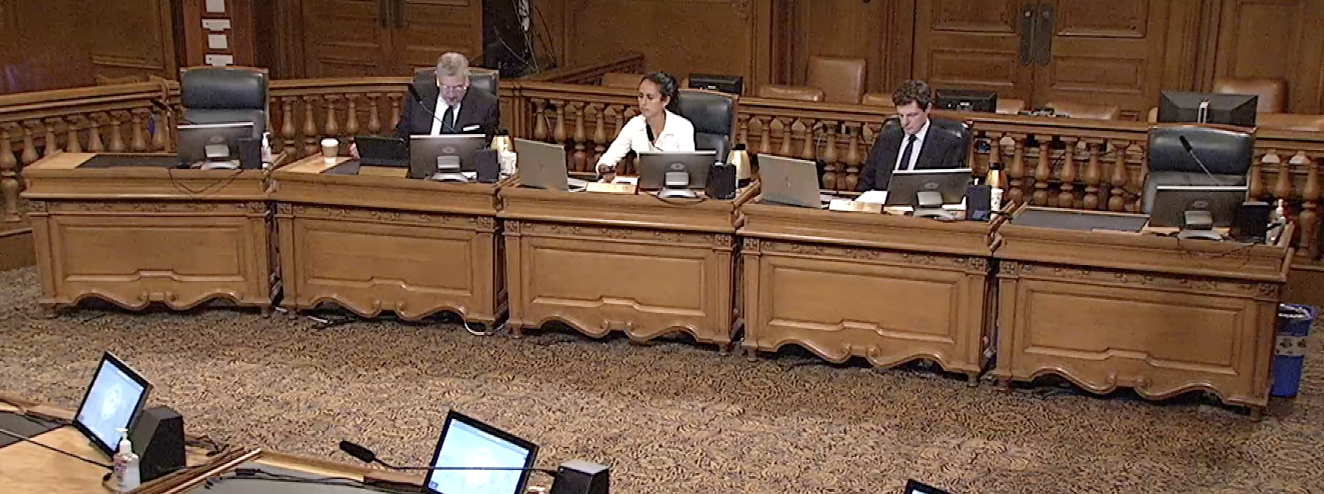
Government Audit & Oversight Committee - Mar 05, 2026 - Regular Meeting

Government Audit & Oversight Committee - Mar 05, 2026 - Regular Meeting

Government Audit & Oversight CommitteeSan FranciscoMarch 5, 2026

Sources:

Locunity is a independent informational service and is not an official government page for this commission.We use AI-assisted analysis and human editorial review to publish information.

Committee Advances Ordinance Cracking Down on Notary Immigration Fraud

San Francisco's Government Audit & Oversight Committee unanimously advanced an ordinance targeting predatory notaries who illegally charge immigrants for legal advice — a new local enforcement tool arriving as federal immigration crackdowns heighten community vulnerability. The committee also approved a ShotSpotter surveillance report that revealed a glaring data gap: the city logged 797 gunshot-detection alerts last year but has no idea how many were false positives.

  • Notary fraud ordinance moves to full Board after community groups rally in support and an HRC employee warns the agency lacks funding for its new enforcement role

  • ShotSpotter logged 797 alerts in 2024-2025, but the city doesn't track whether they're accurate — and the contract runs through April 2029

  • Entire Feb. 19 meeting voided after the San Francisco Examiner failed to publish a legally required notice, forcing the committee to re-vote on eight items

  • Seven lawsuit settlements forwarded to the full Board for March 10 consideration


Immigrants, Fraudulent Notaries and a New City Shield

The basics: In Mexico and most Latin American countries, notarios públicos are licensed legal professionals — roughly equivalent to attorneys. When immigrants arrive in the United States, many assume U.S. notaries hold the same authority. They don't. The result is a well-documented pattern of unlicensed notaries charging vulnerable immigrants for legal advice they're not qualified to give.

Why it matters: The ordinance, authored by Chair Jackie Fielder, Supervisor, District 9, creates a new local enforcement layer at a moment when immigrant communities face intensifying federal pressure. It requires notary businesses and individuals assisting with immigration documents — who are not licensed attorneys — to provide a city-prepared listing of free and low-cost immigration legal service providers and consulates. The San Francisco Human Rights Commission would be authorized to receive complaints, investigate violations, and levy fines. The Office of Economic and Workforce Development would implement a public outreach plan.

Where things stand: Chair Fielder laid out the stakes in blunt terms: "In Mexico and most Latin American countries, notarios públicos are legal professionals and attorneys authorized to provide legal services. So when immigrants come to the U.S., they are often unaware that there's a difference here and that notaries are not licensed attorneys and not legally allowed to provide legal advice."

She cited one high-profile San Francisco case as evidence: a City Attorney lawsuit against notary Leonard Lacayo that resulted in a $600,000 court judgment for predatory behavior against hundreds of immigrants.

Supervisor Dorsey, who sat in for excused Vice Chair Danny Sauter, Supervisor, District 3, immediately asked to be added as co-sponsor. "I was in the San Francisco City Attorney's office when then-City Attorney Dennis Herrera first filed the case against Lacayo and Associates," Supervisor Dorsey said. "It is heartbreaking the kind of fraudulent activities that can play out when people are facing really difficult legal situations, and especially in the environment we're in today."

Two community organizations testified in strong support. Michelle Miguelez of the Good Samaritan Family Resource Center said her organization has witnessed vulnerable immigrant families victimized by dishonest notaries and immigration consultants and urged the committee to move forward. Susana Rojas, Executive Director of Calle Venti Cuatro Latino Cultural District, representing several organizations, urged support, noting the current anti-immigrant narrative is leading people to take advantage of those who are afraid and trying to follow the law.

The other side: Matthew Oglander, an SF Human Rights Commission employee and SEIU Local 1021 member, speaking in a personal capacity, raised pointed concerns about unfunded mandates. "I am concerned that the proposal adds a new enforcement function for HRC without any funding or resources to accomplish its goals," he said. He noted that HRC currently has no enforcement duties under Administrative Code Chapter 100, no comparable enforcement function regarding business referral documents, and no staff with experience working under that chapter. He urged the committee to reconsult with the union and HRC before proceeding.

Decisions: The committee adopted non-substantive amendments and forwarded the ordinance to the full Board of Supervisors with a positive recommendation (For: 3 — Supervisor Dorsey, Supervisor Stephen Sherrill, Chair Fielder; Against: 0; Absent: 1 — Vice Chair Sauter).

What's next: The ordinance heads to the full Board of Supervisors. The unfunded-enforcement question raised by Oglander — whether HRC can absorb complaint investigation and fine-levying duties without additional resources — is likely to surface again.


797 Alerts, Zero Accountability Data

Why it matters: San Francisco's ShotSpotter gunshot-detection system, now operated by contractor Sound Thinking, generated 797 alerts in 2024-2025 — but the city cannot say how many were real gunshots versus false positives.

Where things stand: Deputy Director Rob Smuts of the Department of Emergency Management presented the annual surveillance technology report. He explained that DEM operates the city's 911 center and that ShotSpotter alerts appear on a supervisory bridge, triggering calls for service to SFPD. "We have this technology enabled on our supervisor bridge and it alerts us when it detects a gunshot. And we then send that up as a call for service for the police department," Deputy Director Smuts said.

Chair Fielder pressed on accuracy: "Do you keep data on the false positive rate for ShotSpotter?" Assistant Deputy Director Janet Fallings of DEM's Division of Emergency Communications reported the 797 incidents but said the department does not track call outcomes or distinguish between false and valid alerts. She noted that Sound Thinking operates its own monitoring center that pre-screens sounds — filtering out backfires and firecrackers — before forwarding alerts to the city.

Decisions: The committee forwarded the report to the full Board with a positive recommendation, 3-0. The SFPD contract with Sound Thinking runs through April 2029.


Newspaper Noticing Failure Voids Entire Feb. 19 Meeting

Chair Fielder opened the meeting with an unusual disclosure: every action taken at the committee's Feb. 19 session had to be reconsidered. "After the meeting adjourned, the clerk of the Board and I were informed that the San Francisco Examiner actually failed to properly notice the February 19th meeting in the newspaper. Therefore, unfortunately, all actions we took that day were null and void," she said. Charter Section 2.108 requires newspaper publication, and the Examiner had represented to the clerk that the notice was posted — but it wasn't. Eight items were re-voted without additional discussion.


Minor Items

  • Police Commission Statement of Purpose: Sergeant Stacy Youngblood, Police Commission Secretary, presented the charter-required statement originally approved by the Police Commission on May 8, 2024. Beginning in 2027, it will be incorporated into the Commission's annual report. Forwarded 3-0.

  • Mission District Housing Hearing (2000-2070 Bryant St, 681 Florida St): Hearing on financial commitments by private developers, including $500,000 in capital funding for tenant improvements to a community art space at 681 Florida St. Filed without discussion, 3-0. Reconsidered from voided Feb. 19 meeting.

  • Lawsuit and Claims Settlements (Items 5-11): Seven items — three ordinances and four resolutions — authorizing settlement of lawsuits and unlitigated claims. All forwarded as committee reports for the March 10 full Board meeting, 3-0.