
Goals House Day 2 Finds the Challenge Is Not Innovation — It's Trust
Goals House • United NationsSeptember 21, 2026
Locunity is an independent informational service and is not an official government page for this commission. All information is sourced from public footage and an analysis of official agendas with the aid of responsible, fact-checked AI. to report an error or omission.
Across 16 sessions spanning health, AI, climate, nature, and workforce development, Goals House Day 2 at UNGA and Climate Week New York surfaced a single binding theme: the world does not lack solutions — it lacks the trust, delivery systems, and partnerships to get them to people. From mental health to malaria, from data centers to maternal mortality, every conversation returned to the gap between what is possible and what is actually reaching communities.
- WHO Foundation chief argues mental health progress starts with human connection, not expensive infrastructure
- Health leaders warn AI in medicine must serve patient needs, not the other way around
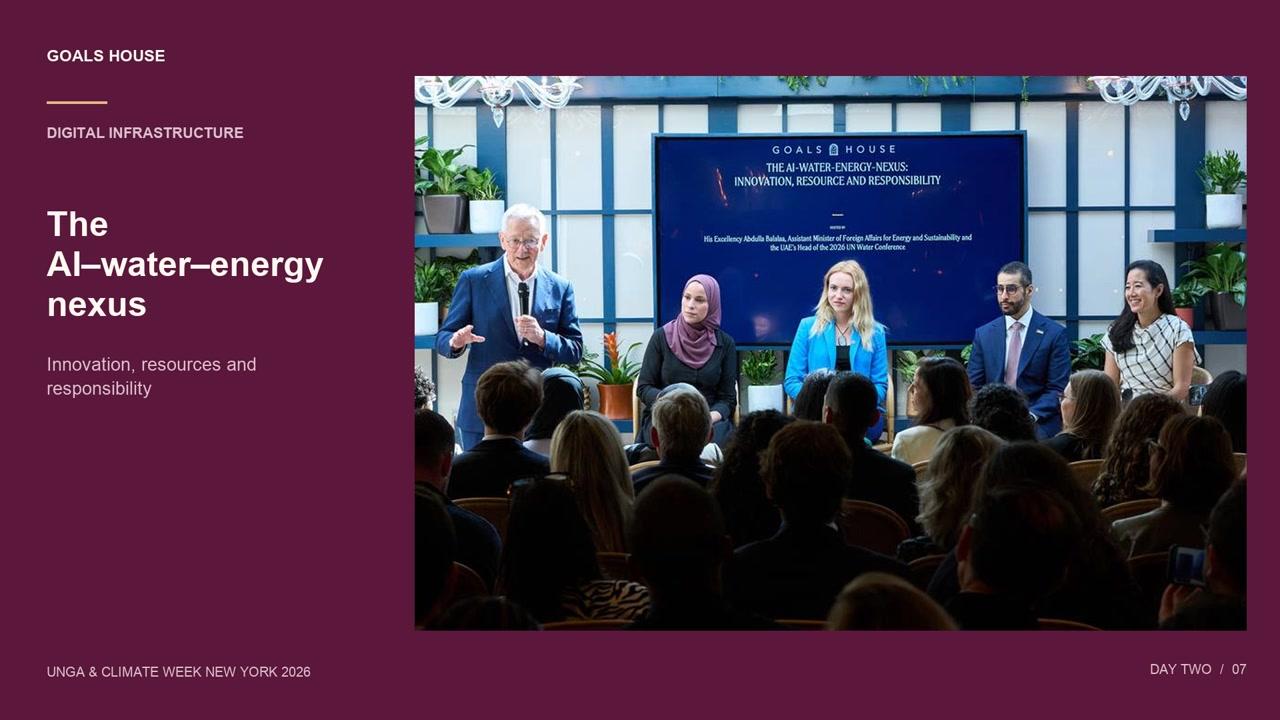
- UAE and Microsoft say the AI transformation is inseparable from water and energy demands
- Nearly 800 women die daily from preventable causes; maternal health panel says delivery — not technology — is the test
- Silver Lining convenes researchers urging governance frameworks before atmospheric interventions scale beyond control
- ServiceNow and City Year argue investing in people must match investment in machines
The Innovation-to-Impact Gap: A Day-Long Consensus
Why it matters: Goals House Day 2 — titled "Care, Trust, and Transition" — did not produce votes or binding agreements. What it did produce was a remarkably consistent diagnosis across sectors: progress on the world's biggest challenges is constrained not by a shortage of solutions but by the systems, financing, and trust required to deliver them.
Where things stand: Session after session, convened by organizations ranging from Maybelline New York to Google to The Nature Conservancy, circled the same question. As one narrator summarized, the recurring message was that "the challenge is not a shortage of solutions." The real test, repeated across every theme, was "whether people will trust it, adopt it, and ultimately benefit from it."
That framing — innovation supply is not the bottleneck; implementation demand is — carried through every major discussion, from Anil Soni, CEO of the WHO Foundation, making the case for simple mental health interventions, to Julia Strong, founder and executive director of the Symbiosis Coalition, arguing that "the next chapter for nature won't be written by individual organizations."
Mental Health: Notice, Engage, Ask
The basics: Maybelline New York and the WHO Foundation opened the morning with a session on building more responsive mental health systems.
Why it matters: Anil Soni, CEO of the WHO Foundation, reframed the mental health challenge as one of simplicity rather than expense. The session argued that effective interventions are grounded in recognition, engagement, and connection — "it is simple: notice, engage, and ask the questions." Soni emphasized "there is tremendous power in grounding solutions in human-to-human interventions."
What's next: The framing challenges cost-based assumptions that have slowed mental health investment, particularly in lower-resource settings. If simple human connection is the foundation, the barrier is political will and system design, not money.
AI in Healthcare: Ask What Patients Need From the System, Not From AI
Why it matters: The West Health Gallup Center on Healthcare, hosted by Tim Lash of West Health and Joe Daly of Gallup and moderated by Gina Chua of Semaphore, tackled a question growing louder across medicine: where do patients welcome AI, and where does trust break down?
Where things stand: The session's central conclusion was direct: "Leaders should not be asking what patients need from AI. They should be asking what patients need from their healthcare system, and then build AI around that." The distinction matters as hospitals, insurers, and tech firms race to deploy clinical AI tools — often before patients or clinicians have weighed in on what they actually want.
AI, Water, and Energy: The Nexus No One Can Ignore
Why it matters: Two interconnected sessions — a Google-hosted roundtable on the AI implementation gap and a panel featuring H.E. Abdullah Balalah of the UAE, Melanie Nakagawa of Microsoft, Dr. Ala Murabit of RAIS/500 Global, Diana Vigrovikova of Zaytoms, and moderator Professor Sir Andrew Steer of LSE/Georgetown — made one of the day's most concrete arguments: the AI transformation is equally a water transformation.
Where things stand: Antonia Gawel of Google framed the core question as "how do you help close the implementation gap?" — moving organizations from successful pilots to systemic change. The subsequent panel went further, arguing that data centers can become platforms for local innovation if the nexus of water, energy, and digital infrastructure is managed well. One participant warned that treating AI's resource demands as an afterthought risks undermining the very communities the technology is supposed to serve.
What's next: With data center construction accelerating globally, the session's implications extend to municipal water policy, energy procurement, and local planning decisions — the kind of infrastructure choices that play out at the city and regional level.
Maternal Health: 800 Deaths a Day, Solutions on the Shelf
Why it matters: Every Pregnancy convened a panel including Isra Chaker of Every Pregnancy (moderator), Mazen Mokhtar of Baytulmal, Dr. Zahar Salul of MedGlobal, Dr. Adanna Steinhacher, senior special assistant to the president of Nigeria on women's health, and Matthew Reilly of Philips.
Where things stand: Chaker set the tone by observing that "the group was not there because it was short of solutions. Many of them are ready to use. And yet, nearly 800 women die every day from preventable causes." The conversation repeatedly returned to delivery as the critical test — not whether a technology reaches a clinic, but whether it reaches and benefits the mother. The panel reframed maternal mortality from a technology problem to a systems problem: financing, supply chains, health worker training, and community trust.
Decisions: No binding commitments, but the framing carries weight for funders and implementers deciding where to direct resources — toward the next innovation or toward getting existing tools into the hands of frontline health workers.
Atmospheric Interventions: Govern Before You Scale
Why it matters: Kelly Wanzer, executive director of Silver Lining, convened climate researchers and funders around the governance of emerging atmospheric interventions — a set of technologies that are advancing faster than the rules designed to govern them.
Where things stand: Participants stressed that "governance must develop alongside the science, with appropriate safeguards, transparency, and oversight established before activity moves beyond the institutions capable of governing it." Wanzer highlighted that better decisions depend on better data and underscored the need for international cooperation, noting that consequences of action or inaction are unlikely to stop at national borders.
What's next: As atmospheric intervention research accelerates — particularly around solar radiation management and marine cloud brightening — the session's message has direct implications for international climate negotiations and national regulatory frameworks.
Investing in People as Urgently as in Machines
Why it matters: ServiceNow hosted a dinner with Nick Zitzen of ServiceNow and Anne Maura Connolly of Voices for National Service/City Year, moderated by Nina Dos Santos, featuring Bob Hughes (City Year board), Daleen van Buren (City Year South Africa), and Jayden Luca (City Year New York).
Where things stand: Participants explored how service, mentorship, and real-world experience can prepare the next generation of leaders as traditional career pathways evolve. Zitzen offered the line that captured the evening's argument: if we can do for people what everyone is doing for the machines, the world will be a much better place. The conversation kept returning to human qualities — adaptability, empathy, resilience, and purpose — as the capabilities no algorithm can replace.
Learning From Hot Cities
Why it matters: Qatar Foundation hosted a Majlis-style conversation connecting sustainability, education, and culture. Hélène Chartier of C40 Cities observed that "there is much the rest of the world can learn from hot and arid cities, because what was once not their reality is becoming their reality now."
Contributions came from Earthna (Qatar Foundation's Centre for a Sustainable Future), Elizabeth Kennedy of Akademiyati, and Alison Watson of Class of Your Own/Design Engineer Construct. The session reinforced the value of knowledge sharing across generations, disciplines, and communities — a reminder that some of the most valuable solutions are inherited, not invented.
Minor Items
- Trane Technologies convened sustainability leaders from Mercedes-AMG Petronas F1, Bayer Consumer Health, and Clever Carbon to explore how collaboration and shared learning can help organizations navigate rapid technological change.
- Novartis Global Health and Malaria No More hosted a roundtable on translating malaria technology breakthroughs into community-level impact, with participants stressing that financing, partnerships, and locally led decision-making remain the key bottlenecks.
- IFS hosted a session with Al Gore (Climate Reality Project) and Benno Blumoser (Siemens AI Lab) arguing AI in sustainability can "raise both the floor and the ceiling, optimizing existing systems while accelerating new sustainability solutions."
- Estée Lauder Companies hosted a lunch where Nancy Mahon, chief sustainability officer, said "in a moment of energy scarcity, it has become clear that it is everyone's responsibility to do more," framing enterprise-wide sustainability integration as a competitive advantage.
- HP Inc. and WWF discussed nature-related business risks, with Sheila Bonini of WWF noting that half of global GDP depends on nature — framing nature-positive action as an economic imperative.
- YouTube, Earthrise, Earth Alliance, and Rewild previewed three forthcoming conservation films. Juma Shipaya, lead subject of the film Yanuni, told the room: "All of us have the power. We only need to believe in that and be willing to work together."
- Target hosted a dinner on consumer trust, where Sarah Pygi Yu of Blueland observed that "the consumer is caring so much more than a year ago" about sustainability.
- The Symbiosis Coalition and The Nature Conservancy, with support from the Earthshot Prize, the Rockefeller Foundation, and Salesforce, hosted a dinner. Julia Strong, founder and executive director, argued the next chapter for nature will be "written through the partnerships that turn innovation into impact at scale."
- A nightcap hosted by Google and Salesforce closed the day.