Global South Pushes for Binding Covenant on Right to Development
General Assembly • United NationsSeptember 23, 2026
Locunity is an independent informational service and is not an official government page for this commission. All information is sourced from public footage and an analysis of official agendas with the aid of responsible, fact-checked AI. to report an error or omission.
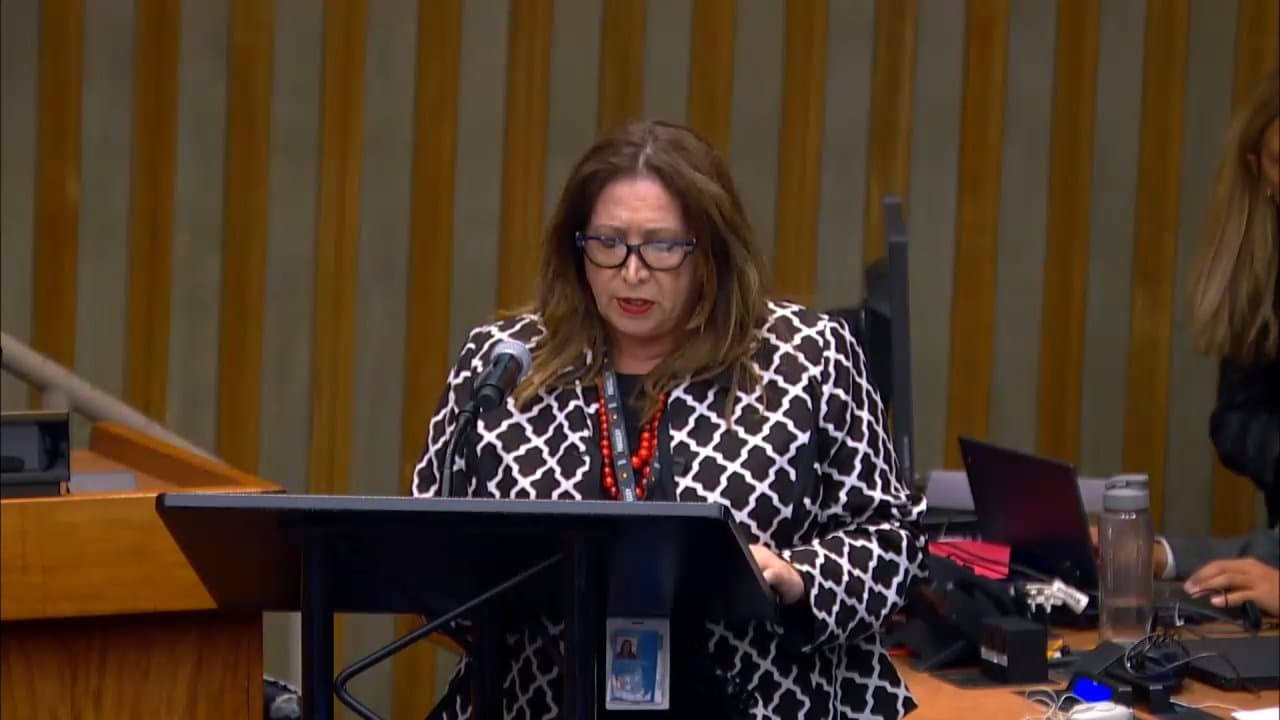
More than 40 nations took the floor at the U.N. General Assembly's high-level meeting marking 40 years since the landmark Declaration on the Right to Development — and the overwhelming majority of developing countries made the same demand: turn the 1986 declaration into enforceable international law. The session exposed a deepening North-South fault line over whether development should be a legal obligation or an aspirational framework, with climate-vulnerable island nations making the most urgent case that the current global financial system is failing them.
Developing nations rally behind a legally binding covenant on the right to development, with India, Algeria, Bangladesh, the Philippines, and dozens more calling for its adoption
Small island and climate-vulnerable states warn that rising seas, cyclones, and glacial melt are erasing development gains faster than aid can rebuild them
Western delegations push back, emphasizing indivisible human rights, gender equality, LGBTQ+ protections, and civil society participation — without endorsing the covenant
Russia and Belarus frame the divide as neocolonial, accusing Western states of blocking the covenant to preserve economic dominance
AI governance emerges as a new front, with Cambodia, Thailand, China, and the African Union warning that developing countries are being shut out of rule-writing
Geopolitical conflicts surface repeatedly, as Iran, Tunisia, and the League of Arab States link Palestinian self-determination to development rights
The Covenant Push: From Declaration to Enforceable Law
Why it matters: A binding international covenant on the right to development would create legal obligations for wealthy nations to provide financing, technology transfer, and policy space to developing countries — a fundamental shift from the voluntary frameworks that have governed development cooperation for four decades.
Where things stand: The 1986 Declaration on the Right to Development affirmed development as an inalienable human right. Forty years later, the declaration remains aspirational, with no enforcement mechanism. At this commemorative plenary, delegation after delegation from Africa, Asia, Latin America, and the Pacific called for changing that.
"India reiterates its support for the Declaration and for the early adoption of the Covenant," said the Delegate (India), adding that "India's development partnerships with the Global South are demand-driven and pursued through grants, concessional lines of credit, capacity building, and humanitarian assistance."
Algeria, Bangladesh, Azerbaijan, Ethiopia, the Philippines, Malaysia, Eritrea, Sudan, and the African Union voiced similar support. The African Union's delegate called for accountability mechanisms with teeth, while the Delegate (China) outlined Beijing's vision: "China has continued to deepen international development cooperation, implement the Global Development Initiative, and advance high-quality Belt and Road cooperation, thereby injecting strong dynamism into sustainable development of the Global South and the world."
The other side: Western-aligned delegations — Finland, Norway, Ireland, the Netherlands, and Portugal — did not explicitly endorse the binding covenant. Instead, they emphasized the interdependence of all human rights and pushed back on what they see as attempts to narrow the development conversation.
The Delegate (Norway) was direct: "Human rights, gender equality, sexual and reproductive health and rights, and the rights of LGBTQ+ persons must remain priorities. Norway will continue to stand up for women's rights, women's rights to decide over their own body, and human rights for all."
The Delegate (Ireland) framed the stakes in institutional terms: "Will we shape the future of the international system, or will we allow financial pressures and short-term decisions to shape it for us? Our answer will have profound implications for the trajectory of global development in decades ahead."
What's next: The strong consensus among Global South nations may accelerate negotiations on the draft International Covenant on the Right to Development at the General Assembly and Human Rights Council. With the Pact for the Future and 2030 Agenda timelines looming, pressure on Western holdouts is likely to intensify.
The Neocolonialism Charge: Belarus and Russia Go on Offense
A sharper edge cut through the plenary as Belarus and Russia accused Western nations of deliberately blocking the covenant to preserve economic dominance.
The Delegate (Belarus) left little room for ambiguity: "Those states which voted against the Declaration or chose to abstain back in 1986 are effectively obstructing the adoption of the Covenant on the Right to Development. Why this position? The answer is simple. They want to continue living in the way they've lived for centuries, that is, at others' expense."
Russia echoed the framing. The Delegate (Russia) argued that "for the global majority, the right to development means the right to independently choose your economic model, to defend your sovereignty, and to manage your own natural resources without external orders being imposed on you nor attempts to artificially limit your competitiveness." Russia accused the "collective West" of using human rights as a tool of geopolitical blackmail and called for a "fair, multipolar world."
The accusations reflect broader tensions playing out across U.N. forums, where Russia and its allies have increasingly framed the right to development as a sovereignty issue, challenging what they describe as a Western-dominated rules-based order.
Climate and Survival: Island Nations Make the Most Concrete Case
Why it matters: Small island developing states and climate-vulnerable nations made the most tangible argument at the plenary — that climate change is not a future risk but a present emergency erasing development gains in real time.
Solomon Islands, Comoros, Vanuatu, Maldives, Palau, and the Dominican Republic each connected rising seas, extreme weather, and ocean acidification directly to the right to development. The delegate from Comoros noted that climate change is already affecting agriculture and infrastructure. Vanuatu cited its role in leading the historic International Court of Justice advisory opinion on climate change, calling it "a human justice" issue. Palau described having to relocate its national hospital away from climate-risk areas.
The delegate from the Dominican Republic warned that traditional development classifications based on per capita income fail to capture the structural vulnerabilities of SIDS, making it harder for them to access concessional financing even as storms grow more destructive.
Zambia cited climate-induced droughts threatening energy, water, and food security. Nepal warned that climate-induced disasters can reverse development gains in minutes. Sri Lanka referenced the devastation of Cyclone Dithwa. Tajikistan flagged glacier melting affecting downstream communities across Central Asia.
Multiple delegations demanded reform of the international financial architecture, with calls for debt relief, concessional financing, and development classifications that account for climate vulnerability rather than GDP alone. Saudi Arabia cited its development fund's $22.5 billion in loans to 102 countries, while the United Arab Emirates urged a global shift "from assistance to investment."
The AI Governance Gap
Why it matters: AI governance rules are being drafted now, largely in forums where developing countries have limited voice. Several delegations warned this risks entrenching a new form of digital inequality.
The Delegate (Cambodia) drew on the country's experience rebuilding after genocide to make the point: "Artificial intelligence is one area and not the only one. Its rules are being written now, and developing countries are not yet fully represented in that work."
Solomon Islands called for accelerated technology transfer and digital capacity building. Timor-Leste argued that digital transformation and AI should expand opportunity rather than deepen exclusion. Bahrain described its national AI policy, targeting 50,000 citizens with AI skills by 2030. Thailand proposed inclusive and equitable AI governance. The African Union called for affordable connectivity, digital skills development, strong data protection, and human rights impact assessments tied to AI deployment.
China urged openness and mutual learning and called on the international community to "address properly emerging issues of AI." Tajikistan highlighted its initiative on safe, secure, and trustworthy artificial intelligence.
Geopolitical Flashpoints: Palestine and Beyond
The plenary's commemorative tone did not prevent geopolitical conflicts from surfacing. Iran, Tunisia, and the League of Arab States each linked the right to development to the situation in Palestine.
The Delegate (Iran) accused the United States and Israel of waging what it called an "absolutely unlawful war," detailing attacks on "medical and emergency facilities, hospitals, ambulances, pharmaceutical and vaccine production facilities, medical research institutions, and humanitarian personnel."
The Delegate (League of Arab States) was equally blunt: "We cannot speak of development while this people is denied its right to self-determination, whose life is being destroyed, and who is denied sovereignty on its land and resources."
Faith and Dignity: The Holy See Weighs In
The Delegate (Holy See) cited Pope Leo XIV, stating: "Pope Leo XIV emphasizes that for individuals as well as for nations, development is both a duty and a right. Minimum conditions are required for enabling every person and people to flourish in accord with their dignity, without being kept in a state of dependence or excluded from access to necessary goods."
Looking ahead: The presiding officer noted that many speakers remained on the list as the session approached its 6 p.m. adjournment and invited remaining delegations to submit written statements. The debate is far from over — the General Assembly and Human Rights Council will continue negotiations on the draft covenant, with the North-South divide over binding obligations likely to sharpen in the months ahead.