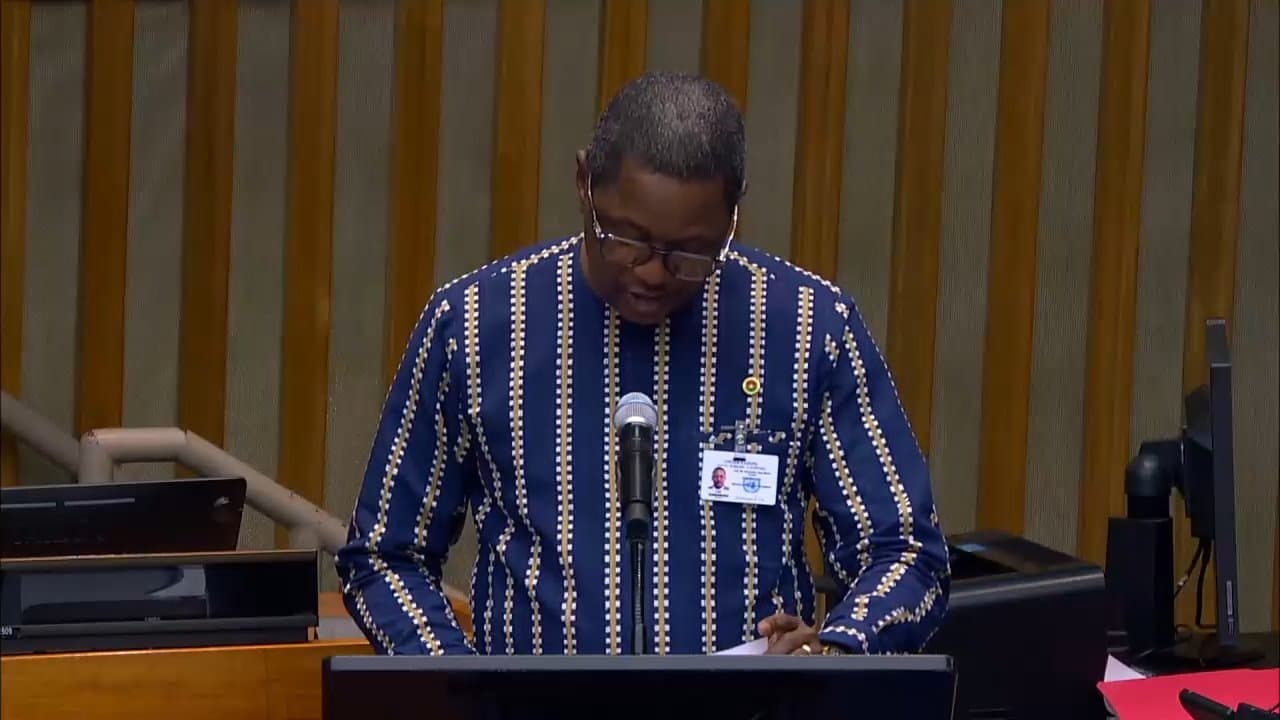
(Part 1) High-level Meeting to Commemorate the 40th Anniversary of the Declaration on the Right to Development - General Assembly, 81st session
General Assembly • United NationsSeptember 23, 2026
Locunity is an independent informational service and is not an official government page for this commission. All information is sourced from public footage and an analysis of official agendas with the aid of responsible, fact-checked AI. to report an error or omission.
Developing Nations Demand Binding Covenant on Right to Development
The United Nations General Assembly convened a high-level meeting to mark the 40th anniversary of the 1986 Declaration on the Right to Development — and what emerged was less a celebration than a collective demand for structural change. Over 25 delegations from the Global South used the session to push for a legally binding international covenant, an overhaul of global financial systems, and equitable governance of artificial intelligence.
- Global South coalition pushes for a legally binding covenant on the right to development, backed by the Non-Aligned Movement, the African Group, and CARICOM
- Developing nations demand overhaul of international financial architecture, citing $1.4 trillion in debt servicing and declining development aid
- Small island states tie climate survival to development rights, calling for financing based on structural vulnerability rather than income alone
- Cuba, Venezuela, Nicaragua, and NAM bloc condemn unilateral sanctions as obstacles to development and violations of sovereignty
- Civil society and multiple delegations warn that the digital divide risks becoming an "AI divide" without technology transfer and inclusive governance
- Burkina Faso announces Sahel Confederation's withdrawal from ICC Rome Statutes, accusing international justice of political bias
- Palestine says Israeli aggression on Gaza has erased 77 years of human development
Forty Years of Promises, a Push for Enforcement
The basics: The 1986 Declaration on the Right to Development established development as an inalienable human right. Forty years later, only 36% of Sustainable Development Goal targets are on track. The General Assembly convened this high-level meeting under Resolution 80/207 to assess progress and build political momentum for a legally binding instrument — a draft International Covenant on the Right to Development.
Why it matters: The declaration has remained aspirational, with no enforcement mechanism. A binding covenant would create legal obligations for states and, potentially, international financial institutions — a prospect that has divided the Global North and Global South for decades.
Where things stand: President of the General Assembly Khalilur Rahman opened the meeting by recalling his own presence at the 1986 adoption and framing three lessons. "I was there 40 years ago during the 41st session of the General Assembly when this Declaration was adopted," he said, adding that development must be inclusive, indivisible from human rights and peace, and must evolve with technology. He flagged that 2.6 billion people remain offline and declared "innovation with inclusion" a presidency priority.
Secretary-General António Guterres struck a more sobering tone. "Today, we celebrate that vision. But we also recognize a stark reality: for millions of people around the world, that promise remains unfulfilled," he said. He cited progress in poverty reduction and social protection expansion but called for debt relief, reformed multilateral development banks, and urgent climate action. He warned that AI "can also be drivers of exclusion and division."
High Commissioner for Human Rights Volker Türk identified three structural obstacles. "The first obstacle is that our international economic and financial systems are grotesquely out of balance," he said. The second: global military spending now totals $2.8 trillion — "that is 8 times more than the estimated cost of ending extreme poverty globally." The third: environmental destruction driven by consumption patterns. Türk encouraged engagement toward a legally binding instrument.
The other side: The delegate from the European Union delivered a statement during the plenary segment but no explicit opposition to the covenant was captured in the session. The near-universal support among Global South delegations — from NAM, the African Group, CARICOM, and the Group of Friends in Defense of the UN Charter — signals formidable political pressure, though negotiations on a binding text will face resistance in coming sessions.
What's next: The session adjourned with additional speakers remaining for an afternoon continuation. The breadth of support creates momentum for the General Assembly to advance negotiations on the draft covenant, which could reshape development financing and human rights accountability in the post-2030 framework.
"Grotesquely Out of Balance": The Fight Over Global Finance
Why it matters: Debt servicing in developing countries has reached $1.4 trillion, with 3.4 billion people living in nations that spend more on interest payments than on education or health. Without financial architecture reform, speakers argued, the right to development is hollow.
Where things stand: The plenary became, in effect, a rolling indictment of the international financial system. Executive Director Chi Youkling of the Third World Network, speaking on behalf of civil society, demanded a debt restructuring mechanism under UN auspices. "We need to have really the global structure that we have asked for from civil society for decades, which is a global, under the UN auspices, an orderly restructuring of debt," she said. She welcomed the Tax Cooperation Convention and criticized credit rating agencies as a constraint on developing countries' policy space.
The delegate from Burundi, speaking on behalf of the African Group, called for trade market access and debt alleviation. The delegate from Tanzania called for a ninefold per capita income increase, requiring affordable financing and effective solutions to unsustainable debt. Pakistan's delegate labeled debt distress a "debt trap." Delegations from Lesotho, Malawi, and Djibouti stressed the decline in official development assistance as a serious threat.
South Africa offered concrete proposals. "One way to do this is to make the right to development a prominent indicator in the universal periodic reviews before the Human Rights Council, thereby holding both national governments and international financial institutions accountable for country-level outcomes," said the delegate from South Africa. The delegation also cited its International Panel on Inequality and called for mainstreaming development-compatible indicators into SDG reporting.
Decisions: No votes were taken — this was a commemorative plenary — but the breadth and specificity of demands signal that financial architecture reform will be a central battleground in upcoming General Assembly negotiations.
Climate-Vulnerable States: "The Climate Crisis Is Also a Development Crisis"
Why it matters: Small island developing states face existential threats from climate change that can erase decades of development progress in a single storm season, yet they are often excluded from concessional financing because their per-capita income appears too high.
Where things stand: Delegations from Micronesia, Fiji, Samoa, Kiribati, and Suriname repeatedly made the case that income-based measures like GDP fail to capture structural vulnerability. The delegate from Micronesia emphasized the Multidimensional Vulnerability Index as a practical instrument for fairer financing. The delegate from Suriname called the current financial system "unsustainable."
Fiji's delegate outlined a three-priority framework: people-centered development, resilience against climate and economic shocks, and a more responsive international system. Kiribati's delegate warned that "the digital divide must not become an AI divide" — linking climate vulnerability to technology access.
The delegate from Saint Kitts and Nevis, speaking on behalf of CARICOM, framed the issue bluntly: the climate crisis is also a development crisis. Multiple CARICOM member states called for predictable climate finance, loss and damage support, and recognition of vulnerability beyond income-based metrics.
What's next: The operationalization of the Multidimensional Vulnerability Index and its adoption in multilateral financing decisions will be a key test of whether these appeals translate into policy change.
Sanctions Under Fire: Cuba, NAM, and the Group of Friends Push Back
Why it matters: A broad coalition of developing states used the anniversary session to frame unilateral economic sanctions — particularly the U.S. embargo on Cuba — as direct violations of the right to development and obstacles to sovereignty.
Where things stand: Cuba's delegate was among the most forceful. "The United States imposes against Cuba a criminal energy blockade which aims to create massive humanitarian damage," the delegate said, warning that secondary sanctions prevent commercial relations with third countries and could be applied against any state.
Venezuela's delegate, speaking on behalf of the Group of Friends in Defense of the UN Charter, called for "the complete and unconditional and immediate lifting" of unilateral coercive measures. Uganda's delegate, speaking on behalf of the Non-Aligned Movement, stated that unilateral coercive measures "carry the risk of undermining global economic stability." Nicaragua's delegate aligned with both groups and demanded elimination of "illegal measures." Egypt and Brazil also reiterated opposition.
In a notable escalation, Burkina Faso's delegate accused international justice mechanisms of being "used as instruments of political pressure" and announced the Sahel Confederation's withdrawal from the Rome Statutes of the International Criminal Court. "It is in this context that the states of our Sahel Confederation started their withdrawal from the Rome Statutes of the ICC," the delegate said.
AI and the Digital Divide: Who Controls the Technology?
Why it matters: With 2.6 billion people still offline and AI governance concentrated in a handful of corporations, unchecked technological change could entrench rather than reduce global inequality.
Where things stand: Chi Youkling of the Third World Network drew a direct line from past corporate monopolies to the present. "The control of technology from the time we were looking at chemicals to seeds to pharmaceuticals and today to AI, is in the hands of very few companies," she said, warning that decisions affecting billions are "made by very few individuals."
Zimbabwe's delegate called for "actively helping create, govern, and benefit from new and emerging technologies." Indonesia, Pakistan, Kenya, and Guyana all called for technology transfer, capacity building, and equitable access to digital infrastructure. CARICOM emphasized both the potential and risks of AI. Kiribati's delegate warned the digital divide "must not become an AI divide."
What's next: The demands for inclusive AI governance and technology transfer are likely to feature prominently in post-2030 framework negotiations and in ongoing discussions around the Global Digital Compact.
Minor Items
- Palestine stated that a joint UN-European Union report found Israeli aggression on Gaza has erased 77 years of human development, calling the right to development inseparable from self-determination.
- Qatar raised the closure of the Strait of Hormuz as a direct threat to the right to development, citing impacts on energy security, food security, and global supply chains.
- Oman, Morocco, Serbia, Angola, Yemen, Guatemala, and Panama delivered plenary statements reaffirming support for the Declaration and the right to development.
- Côte d'Ivoire and Djibouti underscored the importance of development aid and multilateral cooperation.
- The session adjourned as Part 1, with additional speakers expected in a Part 2 afternoon continuation.