
UN General Assembly Adopts Landmark Declaration on Sea Level Rise
General Assembly • United NationsSeptember 24, 2026
Locunity is an independent informational service and is not an official government page for this commission. All information is sourced from public footage and an analysis of official agendas with the aid of responsible, fact-checked AI. to report an error or omission.
The United Nations General Assembly approved by consensus its first-ever declaration on sea level rise, affirming that nations cannot lose their statehood, sovereignty, or maritime zones to rising oceans. But the celebration was tempered by a blunt reality: adaptation financing for the world's most vulnerable countries remains a fraction of what's needed, and delegation after delegation made clear that the true test will be implementation, not words on paper.
- General Assembly approves historic UN Declaration on Sea Level Rise by consensus, affirming statehood and maritime zones for threatened nations
- Secretary-General warns of record sea level rise in 2024 — nearly 6mm — and calls Loss and Damage Fund "ridiculously" underfunded
- Adaptation finance gap stands at 12-to-14 times current flows, with developing countries receiving $26 billion against estimated needs of $310–365 billion annually by 2035
- UK announces "significant change in policy" to recognize statehood even if a nation loses all territory to rising seas
- Papua New Guinea reports first climate refugees relocated from disappearing islands
- EU and Canada launch Global OceanEye Alliance with $250 million in ocean observation pledges; UK pledges £330 million to the Global Environment Facility
A Declaration for Survival — and Its Limits
Why it matters: For the first time, every UN member state agreed on a political text recognizing sea level rise as an existential threat and committing to legal protections for the nations most at risk. The declaration establishes that lawfully drawn maritime boundaries remain stable under the UN Convention on the Law of the Sea (UNCLOS), and it presumes continued statehood, sovereignty, and UN membership even if territory is submerged.
Where things stand: The declaration was co-facilitated by Ambassador James Martin Larsen of Australia and Ambassador Tânia Romualdo of Cabo Verde, and was put to the Assembly by President of the General Assembly Khalilur Rahman. No objections were raised. The text will proceed to formal adoption at a subsequent General Assembly plenary session.
Secretary-General António Guterres set the stakes in his opening address, delivering a report documenting the acceleration of the crisis. "In 2024, the global sea level rose almost 6 millimetres — the highest annual increase ever recorded. And the pace is accelerating," said Secretary-General Guterres. He called for global emissions to fall 60% by 2035 and was unsparing about the financial architecture: "I am very frustrated with the, I would say, ridiculous amount that is today in the Loss and Damage Fund."
PGA Rahman reinforced the numbers. Current adaptation finance flows to developing countries sit at roughly $26 billion — against estimated needs of $310–365 billion annually by 2035. "Adaptation needs are 12 to 14 times greater than the current flows of resources," he said. He added a note of dark humor: "Right here in New York City, sea levels are projected to rise up by 1.3 meters by the end of the century. This basement might be underwater by then."
The other side: Broad consensus did not mean satisfaction. Prime Minister Feleti Teo of Tuvalu captured the mood of frontline nations: "The measure of our success today will not be the words we endorse, but the action that will follow." The Alliance of Small Island States, CARICOM, and the Pacific Islands Forum all delivered group statements stressing that declarations without implementation are hollow — and that the financial architecture must fundamentally change.
Statehood Can't Drown: The Legal Framework Takes Shape
The basics: Under traditional international law, a state must possess territory, a permanent population, a government, and the capacity to enter relations with other states. Sea level rise threatens to eliminate the first two elements for low-lying island nations, raising the question of whether a country can cease to exist because the ocean swallowed its land.
Why it matters: The declaration answers that question with a resounding no — and several major developments during the debate gave the principle practical teeth.
The delegate for Palau, speaking on behalf of AOSIS, put it plainly: "Once a state is established, the loss of its constituent elements because of sea level rise does not mean a loss of statehood. Our nations are permanent members of this community of nations."
The delegate for the United Kingdom announced what may be the session's most concrete policy shift: "We have recently announced a significant change in policy with a starting point to continue to recognize statehood whether a state lost some or even all of its land to sea level rise." The UK also pledged £330 million to the Global Environment Facility.
The delegate for Australia pointed to existing precedent, highlighting a 2024 legally binding treaty: "In 2024, Tuvalu and Australia recognised for the first time, in a legally binding treaty, full sovereignty of Tuvalu's territory irrespective of level rise."
The delegate for Liechtenstein cited paragraph 21 of the declaration — affirming "the presumption of continued statehood and sovereignty, including membership of this organization" — as one of the text's most important provisions. The delegate for Norway said there are "strong legal grounds for concluding that this already follows from established international law." Multiple delegations referenced the ICJ advisory opinion and the International Law Commission's final report as reinforcing these conclusions.
Decisions: The declaration's consensus adoption means the principles of stable maritime zones and continued statehood now carry the political weight of the full General Assembly, even as legal scholars and courts continue to develop the binding framework.
What's next: The declaration will be formally adopted at a subsequent GA plenary. Implementation — particularly financing mechanisms, capacity building, and integration with UNCLOS processes — will determine whether the legal commitments translate into real protection.
$26 Billion vs. $365 Billion: The Finance Fight Behind the Declaration
Why it matters: The declaration calls for predictable, accessible, and scaled-up climate finance, technology transfer, and capacity building. But the gap between rhetoric and resources is staggering, and delegation after delegation used the general debate to hammer the point.
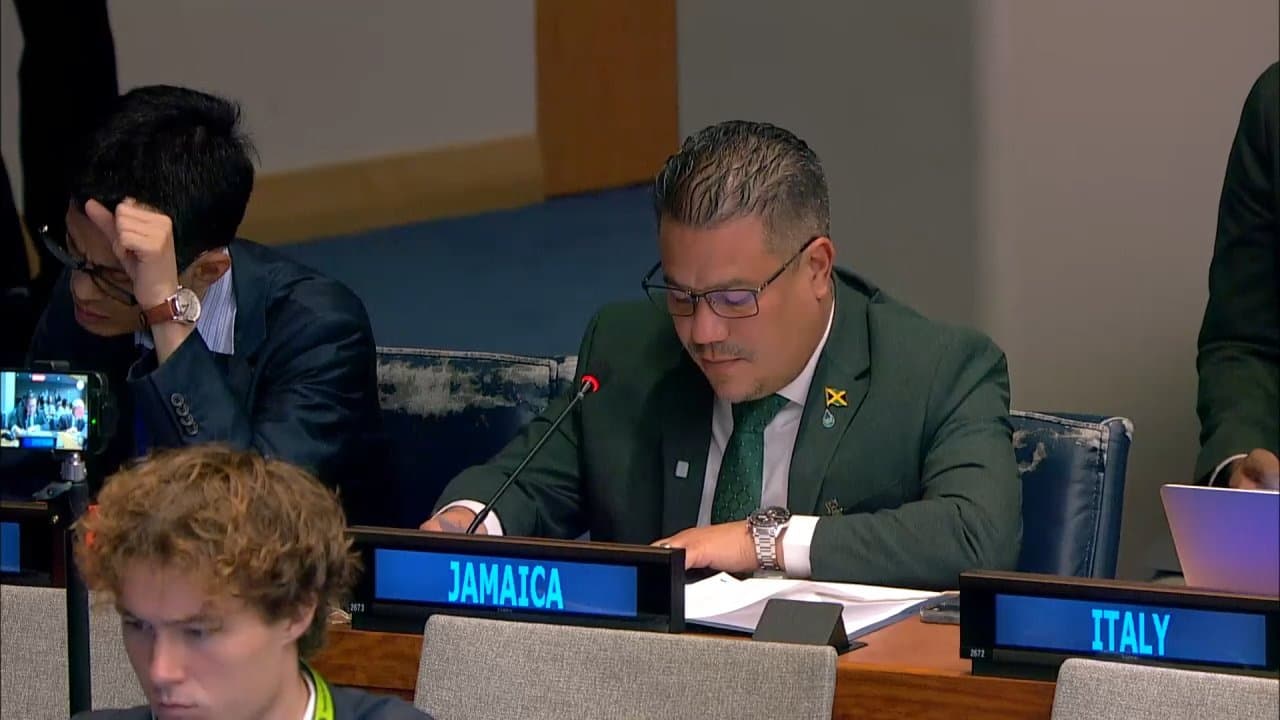
Where things stand: The delegate for Jamaica, speaking on behalf of CARICOM, cited devastating numbers: small island developing states lost $153 billion to climate hazards between 1970 and 2020 — more than 10 times their average annual GDP. Multiple delegations — including Cabo Verde, Samoa, Namibia, Sierra Leone, and Cuba — insisted that finance must be grant-based, must not create additional debt burdens, and must be accessible without onerous application processes.
The delegate for Cuba drew a direct line between geopolitics and climate vulnerability: "Our response capacity is continually limited by the unprecedented tightening of the blockade imposed by the United States against my country, including a criminal and energy siege, which is an act of genocide and collective punishment."
On the pledges side, the EU and Canada launched the Global OceanEye Alliance with more than $250 million in commitments for ocean observation. The Pacific Islands Forum pushed for a dedicated Pacific Resilience Fund. Several African delegations — including Côte d'Ivoire, Sierra Leone, and Angola — emphasized that the crisis is not limited to small islands; continental coastlines are under severe threat as well.
What's next: The declaration's finance provisions are nonbinding. Whether the 12-to-14-fold gap narrows will depend on upcoming negotiations at COP and other multilateral forums, as well as bilateral commitments like the UK's GEF pledge.
From Jakarta to Tuvalu: The Human Cost in Focus
Why it matters: Behind the legal and financial abstractions, delegates described communities already in crisis — relocating, losing freshwater, watching coastlines disappear.
The delegate for Papua New Guinea was among the most forceful: "Papua New Guinea is not here to beg. We are a big maritime nation." The delegate also reported that Papua New Guinea was "amongst the first to experience climate change refugees" when residents of the Motulog and Khatras Islands had to be relocated.
The delegate for Bangladesh warned that a 25-centimeter rise could submerge 4% of the country's land, displacing 10 million people. The delegate for Saint Vincent and the Grenadines reported that 85% of the population and 90% of infrastructure sit on a narrow coastal belt. The delegate for Saint Kitts and Nevis described salinization of freshwater aquifers. The delegate for Indonesia cited a Giant Sea Wall initiative and more than 13,000 hectares of mangrove rehabilitation. The delegate for Fiji reported already relocating people to higher ground. The delegate for the Kingdom of the Netherlands highlighted Caribbean territories facing sea level rise of 3.1cm per decade.
The delegate for Côte d'Ivoire described 560 kilometers of coastline exposed to 3-meter storm waves. The delegate for Angola cited 1,650 kilometers of Atlantic coastline at risk. The picture was consistent across regions: the crisis is here, it is accelerating, and the most vulnerable have contributed the least to it.
Minor Items
- Meeting schedule: The morning session (Part 1) heard approximately 30 delegations; the meeting was adjourned until 3 p.m. for remaining speakers.
- Co-facilitation: The declaration was co-facilitated by Ambassador James Martin Larsen (Australia) and Ambassador Tânia Romualdo (Cabo Verde).
- Regional group statements: AOSIS (Palau), CARICOM (Jamaica), Pacific Islands Forum (Marshall Islands), and the EU delivered coordinated group positions in addition to individual national statements.