
Indonesia Launches Security Council Bid, Demands Justice for Palestine
General Assembly - Debate • United NationsSeptember 26, 2026
Locunity is an independent informational service and is not an official government page for this commission. All information is sourced from public footage and an analysis of official agendas with the aid of responsible, fact-checked AI. to report an error or omission.
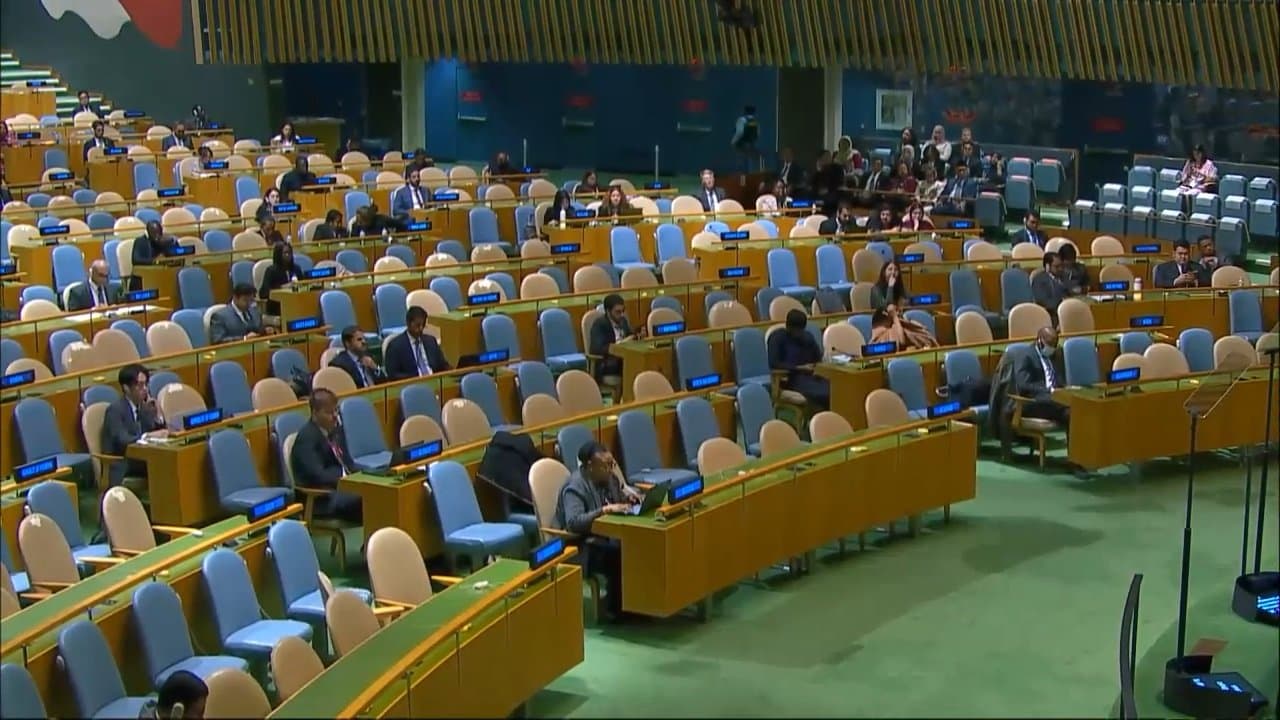
Indonesia's Foreign Minister used the 81st United Nations General Assembly General Debate to formally announce his country's campaign for a non-permanent Security Council seat and deliver one of the session's sharpest indictments of the international community's failure to uphold its founding principles in Gaza. Minister for Foreign Affairs Sugiono wove the two themes together under a single banner — "resilient multilateralism" — arguing the UN must evolve or lose the trust of the people it was built to serve.
Indonesia formally enters the race for a non-permanent UN Security Council seat for the 2029-2030 term, citing nearly seven decades of peacekeeping contributions
Minister Sojono compares Gaza violations to the pre-1945 world, calling Palestine "the test of our conscience" and demanding an independent Palestinian state
Indonesia frames "resilient multilateralism" as the organizing principle for UN reform, financial architecture overhaul, and developing-country representation
ASEAN positioned as the anchor of Southeast Asian stability, now the world's fifth-largest economy, with Indonesia urging the bloc to keep evolving amid great-power competition
Indonesia signals expectations for the next Secretary-General to uphold the Charter and translate multilateralism into concrete results
Resilient Multilateralism: Indonesia's Challenge to the UN
The basics: "Resilient multilateralism" — the through-line of Minister Sojono's address — is the idea that the multilateral system must become more representative, more agile, and more capable of producing tangible outcomes for people, particularly in developing countries. The concept also encompasses reform of international financial architecture at institutions such as the World Bank and International Monetary Fund.
Why it matters: With the United Nations approaching a Secretary-General transition and geopolitical fractures deepening, Indonesia used one of the world's highest-profile diplomatic stages to position itself as a bridge-builder — and to warn that institutional paralysis carries existential risks for the system itself.
Where things stand: Minister for Foreign Affairs Sugiono opened by drawing a parallel between Indonesia and the UN, both born from the devastation of World War II. "81 years ago, from the ashes of the Second World War, Indonesia and the United Nations were born," he said, framing their shared history as a foundation for shared responsibility.
He moved quickly to the stakes. "Multilateralism that cannot deliver will lose people's trust, and without trust, multilateralism will never endure," Minister Sugiono warned. He called for international financial architecture reform to give developing countries greater space for their own development priorities — a demand that aligns Indonesia with broader Global South advocacy at the UN, World Bank, and IMF.
On the question of whether the system should be abandoned or strengthened, Minister Sugiono was unequivocal: "Let us be clear that the answer to imperfect multilateralism is not less multilateralism."
He praised Secretary-General António Guterres for his leadership through what he called an exceptionally challenging period and outlined Indonesia's expectations for the next Secretary-General: uphold the Charter and translate multilateral commitments into concrete results.
What's next: Indonesia's calls for institutional reform will be tested as member states negotiate the terms of the Secretary-General transition and as developing countries press for governance changes at global financial institutions.
Palestine: "The Test of Our Conscience"
Why it matters: Indonesia elevated the Palestine question from a regional dispute to what it called a defining benchmark for the entire multilateral system — arguing that failure in Gaza undermines the legitimacy of every international institution built after 1945.
Where things stand: Minister Sugiono delivered some of the address's most forceful language on the conflict, calling Palestine "one of the clearest tests of these principles, and the test of our conscience."
He drew a stark historical comparison. "The clear violations of international law in Gaza and the West Bank are reminiscent of our world pre-1945," Minister Sugiono said — invoking a period before the UN Charter, the Universal Declaration of Human Rights, and the Geneva Conventions, and describing it as "a world where a certain race was almost annihilated."
Drawing on Indonesia's own anti-colonial founding, Minister Sugiono pledged that "Indonesia will continue to stand with the Palestinian people until their right to self-determination is fulfilled, and until an independent and sovereign State of Palestine is realized based on the two-state solution in accordance with international law."
Decisions: No vote was taken — this was a General Debate address — but Indonesia used the floor to reaffirm its long-standing commitment to Palestinian statehood and to frame the issue as inseparable from the credibility of the multilateral order itself.
Indonesia Bids for the Security Council
Why it matters: A non-permanent seat on the 15-member UN Security Council would give Indonesia direct influence over decisions on international peace and security — from conflict resolution and sanctions to peacekeeping mandates — for a two-year term beginning in 2029.
Where things stand: Minister Sugiono formally presented Indonesia's candidature, declaring: "It is in this spirit that Indonesia presents its candidature for a non-permanent seat on the UN Security Council for the 2029-2030 term."
He built the case on Indonesia's peacekeeping record, which stretches back to 1957 and includes nearly two decades of service under the UN flag in Lebanon through UNIFIL. He framed the bid around two commitments — "fostering unity" and "advancing peace" — arguing that fostering unity means rebuilding trust in the multilateral system and keeping dialogue channels open, while advancing peace requires consistent application of international law.
Minister Sugiono invoked President Prabowo Subianto's philosophy to underscore Indonesia's diplomatic posture: "As President Prabowo Subianto mentioned in his very lecture last year, 1,000 friends are too few." He cited Indonesia's engagement through ASEAN, the G20, D8, BRICS, MIGTA, and the UN as evidence of its commitment to extending friendship into practical cooperation.
What's next: The General Assembly election for the 2029-2030 non-permanent seats will take place in a future session. Indonesia will campaign among member states, leveraging its peacekeeping credentials and multilateral track record.
National Resilience as Global Strategy
Why it matters: Indonesia's domestic framework — centered on food self-sufficiency, energy security, education, and healthcare — doubles as its argument for why it belongs at the multilateral table: a nation that cannot feed and educate its own people, the logic goes, cannot credibly lead internationally.
Where things stand: Minister Sugiono described national resilience as rooted not in military strength but in people's livelihoods. "A nation is resilient when families can provide for their households, when farmers can produce, when workers can find decent jobs, and when children can learn, grow, and dream about their future," he said.
He highlighted Indonesia's management of extraordinary diversity — more than 280 million people across thousands of islands, with distinct histories, languages, and traditions. "Indonesia has learned that diversity is not something to overcome," Minister Sugiono said, describing it as something to manage, respect, and transform into strength. He grounded Indonesia's approach in democracy, human rights, and rule of law, connecting national resilience to the country's capacity to advance the Sustainable Development Goals.
ASEAN: The Fifth-Largest Economy Holds the Line
Why it matters: As strategic competition between major powers intensifies in the Indo-Pacific, ASEAN's ability to maintain unity and serve as a neutral platform for dialogue has direct implications for global trade, security, and the regional balance of power.
Where things stand: Minister Sugiono described Southeast Asia as home to one of the world's largest productive-age populations, now constituting the fifth-largest economy globally, with a fast-growing digital sector. He emphasized ASEAN's nearly six decades of managing differences among nations with vastly different political systems and histories — preserving space for dialogue even as external pressures mount.
He urged the bloc to continue evolving to remain "fit for purpose and beneficial for its people," while defending ASEAN centrality as the principle that enables the region to engage with all partners without being pulled into competing camps.
Minor Items
Secretary-General transition: Minister Sugiono praised Secretary-General Guterres's leadership and outlined expectations for the next Secretary-General to uphold the UN Charter and deliver on multilateral commitments. No timeline was specified beyond the approaching end of the current term.
Multilateral platforms: Indonesia listed its active engagement through ASEAN, the G20, D8, BRICS, MIGTA, and the United Nations as channels for practical cooperation and friendship-building.