Singapore Pushes for UN Convention on AI Safeguards at General Assembly
General Assembly - Debate • United NationsSeptember 26, 2026
Locunity is an independent informational service and is not an official government page for this commission. All information is sourced from public footage and an analysis of official agendas with the aid of responsible, fact-checked AI. to report an error or omission.
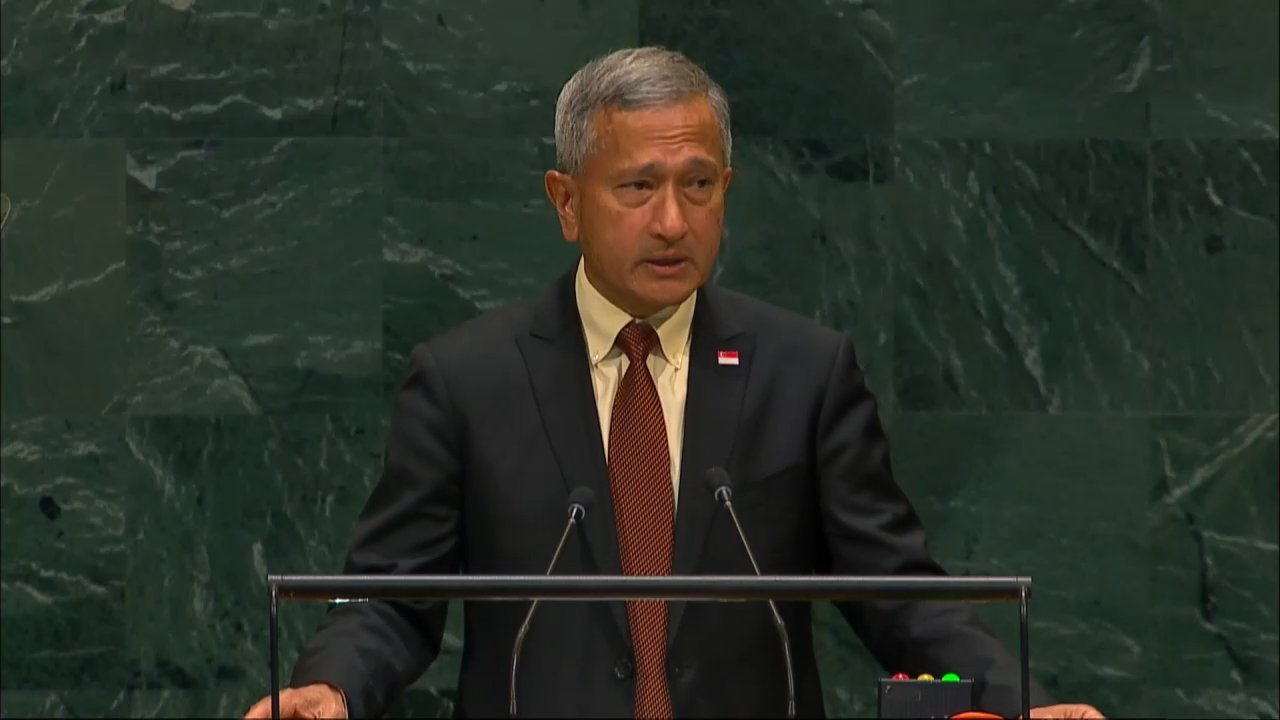
Singapore's Foreign Minister used his General Debate address to lay out an ambitious agenda for global governance, proposing a new UN Framework Convention on AI Safeguards while demanding collective action against the closure of the Strait of Hormuz. Across a wide-ranging, 23-minute speech, Minister Vivian Balakrishnan wove together five interlocking challenges — the case for multilateralism, freedom of navigation, trade fragmentation, artificial intelligence, and UN institutional reform — arguing that rules-based cooperation is not idealism but survival.
- Singapore proposes a UN Framework Convention on AI Safeguards and potentially a new international institution modeled on the ITU or IAEA
- Minister calls for collective rejection of the Strait of Hormuz closure, warning it threatens a fifth of global oil and the entire legal architecture of freedom of navigation
- WTO consensus frays after Yaoundé failure; Singapore champions flexible coalitions including RCEP, CPTPP, and a new 19-nation trade partnership
- Singapore nominates Ambassador Rina Lee for the International Court of Justice as the Assembly prepares to appoint the 10th Secretary-General
- Outgoing Secretary-General António Guterres praised as "a good man with the courage of his convictions"
Why it matters: Artificial intelligence capabilities are advancing faster than governments' ability to assess their risks — and the technology has already become a theater of superpower competition, making international cooperation harder precisely when it is most needed.
Get reports in your inbox
Follow this commission for free and get the next report delivered by email. You'll be able to access the full archive, get real-time updates, and track the topics or keywords you care about most.