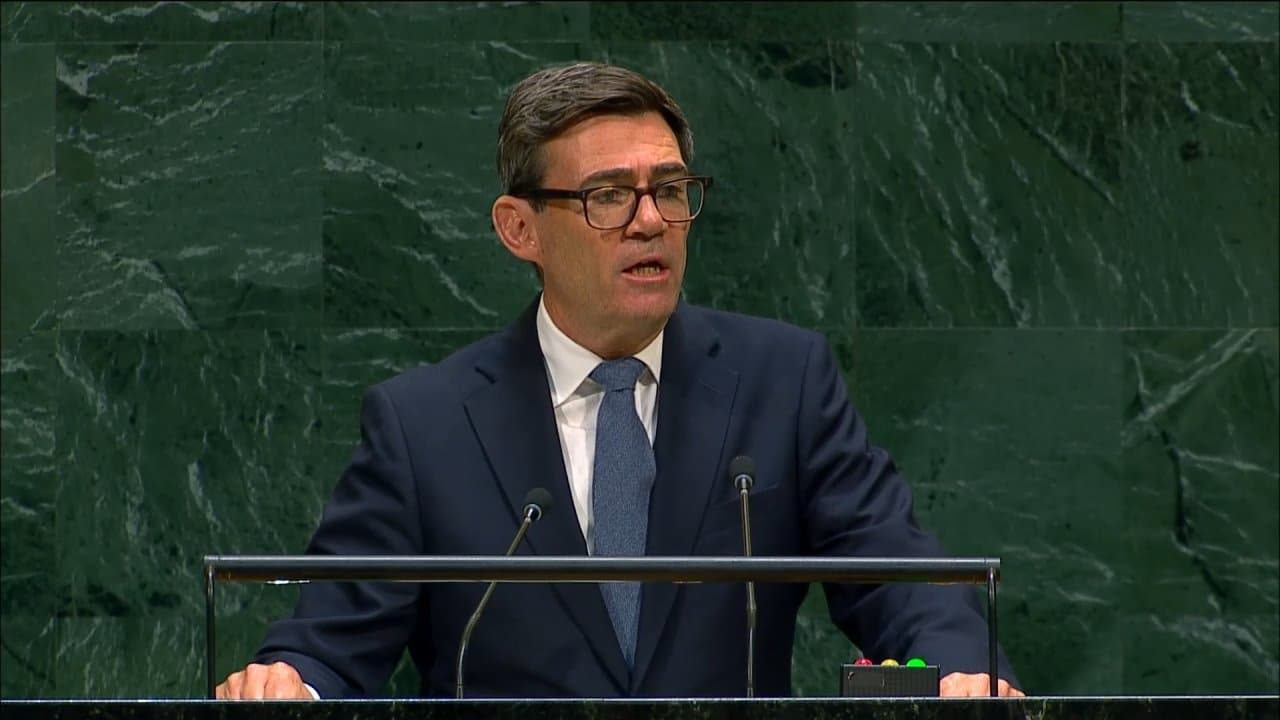
United Kingdom of Great Britain and Northern Ireland - General Assembly General Debate - 2026-09-22
General Assembly - Debate • United NationsSeptember 22, 2026
Locunity is an independent informational service and is not an official government page for this commission. All information is sourced from public footage and an analysis of official agendas with the aid of responsible, fact-checked AI. to report an error or omission.
Burnham Declares 'Britain Is Back,' Unveils AI Pact, Information Defense Center, and Middle East Reset
In his first address to the United Nations General Assembly, Prime Minister Andy Burnham laid out the most sweeping reset of British foreign policy in years — spanning artificial intelligence, Russian disinformation, Ukraine, and the Israeli-Palestinian conflict. Ten years after Brexit, the speech was a deliberate bid to reposition the UK as a global honest broker with concrete institutional commitments, not just aspirational rhetoric.
- UK and US launch new AI defense partnership to protect critical national infrastructure
- National center for information defense ordered to counter Russian disinformation, with Kremlin spending pegged at £1.3 billion annually
- AI placed at the heart of UK's 2027 G20 presidency, with push for single set of global principles and standards
- Trade with illegal Israeli settlements banned, occupation recognized as unlawful, settlement builders sanctioned
- Continued military and humanitarian support pledged for Ukraine, with Russian strikes on civilian infrastructure labeled war crimes
Post-Brexit Britain Stakes Its Claim as Honest Broker
Why it matters: A decade after the upheaval of leaving the European Union, the UK is attempting to carve out a distinctive diplomatic identity — not aligned with any single bloc, but positioned at the intersection of several.
Where things stand: Burnham opened with a direct acknowledgment of the disruption Brexit caused, then pivoted to frame it as an opportunity. He cited the UK's simultaneous membership in NATO, the UN Security Council, the Commonwealth, and the Comprehensive and Progressive Agreement for Trans-Pacific Partnership (CPTPP) as unique leverage.
"As the new British Prime Minister, I am here today to tell you how Britain will deliver leadership in a changing world for the decade that lies ahead," said Prime Minister Andy Burnham.
He announced the establishment of "Number 10 North" — a second Downing Street office in Manchester — as a signal that domestic power devolution would accompany the global pivot. He also pledged a new 10-year plan focused on affordability and reducing inequality.
The speech drew on historical touchstones: Manchester cotton workers who refused to process slave-picked cotton during the American Civil War, and Britain's fight against fascism in the 20th century — framing international engagement as a matter of national identity, not just strategic calculation.
UK Orders National Center to Fight Russian Information Warfare
The basics: The Kremlin has been running what Burnham described as an "industrial-scale" assault on the UK's information environment — deploying bots, fabricating newspaper articles, forging the branding of 28 British organizations including universities and the BBC, amplifying far-right narratives, and attempting to interfere in the 2019 general election.
Why it matters: At an estimated £1.3 billion per year in Kremlin spending on information manipulation, the threat has moved well beyond isolated troll farms. The new center represents a shift from passive monitoring to active disruption.
"The Kremlin spends around £1.3 billion each year on manipulating information," Prime Minister Burnham told the Assembly.
He directed UK security chiefs to begin work on a new national center for information defense, tasked with detecting, attributing, and disrupting hostile state information attacks.
"Today, I am asking our security chiefs in the UK to begin work on a new national center for information defense to detect, attribute, and disrupt these kinds of hostile state information attacks, to support and defend our democracy," he said.
What's next: Burnham offered to share UK expertise with other countries, noting the UK had already helped Moldova protect its elections from Russian interference and extending similar assistance to European nations facing these threats for the first time.
AI at the Heart of UK's G20 Presidency — and a New US Defense Pact
Why it matters: Frontier AI is accelerating breakthroughs in cancer diagnosis and economic productivity, but it is also multiplying security risks. The UK is betting that unified global standards — pursued through its G20 presidency — could shape the technology's trajectory for a generation.
Where things stand: Burnham announced two major moves. First, a new AI defense partnership with the United States focused on protecting critical national infrastructure:
"I am announcing today that we are developing a new AI defense partnership with the United States to protect our critical national infrastructure," Prime Minister Burnham said.
Second, he declared that AI governance will be the centerpiece of the UK's G20 presidency in 2027, building on a meeting convened by King Charles III and Norway's earlier initiative.
"I am going to put AI at the heart of the UK's G20 presidency next year," he said. The goal: "a single set of global principles and standards to ensure the transparency and access we need to increase our preparedness and to ensure that AI development is safe."
Burnham drew a historical parallel with the first Industrial Revolution, warning that workers suffered for decades before conditions improved. He pledged to get it right this time — ensuring elected governments serve working people through the transition.
"I want to reassure the British people that ultimately we will do whatever is necessary to protect them, including bringing forward new laws if that is what is needed," he said.
Ukraine: UK Pledges Air Defense and Infrastructure Repair Ahead of Winter
Why it matters: Russia is expected to target Ukraine's energy grid again as temperatures drop. UK commitments to air defense systems and infrastructure repair could determine whether millions face another winter without heat or power.
Where things stand: Burnham described his recent visit to Kyiv in vivid terms — market stalls set up outside destroyed halls, burned-out cars, bombed buildings, metro stations serving as shelters for elderly residents and children in freezing conditions. He cited the Graham Bill signed by President Trump as making "a huge difference."
He reserved his sharpest language for Russia's attacks on civilian infrastructure, directly confronting the contradiction of a permanent Security Council member committing what he called war crimes:
"Everyone in this room knows that strikes on civilian infrastructure are explicitly forbidden by international law. Yet we stand here in the UN announcing funding to mitigate the effects of these war crimes, which we reliably expect to be perpetrated yet again by a permanent member of the Security Council. It must end," Prime Minister Burnham said.
Decisions: The UK pledged support to protect Ukrainian skies and repair heat and power plants before winter, while urging Russia to accept a ceasefire and come to the negotiating table.
"But until then, we will stand with Ukraine stronger than ever for as long as it takes," he said.
Middle East Reset: Settlement Trade Ban, Sanctions, and a Two-State Ultimatum
The basics: Just eight weeks into his premiership, Burnham announced a comprehensive overhaul of UK policy on the Israeli-Palestinian conflict, developed with Foreign Secretary Ed Miliband.
Why it matters: Israel's issuance of tenders for the E1 mega settlement — which would bisect the West Bank — threatens to make a viable Palestinian state geographically impossible. The UK's response marks one of the most significant shifts in British Middle East policy in recent memory.
Where things stand: Burnham condemned the Oct. 7, 2023, Hamas attack and reaffirmed UK solidarity with Israel against threats including from Iran. But he stated plainly that Israel's actions in Gaza and the West Bank are not justified, citing too many civilian deaths including children, insufficient humanitarian aid, and the prolonged duration of the conflict.
In response, the UK has taken three concrete steps:
"We have acted by banning trade in goods with illegal settlements, recognizing that the Israeli occupation of the Palestinian territory is unlawful, and sanctioning those taking part in the construction of illegal settlements," Prime Minister Burnham said.
The other side: Burnham argued that failing to back the two-state solution with concrete action would erode public trust in democratic politics and be exploited by adversaries — framing the policy not just as a moral imperative but as a strategic necessity.
Minor Items
- Climate and clean energy: Burnham cited climate change as a national security threat and pledged continued UK leadership on clean energy transition, without announcing specific new programs.
- 10-year domestic plan: A new 10-year plan for Britain focused on affordability and inequality reduction was referenced but not detailed.