
Togo Celebrates Historic 'Correct the Map' Resolution, Calls for Global Follow-Up
General Assembly - Debate • United NationsSeptember 25, 2026
Locunity is an independent informational service and is not an official government page for this commission. All information is sourced from public footage and an analysis of official agendas with the aid of responsible, fact-checked AI. to report an error or omission.
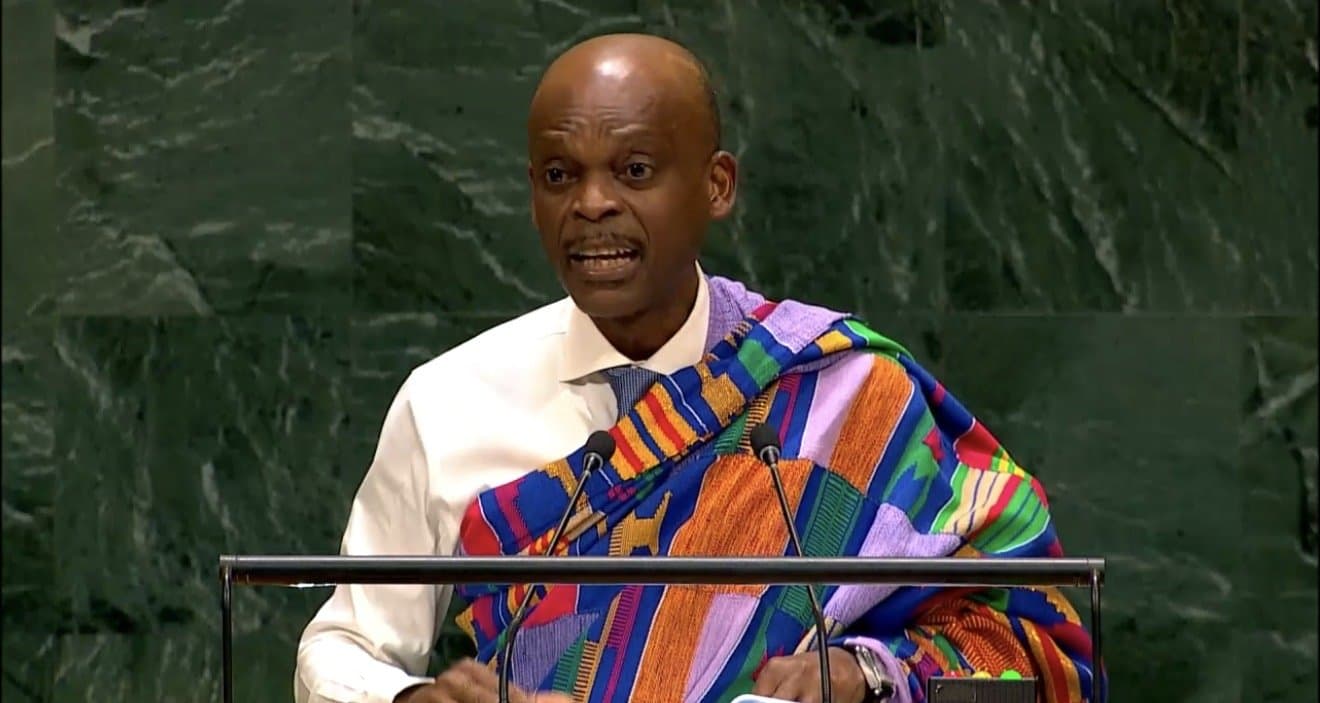
Togo's top diplomat used the United Nations General Assembly podium to mark a milestone: the adoption, with 164 votes, of a resolution aimed at correcting longstanding cartographic distortions that shrank Africa's true size on world maps. Minister of Foreign Affairs Robert Komlan Edo Dussey framed the vote as an act of justice and laid out an ambitious next phase linking accurate mapmaking to digital platforms, education, and artificial intelligence governance.
Togo celebrates 'Correct the Map' resolution adopted with 164 votes, launches global cooperation phase on cartographic accuracy
Minister Duse warns that weak international responses to violations of the UN Charter amount to "tolerance" of lawlessness
Togo champions African-led mediation in West Africa, the Sahel, and the Great Lakes region, arguing security cannot be reduced to military force
Call for stronger, more representative UN backed by endorsement of the UN80 reform initiative
Cartographic Justice: From Resolution to Implementation
One year after Togo first challenged the General Assembly over map projections that distort Africa's geographic scale, the West African nation returned to declare victory — and to open a new chapter.
The basics: On Sept. 4, 2026, the General Assembly adopted the "Correct the Map" resolution with 164 votes. The measure addresses cartographic conventions, most notably the Mercator projection, that visually minimize Africa and the Global South relative to northern continents.
Why it matters: The resolution is not merely symbolic. Minister of Foreign Affairs Robert Komlan Edo Dussey argued the stakes extend to classrooms, smartphones, and the algorithms shaping how billions understand geography. "The question before us is no longer only about printed maps. It's about the digital image of our planet that we are transmitting to the generation of tomorrow," said Minister Dussey.
Where things stand: Duse described the resolution as a turning point but not a finish line. He called on member states, UN agencies, scientific institutions, technology platforms, educators, youth, and AI developers to join a new cooperation phase. Switching from French to English mid-address to broaden his audience, he urged the global community to treat the initiative as a permanent, evolving effort.
"For us as Africans, the adoption of this resolution is far more than a cartographic decision. The adoption of this resolution is an act of recognition. The adoption of this resolution is an act of reparation. The adoption of this resolution, it's an act of justice," said Minister Dussey.
He explicitly linked the campaign to artificial intelligence governance, noting that AI systems interpret the planet through digital cartographic data — meaning distorted maps feed distorted machine intelligence. "Let us make Correct the Map an international laboratory for reflection, refresh, and innovation on the representation of our world," he said.
What's next: Togo is calling for concrete commitments from technology platforms, curriculum developers, and cartographic bodies to update how maps are displayed in schools, on devices, and within AI training data. No specific deadline was announced, but the minister framed the next General Assembly cycle as the window for building out implementation partnerships.
Togo Demands Stronger Multilateralism, Warns of Rising Lawlessness
Why it matters: Against a backdrop of escalating geopolitical tensions, Minister Dussey delivered a pointed warning that the international community's inability to enforce its own rules is eroding the legitimacy of the United Nations itself.
"Violations of international law and of the United Nations Charter are increasing in number, and the weakness of our responses are akin to a type of tolerance that we seem to be willing to accept," he said.
Where things stand: Duse argued that international law is not an obstacle to power but a guarantor of legitimacy and stability — one that protects vulnerable states while also serving the long-term interests of powerful ones. He called for a UN that is more representative in its decision-making structures and closer to the realities of the people it serves.
"Togo thus defends a pragmatic type of multilateralism that transforms commitments into results, that scaffolds power dynamics with shared rules, and organizes the peaceful coexistence of interests," said Minister Dussey.
Togo endorsed the UN80 initiative aimed at improving organizational effectiveness, coherence, and accountability. The minister also paid tribute to outgoing Secretary-General António Guterres, expressing hope that his legacy would guide future leadership.
Africa's Security on Africa's Terms
Why it matters: Togo positioned itself as a key mediator across West Africa, the Sahel, and the Great Lakes region, pushing back against external interventions that bypass local leadership.
Where things stand: Minister Dussey argued that economic vulnerability and climate impacts compound security challenges across the continent, fueling the very tensions that military operations alone cannot resolve. "Lasting security cannot be boiled down just to its military dimension," he said.
He cited President Faure Gnassingbé's personal mediation efforts in the region and made clear that African nations want partnership, not substitution. "Africa is not asking for others to act in its place," Minister Dussey said, insisting that no durable solution can be imposed without listening to local and sovereign realities.