
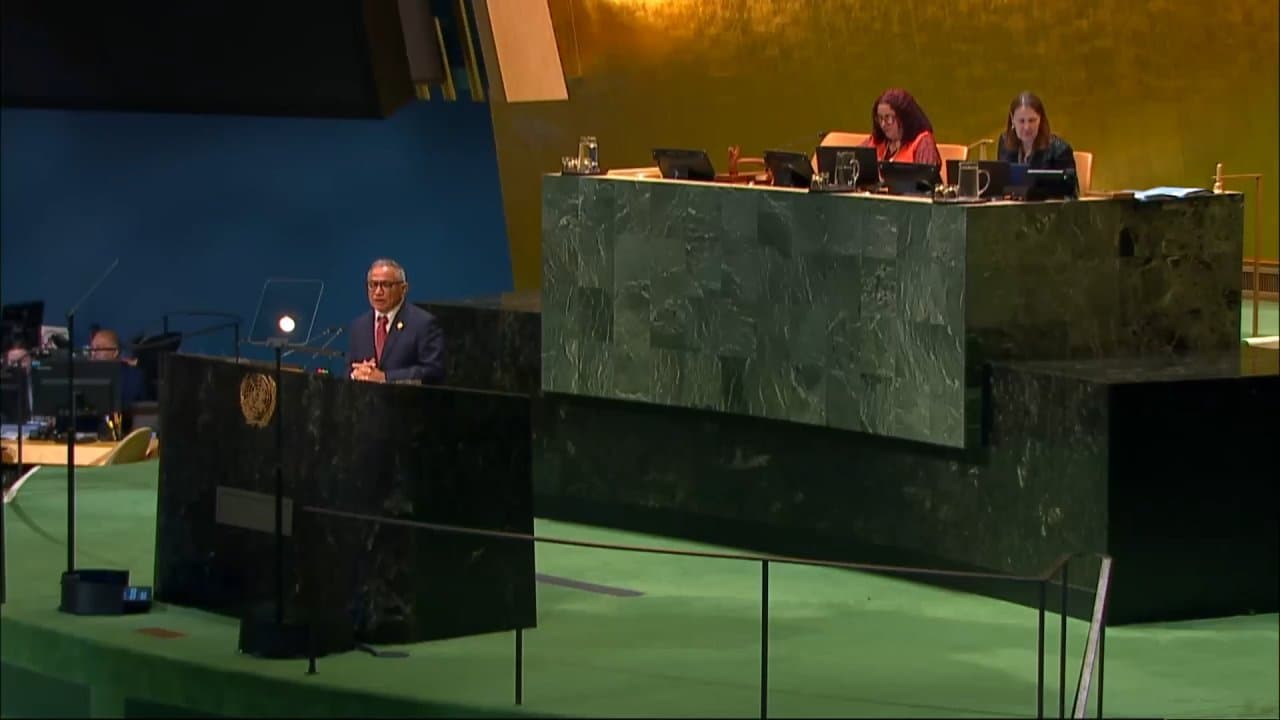
Belize Reports Guatemalan Airspace Violation, Demands Justice at UN
General Assembly - Debate • United NationsSeptember 26, 2026
Locunity is an independent informational service and is not an official government page for this commission. All information is sourced from public footage and an analysis of official agendas with the aid of responsible, fact-checked AI. to report an error or omission.
Prime Minister John Briceño used Belize's turn at the 81st United Nations General Assembly to formally place on the international record a Guatemalan military airspace incursion that occurred just days earlier — and to deliver a sweeping address linking reparatory justice, climate finance, AI governance, and the wars in Gaza, Ukraine, and Haiti. The Sept. 26, 2026, speech positioned Belize as a small state willing to name names, from Guatemala City to Jerusalem.
- Belize formally reports a Guatemalan military aircraft entered its sovereign airspace on Sept. 23, 2026, with its transponder intentionally disabled, demanding an immediate end to violations ahead of a February 2027 ICJ hearing
- Prime Minister calls Israel a "settler-colonial state," denounces apartheid and genocide in Palestine, referencing International Criminal Court warrants
- Belize endorses Carolyn Rodriguez-Brikett of Guyana as the next UN Secretary-General, the first Caribbean woman to be formally backed for the role
- Reparatory justice declared "no longer a marginal whisper" as Briceño demands historical debts from slavery and colonialism shape the post-2030 development framework
- Belize pushes for the Multidimensional Vulnerability Index to become operational in international finance, arguing small states deserve "accurate treatment, not special treatment"
- AI governance framed as the next frontier of inequality, with Briceño warning old power imbalances could be coded into data ownership and technology standards
Airspace Incursion: Belize Puts Guatemala on Notice
Why it matters: Belize used the highest platform in global diplomacy to formally accuse its neighbor of a military provocation — just three days before taking the podium — setting the stage for a critical International Court of Justice hearing.
Where things stand: Prime Minister John Briceño told the Assembly that on the night of Sept. 23, 2026, a Guatemalan military aircraft entered Belizean sovereign airspace and intentionally disabled its transponder, violating the Chicago Convention on International Civil Aviation and Article 2 of the UN Charter.
"Belize informs this Assembly of a serious breach of international law committed on the night of September 23rd, 2026, when a Guatemalan military aircraft entered Belize's sovereign airspace and intentionally disabled its transponder," said Prime Minister Briceño.
He described the incursion as part of a continuing pattern, including Guatemalan state vessels and personnel operating in Belizean territorial waters along the Sarstún River — in defiance of obligations to refrain from aggravating the dispute before the ICJ.
What's next: The ICJ case is scheduled for hearing in February 2027. Belize called upon Guatemala to immediately cease all incursions by air, land, and sea, comply with UN Charter and OAS confidence-building measures, and respect the ICJ process. Belize also requested heightened monitoring by both the UN and the Organization of American States.
"An Affront to Humanity": Belize Takes Aim at Israel, Backs Haiti, Cuba, and Taiwan
Why it matters: Small states rarely use language this direct on the General Assembly floor. Prime Minister Briceño's remarks on Palestine, Cuba, and Taiwan signal a coordinated CARICOM posture on some of the world's most contested geopolitical questions.
Where things stand: On Palestine, Prime Minister Briceño used the strongest language of the entire address, calling Israel a "settler-colonial state" and describing its actions as apartheid and genocide. He referenced outstanding International Criminal Court warrants.
"It is an affront to this Assembly and to humanity to be forced to listen to a man justify apartheid and genocide when he is wanted by the International Criminal Court for war crimes and crimes against" humanity, Prime Minister Briceño said, demanding decolonization of Palestine.
On Haiti, he echoed CARICOM's call for urgent full deployment of the Gang Suppression Force ahead of December elections and a Haitian-led political transition.
On Cuba, Prime Minister Briceño called for the lifting of the economic blockade and removal of Cuba from the state sponsors of terrorism list.
On Ukraine, he affirmed that borders cannot be redrawn by force.
On Taiwan, he highlighted its role in global supply chains and semiconductors and its partnership with Belize. "Belize calls once more for Taiwan's meaningful participation in the United Nations system," Prime Minister Briceño said.
Reparatory Justice and the Post-2030 Agenda
The basics: The UN's Sustainable Development Goals expire in 2030. Belize argued the successor framework must confront historical injustice — not just set new targets.
Why it matters: Prime Minister Briceño declared that the demand for reparatory justice has moved from the margins to the center of the General Assembly, connecting the wealth generated during the industrial age directly to the labor of enslaved and colonized peoples.
"The demand for reparatory justice is no longer a marginal whisper in this Assembly," Prime Minister Briceño said.
He cited the Assembly's declaration of slavery as the gravest crime against humanity and argued that the rewards of the industrial age flowed almost entirely away from those who produced the wealth. "When independence came, the flags changed. The structures did not. The terms of trade did not change," he said.
Prime Minister Briceño then connected this historical frame directly to the AI and technology transformation, asking whether old inequalities will be "written into the code" — who owns the data, who sets the standards, and who captures the value. He argued national legislation alone cannot govern a technology that crosses every border, and called for inclusive global governance of artificial intelligence to prevent developing countries from becoming dependent on systems designed elsewhere.
Climate, Vulnerability, and the Fight for Fair Finance
Why it matters: For small island developing states, the climate crisis is not a future risk — it is a present emergency. Belize used this address to push for a structural change in how international lenders evaluate small states.
Where things stand: Prime Minister Briceño warned the world is on course to exceed the 1.5-degree Celsius threshold set by the Paris Agreement, with rising seas threatening coastlines and even the very territory of some member states. He cited biodiversity loss weakening forests, reefs, and mangroves on which economies depend, and flagged unprecedented sargassum influx along Belize's coast as a new environmental stressor.
The core policy demand: the Multidimensional Vulnerability Index must become a working instrument across the international financial system — built into concessional finance eligibility and debt sustainability analysis — so that small states do not have to prosecute their case for fair treatment over and over again.
"Belize does not seek special treatment," Prime Minister Briceño said — it seeks "accurate treatment," arguing that income per capita alone cannot reveal hurricane exposure or the cost of serving dispersed communities.
What's next: Adoption of the MVI in international lending frameworks would change how development assistance and debt relief are allocated to climate-vulnerable small states. Belize and its CARICOM allies are expected to continue pressing the issue through the Antigua and Barbuda Agenda for small island developing states.
Belize Endorses Caribbean Candidate for UN Secretary-General
Prime Minister Briceño announced Belize's support for Carolyn Rodriguez-Brikett of Guyana as the 10th UN Secretary-General — a candidacy that would make her the first Caribbean woman to lead the organization.
"Belize proudly supports the candidacy of Her Excellency Carolyn Rodriguez-Brikett of Guyana, a distinguished daughter of the Caribbean," he said, adding that while the historic nature of the candidacy is significant, her record is the argument. The next Secretary-General, he said, will inherit an institution under strain and a world impatient for results.
He called for small and vulnerable states to be placed at the center, not the margins, of decisions that determine their survival — and for a more agile, representative, and better-equipped United Nations.
Minor Items
- Belize national development metrics: Prime Minister Briceño reported multidimensional poverty at 19.1%, unemployment at 1.9%, and public debt reduced to 66.6% of GDP, describing the country as on a path of sustainable development for the first time in a generation. Plan Belize 2.0 focuses on job creation, reduced energy dependence, ecosystem protection, and workforce skills.
- Belize Compact with the United States: The Prime Minister announced a landmark grant partnership with the U.S. focused on energy security and youth workforce training.
- Multilateralism warning: Prime Minister Briceño opened by praising the UN's 80-year record but warned the institution risks repeating the League of Nations' failure. "The League did not collapse for want of noble principles, but because member states abandoned those principles the moment they became inconvenient or constrained their power," he said.