
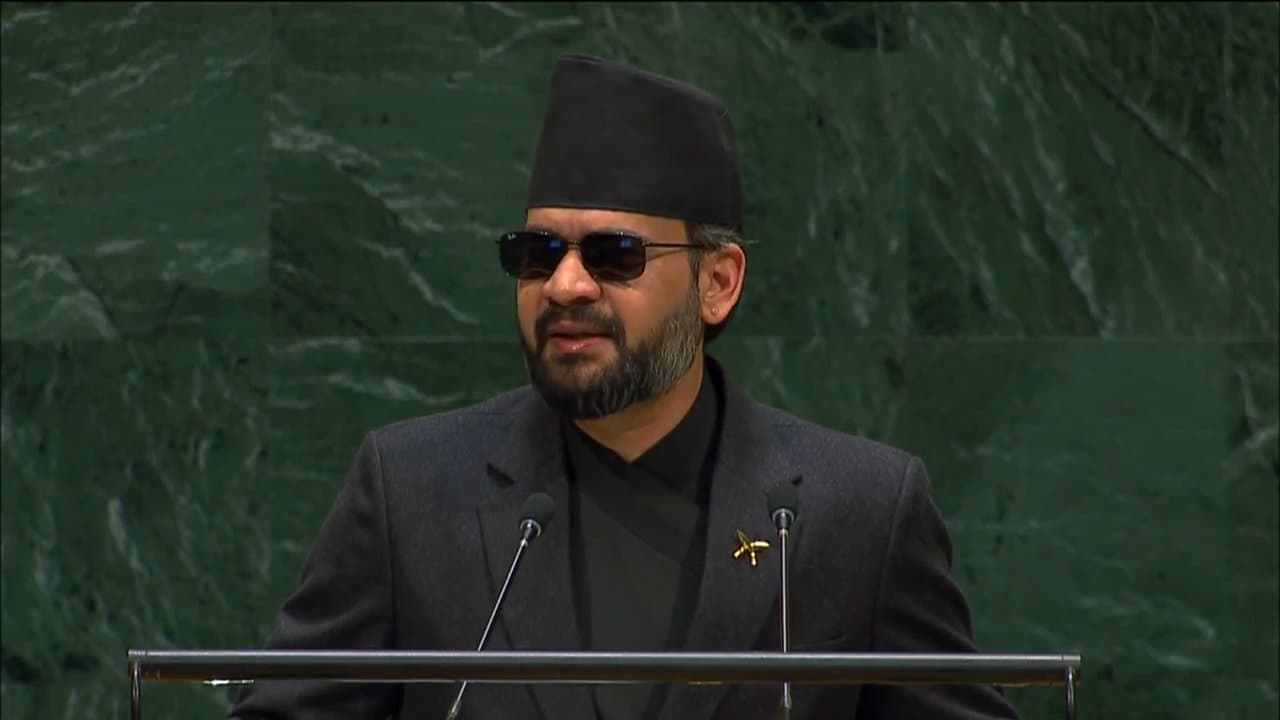
Nepal's Prime Minister Demands Climate Justice After 'Himalayan Tsunami' Kills 1,400
General Assembly - Debate • United NationsSeptember 24, 2026
Locunity is an independent informational service and is not an official government page for this commission. All information is sourced from public footage and an analysis of official agendas with the aid of responsible, fact-checked AI. to report an error or omission.
Prime Minister Balendra Shah used his United Nations General Assembly address to deliver a sweeping indictment of global climate finance, propose a new trilateral Himalayan monitoring mechanism with India and China, and challenge a world order he said can move weapons in 72 hours but cannot get fertilizer to farmers.
Nepal reports at least 1,400 dead and 66,000 missing after catastrophic Bhotekoshi-Trishuli floods, with recovery costs pegged at roughly 10% of GDP
Shah proposes a Himalayan Climate Resilience Mechanism led by Nepal, India, and China to share satellite data, monitor glacial lakes, and coordinate cross-border disaster response
Loss and Damage Fund and Global Environment Facility called "grossly inadequate" as Shah demands grant-based climate finance instead of loans for vulnerable nations
Shah challenges global economic order, contrasting efficient arms delivery with broken supply chains for food, fuel, and fertilizer in the developing world
Nepal highlights its own climate record: forests restored to nearly half its territory, hydropower installed, electric vehicle adoption rates rivaling parts of Europe
A 'Warning to the World' From the Himalayas
Four weeks before Prime Minister Shah took the General Assembly podium, catastrophic flooding tore through Nepal's mountain communities along the Bhotekoshi-Trishuli corridor. Shah described families still searching through mud and rocks for loved ones who will never come home — bridges, roads, schools, homes, and livelihoods swept away in minutes.
The basics: The Bhotekoshi-Trishuli disaster killed at least 1,400 people and left more than 66,000 missing. Shah estimated physical recovery needs at approximately 10% of Nepal's GDP.
"The Bhotekoshi-Trishuli disaster was not just a local tragedy; it was a warning to the world," said Prime Minister Shah, who described the event as a "mountain tsunami" or "Himalayan tsunami."
Why it matters: Nepal contributes less than 0.1% of global greenhouse gas emissions, yet the disaster erased years of development progress in one of the world's least-developed countries. Shah framed warming temperatures as destabilizing fragile Himalayan ecology — melting permafrost, fracturing mountain slopes beneath glaciers, and accelerating cascading hazards. The flooding crossed international borders and continued downstream into India, illustrating that climate disasters do not respect national lines.
"For Nepal, climate catastrophe is not just a humanitarian event but a development emergency," Shah told the Assembly.
He expressed gratitude to India, China, other countries, the UN system, humanitarian agencies, and philanthropies for their aid, and compared the scale of recovery ahead to the rebuilding that followed Nepal's devastating 2015 Gorkha earthquake. He appealed for continued solidarity and sustained support.
Six Words and a Burning House: Shah's Climate Finance Challenge
The prime minister used some of the sharpest language of the session to challenge international climate financing mechanisms and frame what Nepal expects from the global community.
"This is why this assembly must note 6 words: relief, rehabilitation, reconstruction, and also responsibility, reparation, resilience," Shah said — the first three for immediate disaster response, the second three to keep disaster from becoming a permanent condition.
Where things stand: Shah called out the Loss and Damage Fund, the Global Environment Facility, and other financing mechanisms by name, calling them "grossly inadequate." He argued that climate finance must not become another bureaucratic maze, and used a vivid analogy to make the point:
"When the house is burning, we do not ask family to complete 50 forms," he said.
He called for adequate grant-based support rather than what he characterized as mega-loans or patchwork small grants. His critique touched all three dimensions of climate justice — distributive justice (who bears the cost), procedural justice (who has a voice), and intergenerational justice — arguing that mountain communities, small island states, landlocked nations, and least-developed countries are paying a price they did not create.
Why it matters: The speech positions Nepal as a leading voice in the bloc of climate-vulnerable nations pushing to reshape how climate finance flows. The core argument — that countries responsible for negligible emissions should not shoulder recovery costs through debt — is gaining traction ahead of upcoming international climate negotiations.
A Himalayan Lab, Not a Frontier
As a concrete policy proposal, Shah announced Nepal's call for a Himalayan Climate Resilience Mechanism led by Nepal, India, and China.
"That is why, as an urgent first step, we propose that we establish Himalayan Climate Resilience Mechanism led by Nepal, India, and China," Shah said.
The mechanism would share satellite data and expertise, monitor dangerous glacial lakes, strengthen joint early warning systems, and coordinate assistance across borders when disaster strikes.
"They are part of planet's life support system," Shah said of the Himalayas, pushing back against the notion that the region is peripheral. He noted the Hindu Kush Himalaya is home to nearly 2 billion people and provides water, ecosystem services, agriculture, and livelihoods to populations far beyond Nepal's borders. He urged the mountains become "a laboratory of international cooperation rather than a frontier of fragmented information."
Nepal's own contributions: Shah highlighted domestic climate action — forests restored to cover nearly half of Nepal's territory, hydropower development, electric vehicle adoption rates he said match parts of Europe, and strengthened climate adaptation at local levels. He also announced a "Sagarmatha to Seaside" event at the United Nations beginning the following day, positioning Nepal as a convener on climate justice.
What's next: The trilateral mechanism remains a proposal. If realized, it would represent the first coordinated Nepal-India-China climate monitoring and disaster response system for the Hindu Kush Himalaya region.
'Flawless Logistics for War, Broken Logistics for Food'
Shah broadened his address into a critique of global governance, arguing military and economic power too often determines whose voice is heard.
"We have built a world with flawless logistics for war and broken logistics for food. And this is not Nepal's private misfortune," Shah said.
He described how Nepal's new majority government — elected through what he called the fairest and most peaceful elections in Nepal's history — immediately faced international adversities including shortages of fertilizer, bitumen for highways, and cooking gas.
"A country that is willing to pay should be able to buy, and a world that can deliver a weapon anywhere in 72 hours has no excuse for leaving a farmer without means of decent livelihood," he said.
Why it matters: Shah referenced the 1994 UNDP Human Development Report's concept of human insecurity, which defined security in terms of people rather than territories and development rather than arms. He defended multilateralism as essential for small, poor countries, saying the United Nations is the forum where their presence is felt.
Shah noted the generational shift his government represents — he described himself as the youngest head of government to address the Assembly that session — and committed to building a state that delivers decent jobs, social protection, and a fair chance to every Nepali.