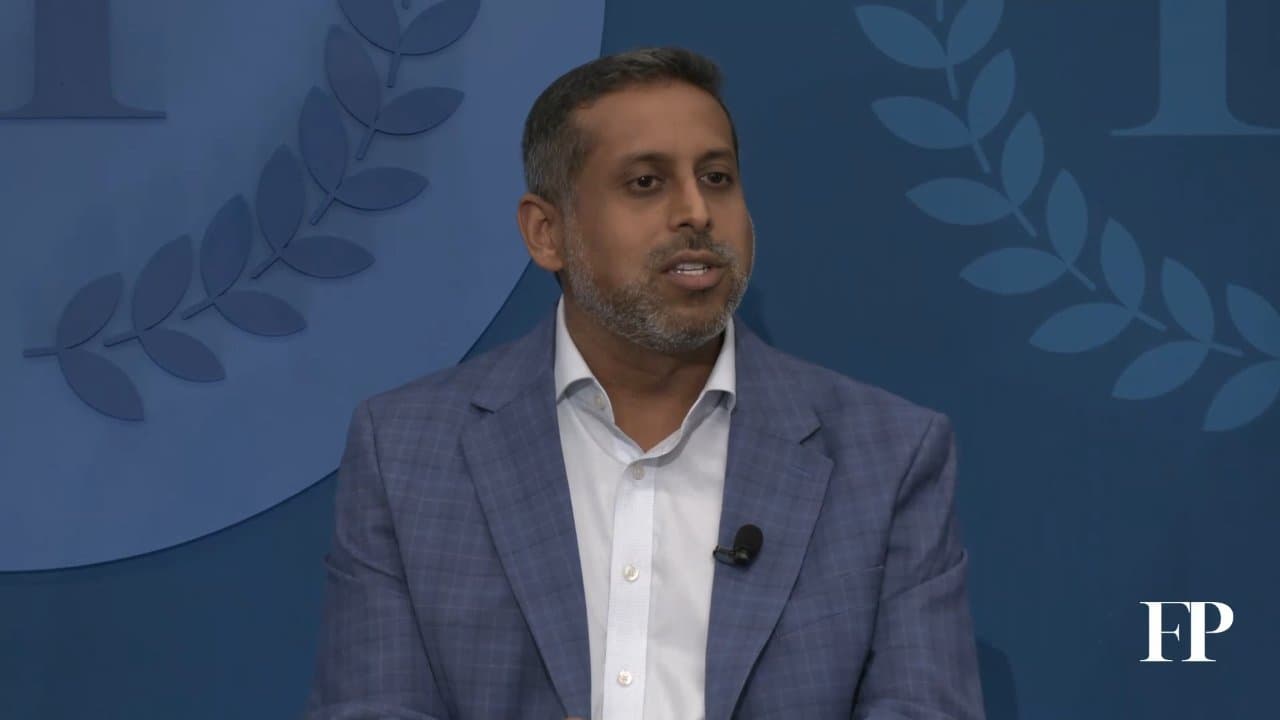
Foreign Policy - Sep 22, 2026 - Meeting
Foreign Policy • United NationsSeptember 22, 2026
Locunity is an independent informational service and is not an official government page for this commission. All information is sourced from public footage and an analysis of official agendas with the aid of responsible, fact-checked AI. to report an error or omission.
Workers, Women, and the Kill Switch: A Global Forum Confronts AI's Deepest Fault Lines
Foreign Policy's two-day Tech and AI Forum, convened during United Nations General Assembly week, brought together ministers, tech executives, labor leaders, a Nobel laureate, and a U.S. senator to reckon with a shared conclusion: AI governance is no longer theoretical, and the window for action is closing fast.
AFL-CIO highlights casino workers' contract as model for AI deployment, warns women in administrative roles face displacement first
Senator Murphy demands deepfake bans, friendship bot restrictions, and frontier model approval within 12 months
Nobel laureate Maria Ressa says AI has progressed from hacking attention to hacking human agency itself, warns 74% of the world is now under authoritarian rule
McKinsey projects 11 million U.S. jobs in transition — a COVID-scale labor shock sustained for a decade
Microsoft security chief reveals 1 million AI agents running inside the company, calls them the new insider threat
GSMA warns a memory chip crisis has doubled smartphone costs, threatening 3.1 billion unconnected users
Finland's foreign minister pitches nuclear-powered energy independence as Europe's competitive edge, cites Google's €13 billion investment
AI Is Coming for Women Workers First — and Unions Have a Playbook
A panel on AI, labor, and the meaning of work produced the forum's most urgent exchange, weaving Catholic social teaching, union strategy, and existential anxiety into a single argument: that workers must have a seat at the table before new technology arrives — not after.
Why it matters: AI-driven automation is not an abstract future risk. It is already reshaping administrative work, customer service, and logistics, with disproportionate impacts on women without college degrees. The panel demonstrated that practical solutions exist but require political will and collective bargaining power.
Where things stand: Lauren McFerran, Executive Director of the AFL-CIO Technology Institute, put the gender dimension front and center. "AI is coming for a lot of workers, but it's coming for women workers first, actually, and particularly women with high school degrees that do administrative work," she said, citing researcher Molly Kinder's findings.
McFerran described how AI already dehumanizes workers through surveillance, algorithmic management, deskilling, and loss of autonomy — before it replaces them outright. But she also offered a concrete counter-model. "Unite Here, which represents, among many other workers, casino workers in the Las Vegas area, has negotiated provisions in their collective bargaining agreements that gives them up to 6 months notice before any new technology is implemented in their workplace," she said. Those agreements also include the right to bargain over technology decisions, worker voice in implementation, training programs, and displacement protections. The AFL-CIO's partnership with Microsoft, she noted, brings workers directly into corporate labs.
The other side: Father Sam Sawyer, Editor-in-Chief of America Media, grounded the discussion in Pope Leo XIV's recent encyclical Magnificat Humanitas, which he said builds on Leo XIII's 1891 Rerum Novarum. He noted that Anthropic's Chris Olah spoke at the encyclical's Vatican launch — an unusual convergence of Silicon Valley and the Holy See.
"Work is not just an economic activity," Sawyer said. "We need it as part of the way that we become more human ourselves." He rejected narratives that treat AI displacement as inevitable. "The economy is not a cosmic force. The economy is not a god. It's something we can make human decisions about together."
Wes McEnaney, Labor Outreach and Coalition Builder at the Future of Life Institute, described a pro-human declaration assembly that featured both Sen. Bernie Sanders and Steve Bannon — evidence, he argued, that anxiety about AI crosses partisan lines and could create unusual conditions for legislative action.
McFerran called regulation "the R word no one wants to use," but insisted it was necessary and overdue.
What's next: The panel's convergence of labor, faith, and policy voices suggests a growing coalition pushing for enforceable worker protections in AI deployment, with the Unite Here model as an early template. Whether Congress acts on the bipartisan energy McEnaney identified remains the open question.
Murphy Says Regulate AI in 12 Months or Risk Losing Democracy
Sen. Chris Murphy (D-CT), a member of the Senate Foreign Relations Committee, closed the forum with a blunt assessment: the biggest trust problem in AI is not international — it is domestic. The American public is begging for regulation that has not arrived.
Why it matters: Murphy identified three measures he called achievable on a bipartisan basis: outlawing or watermarking political deepfakes, banning or restricting "friendship bots" for children, and creating approval processes for frontier models. He argued failure to act would erode public faith not just in technology but in government itself.
"Friendship bots — a poison for our kids, a poison," Murphy said. "We could just outlaw those writ large or we could outlaw them for kids." He cited a figure of 60% of American children now using chatbots regularly.
On geopolitics, Murphy rejected the argument that regulation would slow American competitiveness. "China would love nothing more than for the United States to do nothing to protect people spiritually and the economy generally from what AI could do unchecked," he said. "They would love for us to be the one that submits our citizens as guinea pigs to this technology."
He criticized the Trump administration for simultaneously blocking international AI engagement while "signing off on agreements to give sensitive technology to the Chinese." He predicted the upcoming Trump-Xi summit would be a "badly missed opportunity" on AI governance.
The other side: Jeff Browning, Director of Global Government Affairs and Public Policy at ServiceNow, advocated for industry-led standards through NIST, OECD, and ISO 42001, arguing that trust "is gained in drops and lost in buckets."
But Browning also endorsed a critical safeguard: "Every organization that's deploying AI needs a kill switch that they control," he said, emphasizing it must operate "at machine speed."
Murphy was direct about the relationship between companies and regulation: "The last thing we should do is give them veto power. They will attempt to try to have veto power. They will try to spend money in elections to get folks in power who will only pass regulatory regimes that they approve."
What's next: Murphy called for legislative action within 12 months. Whether the political conditions he described — bipartisan public anxiety, growing evidence of harm to children — translate into votes remains uncertain.
Ressa: AI Has Moved From Hacking Your Attention to Hacking Your Agency
Maria Ressa, Nobel Peace Prize laureate, Founder and CEO of Rappler, and Co-chair of the UN Independent International Scientific Panel on AI, delivered the forum's most sweeping warning, mapping AI's evolution through three biological phases.
Why it matters: Ressa argues that the same technology pipeline that shortened attention spans through social media is now capable of manipulating intimate relationships and, with agentic AI, overriding human decision-making entirely.
"The first on social media is the attention economy," Ressa said. "What happened after that? We know that we literally — our attention span diminished." The second phase came with large language models and chatbots in 2022-23, which she described as hacking intimacy. She cited the case of Megan Garcia, a 14-year-old who died by suicide after engaging with a Character AI chatbot. The third phase — agentic and multi-agentic AI — hacks agency itself.
As co-chair of the UN panel (40 experts from 37 countries), Ressa said the real division in their consensus-building process was not between nations but "people versus big tech." The panel released a thematic brief asking three questions: What do we know? What don't we know? What would be irresponsible to ignore?
She called information integrity "the mother of all battles. We win that; we win everything. We lose that. We lose everything. Gender, climate, health, you name it, democracy."
On journalism, Ressa described the business model as functionally dead. "When you now search and generative AI gives you your answer without bringing you to our website, it means it took our content and did not bring you back, which means we have no revenue," she said. "The drop globally is around 75 to 80%."
She referenced MIT research showing lies spread six times faster than facts, and said 74% of the world is now under authoritarian rule according to V-Dem data, linking the trend directly to technology-enabled manipulation.
McKinsey: The Largest Skills Migration in History
Tongyi Catlin, Director of the McKinsey Global Institute, previewed forthcoming research projecting that AI will force the largest workforce transformation in modern American history — and that most displaced workers will struggle.
Why it matters: The research finds 11 million U.S. jobs are in transition and 25 million more will be retained but require fundamentally different skills, affecting 70% of the workforce. Sales, office administration, and transportation face the sharpest displacement. Healthcare has the highest new demand — but also the biggest credentialing barriers.
"Imagine what we've experienced during COVID," Catlin said. "COVID was a massive, massive shock in the labor system. Well, you take COVID and now we're going to need to sustain that level of magnitude and pace for 10 years."
Among workers in transition, only 1 in 7 will find easy pathways to new roles. Forty percent face moderate challenges. Fifty percent face significant hurdles driven by skill mismatches and credentialing requirements.
Catlin identified three skill tiers: "essential skills" (communication, problem-solving) that grant access to 70% of jobs; "advancement skills" (critical thinking, leadership) commanding $83,000 more in annual pay; and "reinvention skills" (resilience, AI proficiency — up 11-fold in four years).
He drew a historical parallel: "What's happening fundamentally with AI right now is the cost of prediction is coming down to zero, which basically means that the demand for judgment and the value of judgment is going to increase dramatically." He compared it to the 1920s transition when farmers became bankers — a shift that took decades and remade American society.
Catlin cited Singapore's merger of its skills and workforce departments, creation of 200 AI classes, and Canada's self-assessment platform as international models.
Microsoft's Security Chief: AI Agents Are the New Insider Threat
Hayat Gallo, Executive Vice President of Security at Microsoft, and Jonathan Black, former Deputy National Security Advisor for the United Kingdom, argued that agentic AI has fundamentally broken the assumptions underlying enterprise cybersecurity.
Why it matters: Defenses built to monitor and contain human behavior cannot scale for AI agents that are polymorphic, unpredictable, and operate at machine speed. Microsoft itself is managing roughly 1 million AI agents in its own environment.
"The physics of cybersecurity have been completely changed by AI," Gallo said. "We build defenses and controls — it was for humans. But humans and agents do not behave the same way and they don't create the same levels of risk."
She identified three categories of threat: AI insiders (sanctioned or rogue agents with high-privilege access that can be poisoned), AI-powered attacker campaigns moving faster at scale, and amplified vulnerability exposure. "Take Microsoft — we have 1 million right now running in our environment. We have to be able to see them. We have to understand what they're doing and we have to adjust what they can do," she said.
Gallo recommended three questions for every corporate board: What observability do you have over AI in your enterprise? Are you using AI for defense? How is your cyber hygiene? She called for democratizing defensive AI tools beyond large enterprises and emphasized that cross-border coordination is essential because "models don't stop at country boundaries."
Black argued the public debate spends too much time on the "1% existential risk" and not enough on the "99% of real-world deployment risks," citing the United Kingdom's active startup ecosystem in cybersecurity risk management.
A Memory Chip Crisis Threatens 3.1 Billion Unconnected Users
A panel on global connectivity revealed a hardware bottleneck threatening to widen the digital divide just as AI makes internet access more consequential than ever.
Why it matters: Without affordable smartphones, billions of people cannot generate the data needed to train locally relevant AI models — creating a vicious cycle in which underrepresented populations remain invisible to the technology shaping their futures.
Vivek Badrinath, Director General of the GSMA, reported that mobile coverage in Africa has reached 92%, up from 85-86% in recent years. But a 3.1 billion-person "usage gap" persists, driven primarily by handset affordability. A memory chip crisis has made the $50 smartphone impossible.
"That $50 phone today is impossible," Badrinath said. Costs have jumped to roughly $100 — six weeks' wages for the poorest 20% of earners in sub-Saharan Africa. He highlighted language initiatives including SEA-LION for Southeast Asian languages and ATLAS-Umoja for African languages, and noted that only 0.3% of internet content represents underrepresented languages.
Minister Marc-Alexandre Doumba, Minister of Digital Economy and Innovation for the Republic of Gabon, described a mobile-first governance strategy: building super apps, designing lightweight applications, leveraging high mobile money penetration to layer identity services on top of payments, and passing a Law on Digitalization with national preference requirements in technology procurement.
Vilas Dhar, President and Trustee of the Patrick J. McGovern Foundation, challenged two assumptions he called "conceits." "The first is the idea that access equals agency," he said. "We have spent billions of dollars to build infrastructure and unfortunately have also created captive user bases for private sector technologies that don't lead to the equitable outcomes we're looking for."
Dhar argued communities must be "creators of technology, not consumers," and reframed AI literacy around resilience and values. "Tell me, you're a parent. The first time you held a child in your arms and you looked into their eyes, did you say to yourself, I really hope you have the skills to participate in the economy?"
Finland Bets on Nuclear Power and Quantum Computing in AI Race
Elina Valtonen, Minister of Foreign Affairs of Finland, offered a pragmatic European counter-narrative: stop trying to match Meta's $125 billion chip investment and focus on competitive advantages across the AI stack.
Why it matters: Finland's pitch — energy independence through nuclear and renewables, quantum computing infrastructure, and trusted connectivity companies Nokia and Ericsson — positions smaller nations as strategic partners in an AI landscape dominated by U.S. and Chinese hyperscalers. Google's €13 billion AI infrastructure investment in Finland, coupled with nuclear power investments, validates the approach.
"Finland actually — now we have the lowest pricing electricity as we speak. We are completely independent in our electricity production. We rely on nuclear and renewables," Valtonen said.
She identified Europe's core problem as cultural rather than technical. "It's more of a philosophical issue that we have been lacking the entrepreneurial risk-taking spirit in the past 20 years," she said. She noted European pension funds invest heavily in American stocks rather than domestic innovation — sending European savings to fund American competitors.
Valtonen categorized AI risks into three types: AI in the wrong hands (U.S. vs. China competition), autonomous systems taking control, and humans voluntarily delegating agency. On regulation, she argued Europe is "a master in regulation" and needs to cut red tape, not add layers. Finland, she noted, has been the world's happiest country for nine consecutive years.
Singapore: Test Before You Trust
Josephine Teo, Minister for Digital Development and Information for the Republic of Singapore, outlined a governance-first national AI strategy anchored by a simple principle borrowed from aviation.
"You and I are not going to step on a plane if we don't think that it will land and get us home," Teo said, explaining the need for multi-layered AI protection spanning model makers, deployment standards, and user training.
Singapore's strategy, which evolved from early experimentation in 2018 through a generative AI pivot in 2022-23, is guided by a vision statement: "AI for the public good. For Singapore and the world." The country created an AI safety testing framework and software toolkit, and produced the "Singapore Consensus" through two years of international scientific exchanges.
On geopolitics, Teo rejected binary choices between American and Chinese technology stacks. "We cannot simply expect to make progress by accessing any single platform or ecosystem," she said. "This is not the approach that is sustainable, and it doesn't confer resilience."
For its upcoming ASEAN chairmanship, Singapore is prioritizing cross-border data flows with trust, AI adoption for small and medium enterprises, and continuity of digital agenda across rotating chairs with the Philippines and Thailand.
Minor Items
Mozilla's Ziad Pourath framed open-source AI as "a precondition for sovereignty" and argued frontier model consolidation leads to cultural "sameness," citing research showing individual users may be more creative with AI but collectively average toward homogeneity. Africa accounts for only 2% of web data used to train leading models.
TikTok's Tom Varghese reported the platform has labeled over 3 billion pieces of AI-generated content using watermarking and technical standards. The company launched an AI Literacy Fund partnering with 20+ organizations including Common Sense Media and the News Literacy Project, reaching 200 million viewers in six months.
Luminate CEO Melanie Hui announced a global strategic litigation fund, launching with other philanthropies, to bring legal accountability to big tech platforms. She cited the Rohingya genocide in Myanmar as an example of "algorithmic violence" amplified by platforms not designed to be safe.
Omidyar Network CEO Michelle Jawando argued AI outcomes are "design, not destiny," highlighting Howard University's watermarking research, New York's fashion model protections, and California consumer protection law as existing legal frameworks applicable to AI harms.
The FIFA World Cup panel featured Kate Dillon of the U.S. State Department, Lindsay Krasnoff of NYU, and Ladan Fakouri of Lenovo discussing how the tournament — with 6 billion viewers, AI analytics reviewed by all 48 teams, and 1,248 player avatars — set technological and economic precedents for the LA 2028 Olympics.
Zoom's Josh Kalmar argued that data localization requirements undermine the sovereignty they claim to protect, noting the company grew from 2,000 to 7,000 employees since the pandemic and could not have connected the world during COVID under strict localization rules. AI's compute demands, he said, make every unit of localization exponentially more costly.