
Fire Chief Moves on Cancer Screening, PFAS-Free Gear as Projects Slip
Fire Commission • San FranciscoNovember 10, 2026
Locunity is an independent informational service and is not an official government page for this commission. All information is sourced from public footage and an analysis of official agendas with the aid of responsible, fact-checked AI. to report an error or omission.
San Francisco firefighters are getting new health protections. The Fire Department is moving ahead with a $500,000 cancer-screening contract and a $7M purchase of PFAS-free protective gear. At its Nov. 10, 2026, meeting, the Fire Commission also heard about delayed construction projects, an $80M plan to replace aging fire engines and ambulances, and public commenters who want peer counselors back on the city's Street Crisis Response Team.
- $500,000 cancer-screening request for proposals (RFP) is coming after the Department of Public Health said it could not do the screening.
- $7M purchase of PFAS-free turnouts headlines the Chief's report.
- Station 13 groundbreaking set for Oct. 31, 2027, and a training facility needed its foundation piles re-drilled.
- $80M, 10-year apparatus package targets 25 engines and 14 trucks older than 20 years.
- Peer counselors have been off the Street Crisis team for 87 days, a public commenter said.
Health Gear Advances, Construction Lags
The basics: PFAS are a family of synthetic "forever chemicals." Turnouts are the protective coats and pants firefighters wear into fires.
Why it matters: Firefighter health and capital projects both shape department readiness and costs. The Chief's report drew the longest discussion of the morning.
Where things stand: Chief of Department Dean Crispin said the Department of Public Health could not perform the cancer screening. Instead, the department will issue an RFP covering MRIs, ultrasounds and blood panels.
"We did receive $500,000 in city funds in our budget for cancer screening," said Crispin. The report also covered the $7M purchase of PFAS-free turnouts.
The screening drew support from the dais. "I just wanted to say as a commissioner how important that is," said Commissioner Stephen A. Nakajo.
Concrete problems: The foundation piles at the Carroll Avenue training facility had to be re-drilled. Crispin said "it is mostly the responsibility of the subcontractor."
- Station 13 is scheduled to break ground Oct. 31, 2027, and be completed in April 2030.
- Station 2 will follow Station 13.
Paperwork in motion:
- A racial equity action plan, which now includes gender, is with the City Attorney.
- A General Order merged the department's EMS and community paramedicine section chiefs.
The other side: Public commenter John Ellis suggested other approaches to screening and response:
- thermal scopes;
- community volunteers;
- mobile MRI and ultrasound units.
Decisions and stakeholder impacts: The report was informational, and the commission took no vote. Rank-and-file firefighters gain screening access and safer gear. However, the construction delays push station replacements years out for the neighborhoods those stations serve.
What's next: Commissioners asked for an update on contingency funds in the ESER bond, the city's Earthquake Safety and Emergency Response bond, and on design-build contracting. "Chief Schwartz is going to give an update by either next meeting or the one following," said Crispin.
An $80M Bet on an Aging Fleet
Why it matters: The department says decades of deferred replacement have left much of its fleet past its service life.
Where things stand: According to Assistant Deputy Chief of Support Services James O'Connell, the fleet includes:
- 25 engines and 14 trucks older than 20 years;
- 18 ambulances older than 10 years.
"The city approved an $80 million apparatus procurement package during the fiscal year 2026 budget cycle," said O'Connell.
How the money works:
- The city will set aside about $8M a year for 10 years.
- That stream will be financed up front, so the department can buy vehicles now.
- O'Connell estimated "approximately $65 million to $70 million in net purchasing power after financing costs are accounted for."
- The financing terms are not yet final.
Buying rules: The purchases are exempt from competitive bidding until July 1, 2027. The Chief clarified that the department obtained sole-sourcing authority. The presentation also cited behested payments from PG&E, Salesforce and the San Francisco 49ers. A behested payment is a contribution made at an official's request to a government agency or other third party.
Political credit: The department pointed to the Board of Supervisors' budget chair. "None of this would have happened without your leadership as a budget chair," Crispin told Supervisor Connie Chan.
Chan tied her support to the health push. "I think that the very least that this city can do for them is to provide them the uniforms that are cancer-free," said Chan.
The other side: Ellis asked that any procurement difficulties be made public. He also urged forward-looking technology, such as infrared tools and mobile MRI.
Decisions and stakeholder impacts: The commission took no vote on the plan.
- Crews would get newer engines, trucks and ambulances.
- Sole sourcing speeds up delivery but limits price competition while the exemption lasts.
- Taxpayers carry financing costs of roughly $10M to $15M, the gap between the $80M package and the estimated purchasing power.
What's next: Watch for final financing terms and purchases made before the July 1, 2027, exemption deadline.
Street Crisis Team Faces Pressure on Peer Counselors
Why it matters: The commenters argued that peer support is central to the Street Crisis Response Team's identity and funding. They questioned whether the team is still a specialized service.
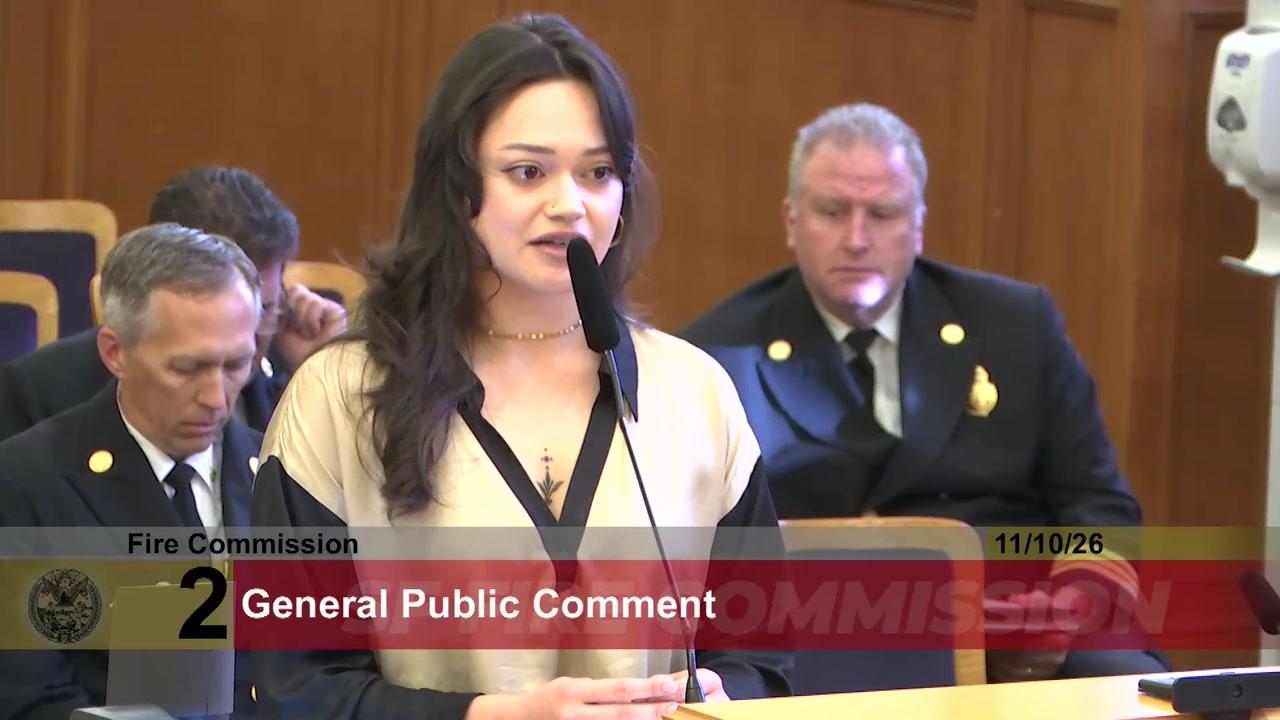
Where things stand: Public commenter Amelia Harmon spoke during general public comment and twice more during the Chief's report.
"It's been 87 days since the peer counselors were removed from the Street Crisis Response Team," said Harmon. She said more than 240 letters had gone to city leadership. She also gave commissioners packets of studies on peer specialists.
Harmon later cited a Kentucky hospital case study that found a "63.5% reduction in inpatient admissions."
Ellis is a Resident Advisory Board member with the Supportive Housing Providers Network, though he spoke for himself. He backed trained peer responders and pushed for:
- data sharing with patient consent;
- accountability across agencies;
- more permanent supportive housing.
"There was over 100 EMS calls to the 1460 location," said Ellis.
The department's response: Crispin discussed a data-sharing agreement with the Department of Public Health and the limits that federal health privacy law (HIPAA) places on sharing records.
A structural shift in EMS: The department launched EMS 2 on Oct. 10. It merges two weekday section chief positions into one role that is "combined into a single 12-hour-a-day, 7-day-a-week EMS field operation position," said Assistant Deputy Chief of EMS Emily Anderson.
- A field training officer pilot is underway.
- A formal training program is hoped for in spring 2027.
- Harmon supported the field-based EMS 2 model but urged attention to peer-specialist data.
Hospital delays: APOT, or ambulance patient offload time, measures how long crews wait to hand patients over to a hospital. Deputy Chief for Emergency Medical Services Garreth Miller said "we received notification from the LEMSA that 7 hospitals would be notified that they are exceeding the 30-minute APOT limit." LEMSA is the local agency that oversees emergency medical services.
Decisions and stakeholder impacts: The commission took no action. Unhoused residents, peer specialists and supportive housing providers have a direct stake in how the team is staffed.
What's next: The commission president asked how APOT is calculated. The president also asked for follow-up on alternate destinations for patients, such as the Bayview Navigation Center.
Minor Items
- El Niño preparations: Deputy Chief of Operations Patrick Rabbitt described a task force and General Order 26A99. It calls for pre-storm checks at more than 50 department facilities and drone documentation of roof conditions ahead of king tides.
- Recruitment: Deputy Chief of Administration Sayumi Brannon reported 1,189 new H-2 applicants, with panel interviews on Nov. 30. Los Bomberos President David Crespin said "we would like to see more Latinos in all ranks in the fire department."
- Battery permits: Eric Schoonbaert, director of engineering at Luminalt, asked the department to use the automated SolarAPP+ platform for standalone battery permits. He said manual reviews take four to five weeks.
- 730 Stanyan: Tenant Jay West alleged that management props open fire doors and that alarms go off frequently. "I want inspectors to come out and inspect the building," said West.
- Votes: The commission approved the Oct. 14 minutes and its 2027 meeting calendar by voice vote, with no tally announced. It also voted to hear discipline Case No. 2026-01 in closed session, then voted not to disclose that discussion.
Looking Ahead
A bond-contingency update from Chief Schwartz is expected at the next meeting or the one after. Also watch for the cancer-screening RFP and final financing terms for the fleet package.