
High-Rise Owners Pack Fire Commission to Fight Sprinkler Retrofit Mandate
Fire Commission • San FranciscoOctober 14, 2026
Locunity is an independent informational service and is not an official government page for this commission. All information is sourced from public footage and an analysis of official agendas with the aid of responsible, fact-checked AI. to report an error or omission.
Owners from San Francisco's older high-rises filled the Fire Commission's Oct. 14, 2026, meeting. They warned that a sprinkler retrofit mandate could cost $200,000 to $300,000 per unit and push retirees out of their homes. Commissioners took no action. Leadership signaled it will wait for a technical advisory committee, now on a 90-day clock, to finish its work before weighing in.
- Sprinkler mandate opponents dominate public comment, citing 126 buildings and about 10,000 apartments
- Advisory committee has a 90-day window to recommend hardship and relocation exemptions to the Fire Marshal
- Vice President favors waiting for the committee to finish before a commission discussion
- Five-project workforce equity plan unveiled, including a new lactation policy, plus two leadership promotions
- New Professional Standards Division will centralize investigations of misconduct and complaints
Sprinkler Retrofit Fight Lands at Fire Commission
Why it matters: Speakers said the mandate, adopted in 2022, covers 126 older high-rise residential buildings and roughly 10,000 apartments. Commenters said the costs could displace seniors and fixed-income owners.
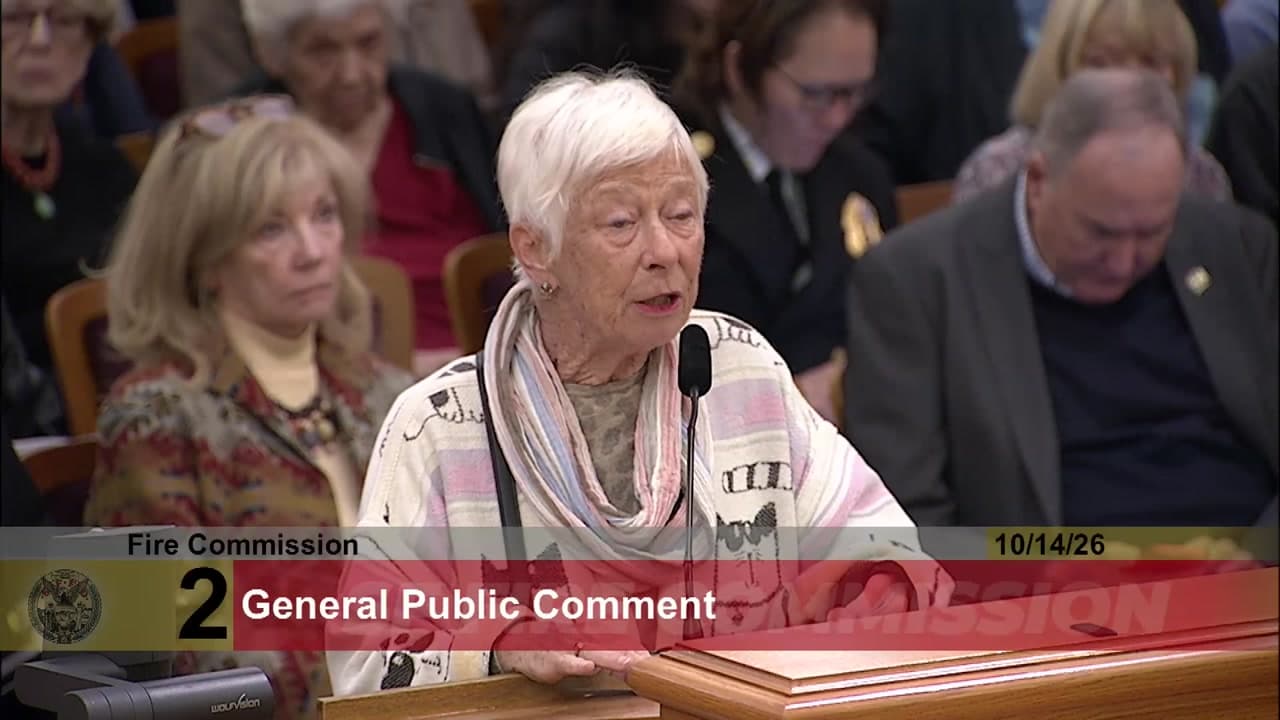
Where things stand: General public comment ran about 30 minutes. Nearly every in-person speaker urged repeal, and each stressed support for fire safety.
Velma Dean, an 85-year-old retired teacher at Fontana West, said a roughly quarter-million-dollar assessment would force her out. She added that a 5-year extension does not solve the problem. Patrick Carney, an architect, said estimates for his 25-story concrete building run $18M to $42M, or $250,000 to $300,000 per apartment. He warned that coring through concrete shear walls would weaken the structure seismically.
A speaker for a coalition of 30 buildings and more than 2,000 homeowners said the mandate passed without notice or hearings. The speaker cited only 10 fire-related injuries in 23 years in affected buildings and asked why no independent cost-benefit analysis was done. John Hopkins, a retiree on a reverse mortgage, said even a $20,000 cost would force him out. Michael Ely said unit values have already dropped.
Marlene Morgan, president of the Cathedral Hill Neighborhood Association, said four large buildings in her area would be devastated. Those buildings hold about 630 units and 1,000 residents. She compared the impact to redevelopment.
The other side of the argument: Some speakers pushed for alternatives rather than straight repeal.
- Daniel, general manager at 1750 Taylor Street and a certified high-rise fire safety director, urged rules grounded in the realities of retrofitting occupied buildings with elderly and disabled residents.
- One speaker asked for a building-by-building review of all 126 buildings based on risk.
- Jan Massera suggested controlling ignition sources, such as scooters and mobility devices.
Two speakers raised other concerns:
- Jim Edlin argued the ordinance was jobs legislation. He said lobbying by the Building and Construction Trades Council derailed a compromise that would have limited the mandate to major renovations.
- Olive Rubenstein, a cable car worker, warned that water shutdowns during construction could halt the Hyde, Mason and California cable car lines and Muni service.
The advisory committee's clock: In his report, Chief of Department Dean Crispen said the committee has held 2 of 6 meetings. Supervisor Sherrill chairs the committee, and Fire Department Captain Tracy O'Keefe serves as co-chair. Seating its 11th member was delayed. Crispen described the committee's charge:
"The Technical Advisory Committee Council is expected to provide recommendations to the fire marshal on potential exemptions based on financial hardship, relocation, and other issues identified in the ordinance," said Crispen.
Commissioner Stephen Nakajo asked when the committee would report. "My understanding was a 90-day window from the onset, and they're required to have 2 meetings a month," said Crispen.
Decisions and stakeholder impacts: No vote was taken. "I'm of the mind we should let the TAC process complete itself," said Allan Low, Commission Vice President. Crispen agreed. Commission President Paula Collins framed the choice as a midstream update versus a final report, and invited other views. Collins also acknowledged the crowd: "And we hear you."
For owners, the exemption criteria are now the main lever. Those criteria include financial hardship and relocation. Several commenters also urged the department to publicly back repeal.
What's next: The committee meets publicly on SFGovTV. Its recommendations are expected roughly in early 2027.
Workforce Plan Targets Women, Gender-Diverse Staff
Why it matters: The department set a three-year framework with measurable tracking of how women and gender-diverse employees are hired, promoted and retained.
Where things stand: Assistant Deputy Chief of Workforce Development Dustin Nguyen presented the plan, which supports the city's Department on the Status of Women.
"The Women's Agenda Department Action Plan is a 3-year approach to improving opportunities and workplace conditions for women and gender-diverse employees," said Nguyen.
The plan includes five projects:
- Tracking of applicants, promotions, retention and lactation access
- A lactation policy guaranteeing breaks, private space and protection from retaliation
- A four-day supervisor training program with the Department of Human Resources
- A career-track map and guide
- An updated Racial Equity Action Plan that includes gender-diverse employees
"This lactation policy came at a perfect time," said Sayumi Brannon, Deputy Chief of Administration.
The other side: Commissioners pressed on how the projects were chosen, when they would roll out and how results would be measured. Nguyen said senior leadership assigned the projects to him. Commissioner Frazier asked for before-and-after details on discrimination protections and corrective action.
Decisions and stakeholder impacts: The item was informational, and no public comment was offered. Crispen announced that Nguyen has been promoted to Assistant Chief. He named his successor in the workforce role:
"One person has stood out, and I'd like to announce the new Assistant Deputy Chief of Workforce Development, current Battalion Chief, Kentrez Triplett," said Crispen.
Nguyen noted the workforce development post has existed for only about five months.
New Discipline Unit, Training Facility Cost Questions
Why it matters: The department is overhauling how it handles misconduct complaints. Separately, its new training facility faces foundation changes with an unknown price tag.
Where things stand: Deputy Chief of Operations Patrick Rabbitt described General Order 26-A78, which creates a Professional Standards Division. Rabbitt said complaints and discipline had been handled through multiple processes. That led to inconsistent practices, delays, documentation gaps, and legal and labor exposure.
The new division will report to the Deputy Chief of Operations. It will investigate misconduct, track complaints, identify trends and recommend policy and training changes. "It's not simply an investigation function for our department. It's a risk reduction strategy," said Rabbitt.
Foundation redesign: At the Division of Training site, Assistant Deputy Chief Schwartz said subsurface conditions forced a foundation redesign. The change adds formwork, steel and concrete, and it is causing delays. Commissioner Morgan asked whether shallower-than-expected bedrock saved money. "I cannot give you a firm dollar figure on that right now as far as savings," said Schwartz.
Collins, citing her real estate experience, was skeptical. She said such a foundation change "rarely costs less."
Decisions and stakeholder impacts: Both items were reports, and no action was taken. Brannon also reported progress on several programs:
- Distribution of Lifeline cards, which help responders identify a resident's medical issue
- CPR training in schools
- Recruitment efforts
- Voluntary flu vaccines
Crispen's report covered several milestones:
- 48 recruits in the 138th Suppression Academy
- EMS Academy 35
- Meritorious awards for 75 members
- Fleet Week operations
Minor Items
- Minutes approved: Sept. 30, 2026, special meeting minutes passed by voice vote; no tally stated.
- Asian Firefighters Association: President Clarence Hom marked 50 years, citing over 300 members, youth mentoring and donations.
- Bay rescue honored: Civilian boaters were credited with rescuing 17 people near Alcatraz on July 14; four people died.
- Crisis team concerns: Public commenter Amelia Harmon said the 911 behavioral health team lost its clinicians and peer counselors. She asked the department to name a crisis-working-group representative.
- Transformer fire complaint: Mark Brennan questioned why the first engine left a smoking PG&E vault at 575 Cole Street on July 31.
Looking ahead: Crispen said a new El Niño task force plans an exercise before November's king tides. The task force covers water rescue capacity, communications resilience and interagency coordination.