
ABAG Finance Committee Backs 3% Dues Increase as Pension Debt Looms
Finance Committee • Association of Bay Area GovernmentsMay 21, 2026
Locunity is an independent informational service and is not an official government page for this commission. All information is sourced from public footage and an analysis of official agendas with the aid of responsible, fact-checked AI. to report an error or omission.
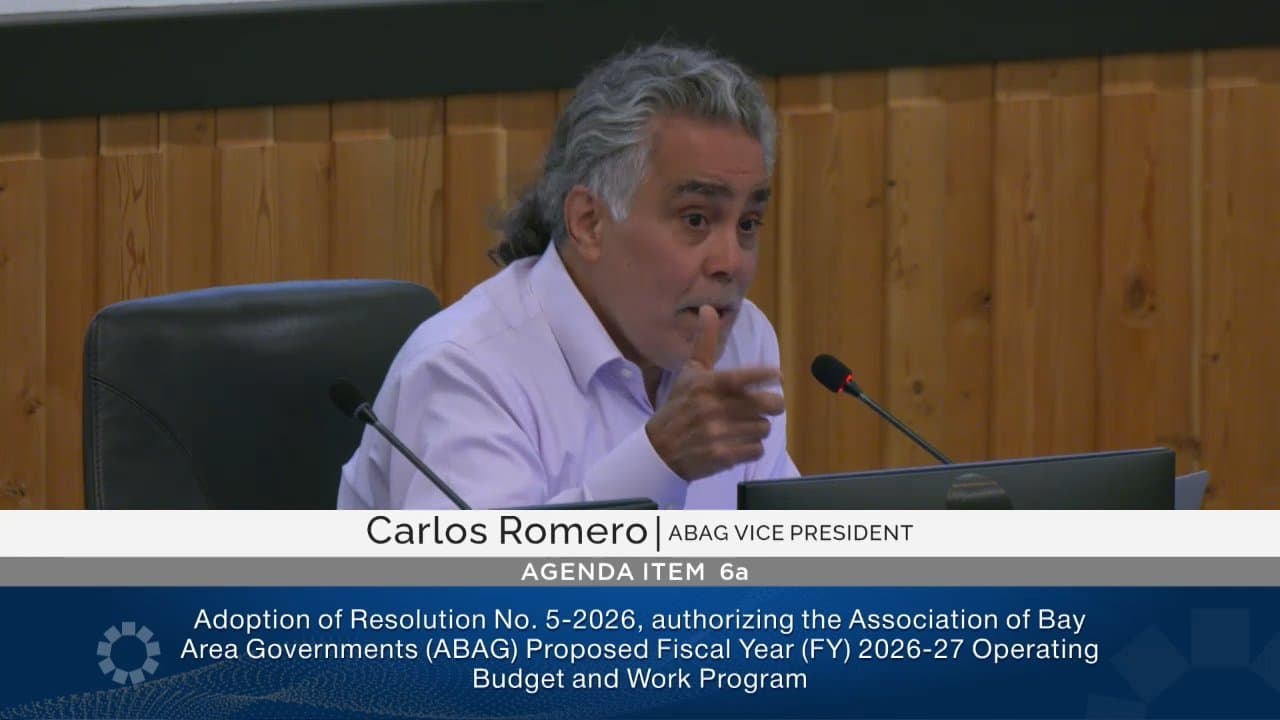
The Association of Bay Area Governments’ next budget is balanced, but about two-thirds of what member cities and counties pay in dues goes to a legacy pension bill. On May 21, 2026, the Finance Committee voted 5-0 to recommend Resolution 5-2026, the FY 2026-27 operating budget and work program, to the Executive Board and the General Assembly.
- Budget advances 5-0: Resolution 5-2026 includes a 3% dues increase pegged to inflation.
- $12,000 surplus after a $19,000 transfer from ACFA balances the books.
- Pension debt: A roughly $18M unfunded liability absorbs about two-thirds of member dues through 2035.
- MTC subsidy: The Metropolitan Transportation Commission covers shared-services costs beyond its contract.
- Condo appraisal due next month; members want General Assembly talking points.
A Lean Budget With an Inflation-Pegged Dues Bump
Why it matters: Member dues are what Bay Area cities and counties pay to belong to ABAG. This budget raises them and sets the agency’s work program for the coming year. The General Assembly has final say.
Where things stand: Staff presented a balanced administrative budget built on a dues increase, which staff described as essentially a consumer price index, or CPI, adjustment. CPI is the standard inflation measure.
“It does show a 3% membership dues increase,” said Derek Hansel, ABAG staff.
A $19,000 transfer from ACFA closes the gap and leaves a $12,000 surplus. That cushion is thin for an agency of ABAG’s reach. It also signals that the administrative budget has little room to maneuver.
The grant-funded programs: ABAG’s two largest program arms pay for themselves and draw no ABAG funds, according to staff:
- BayREN is funded through California Public Utilities Commission grants. It now includes a $5M statewide home energy score program.
- SFEP is funded by grants from the California Department of Water Resources and the federal EPA. It also has a separate conference budget of under $700,000.
The arrangement matters for member agencies. Growth in energy and water programs depends on state and federal grant decisions, not on local dues.
Decisions and stakeholder impacts: Councilmember Lisa Motoyama, the committee’s vice chair, moved the recommendation, and Councilmember Susan Adams seconded it. The motion passed by roll call. For: 5, Against: 0, Absent: 2 (Supervisors Betty Duong and David Rabbitt).
Member cities and counties face a modest dues increase if the General Assembly agrees. One would-be public commenter raised a hand during the item but chose to wait for a future meeting after audio echo problems. No substantive public comment was recorded.
What’s next: The resolution goes to the ABAG Executive Board, then to the General Assembly for final approval.
The Pension Bill Behind the Dues
The basics: In 2017, ABAG’s staff merged with MTC’s. ABAG kept a closed pension plan for retirees from before the merger. A closed plan takes in no new employees, but its obligations remain.
Why it matters: The pension plan, not new programs, is the main pressure on ABAG’s administrative budget.
“Two-thirds of member dues go to pay off this unfunded pension liability,” Hansel said.
Where things stand: The 2024 actuarial valuation, an expert estimate of future pension obligations, put the gap at “about an $18 million unfunded liability,” Hansel said. Investment returns have improved the picture. Even so, minimum contributions of more than $2M a year continue through 2035.
The MTC factor: Staff also described how ABAG’s regional partner absorbs costs. “MTC has been subsidizing shared services costs well beyond those that are required in the contract for services,” Hansel said. MTC also does not charge ABAG for some administrative staffing.
That support keeps ABAG’s administrative budget afloat, but it is not written into the contract. If MTC’s support changed, member dues would have to cover more. The pension payments already claim most of those dues for roughly another decade.
The condo question: Staff said an appraiser is valuing ABAG’s condominium interest, with results expected next month. ABAG has promised the General Assembly information on the condo interest this year.
A committee member asked staff to work with the Finance Committee chair and the ABAG president on talking points for a report back to the General Assembly. “Thanks. Pleased to do that,” Hansel replied.
Decisions and stakeholder impacts: The committee took no separate action on the pension or the condo. Both bear on how much flexibility member agencies get for their dues.
What’s next: Look for the appraisal results and the General Assembly briefing on the condo interest later this year.
Minor Items
- Consent calendar approved 5-0, Absent: 2. It covered:
- Jan. 15, 2026, minutes
- Unaudited investment reports for periods ending March 31, 2026, and Dec. 31, 2025
- The FY 2025-26 revenue and expense statement through March 31, 2026
Councilmember Carlos Romero moved and Councilmember Lisa Motoyama seconded. There was no discussion or public comment. The financial reports go to the Executive Board for acceptance.
- Quorum confirmed with five members present. Supervisors Betty Duong and David Rabbitt were absent.
Looking Ahead
The Finance Committee next meets Aug. 20, 2026, at 375 Beale Street in San Francisco. Questions to watch:
- What does the condo appraisal show?
- How will the General Assembly respond to the dues increase?
- How long can ABAG rely on MTC’s uncharged support while pension payments run through 2035?