Finance and Administration Committee - Apr 15, 2026 - Meeting
Finance and Administration Committee • Bay Area Air Quality Management DistrictApril 15, 2026
Locunity is a independent informational service and is not an official government page for this commission.We use AI-assisted analysis and human editorial review to publish information.
Fee Overhaul Advances as Industry Pushes Air District on Permit Delays
The Bay Area Air Quality Management District's Finance and Administration Committee unanimously advanced a fee restructuring that cuts costs for small businesses while raising them for refineries — all while facing pointed industry criticism that years of rising fees have yet to fix a stubborn permitting backlog.
Committee sends Regulation 3 fee amendments to full Board with a 5.7% weighted average increase, a 20% cut for small-business registration fees, and elimination of the delinquent payment penalty
Industry groups challenge permitting progress, with California Council for Environmental and Economic Balance (CCEEB) reporting Schedule P fees up 101% in six years and Western States Petroleum Association (WSPA) projecting $87 million in refinery permit costs through 2030
Permit backlog targets set for 2028–2029, with staff reporting a 17% processing increase and rolling out AI-powered dashboards
Clean audit confirms $491.4 million net position for FY2025, but Vice Chair presses for faster audit turnaround
New Permitting Efficiency Task Force set to co-convene with a Board Ad Hoc Committee on April 22
Fee Shake-Up: Small Businesses Get Relief, Refineries Pay More
The committee voted 7-0 to recommend the Board of Directors adopt proposed amendments to Regulation 3, the Air District's fee regulation, setting up a June 3 adoption vote with changes taking effect July 1.
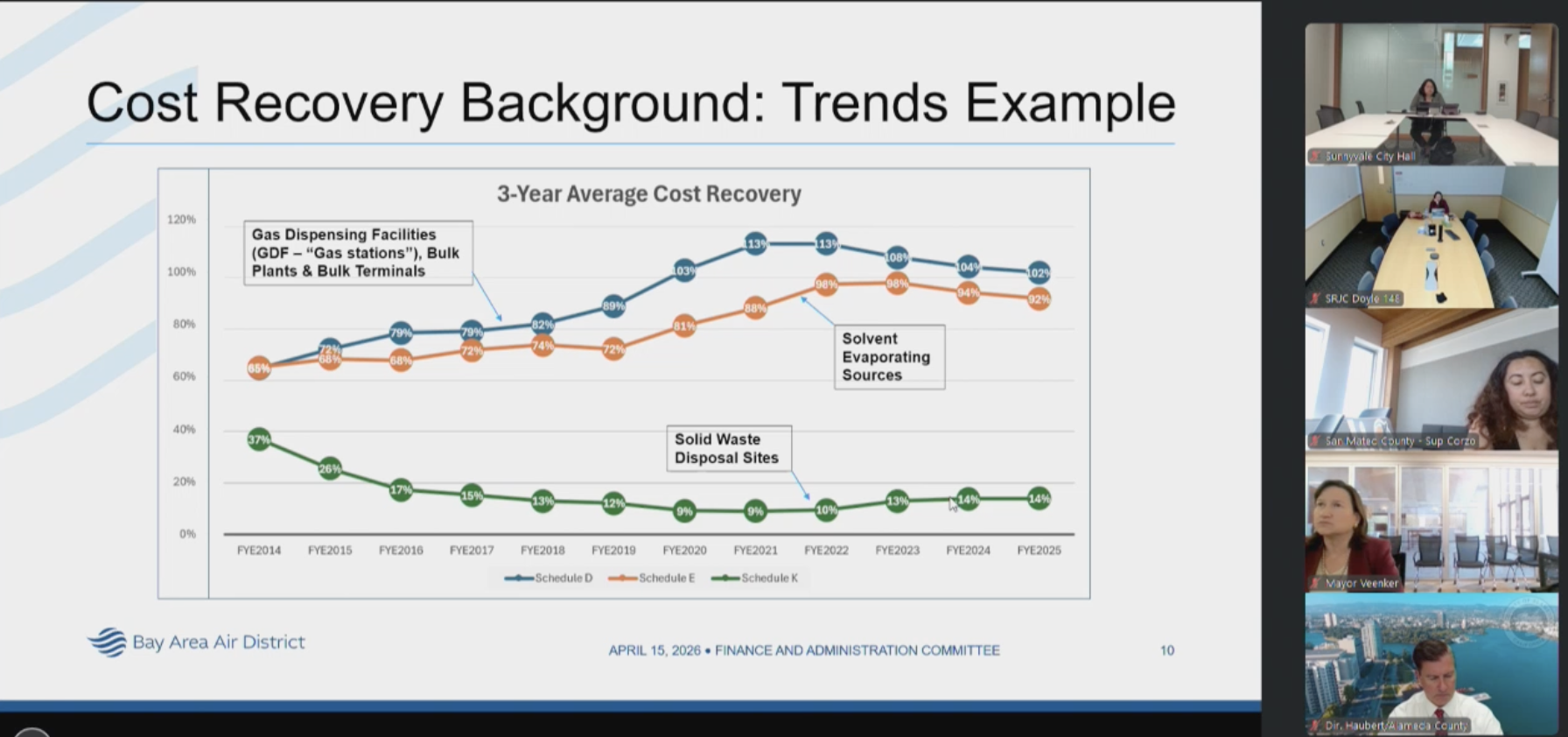
The basics: Regulation 3 governs how the District recovers costs from permitted facilities across the Bay Area. The District's cost recovery policy, last reviewed in December 2022, limits certain fee increases to actual level of effort. Currently about 90% of total costs are recovered, with 63% of fee schedule revenue at 95% or better recovery. Five fee schedules sit below 50% recovery but account for less than 2% of total revenue.
Why it matters: The amendments reshape how the District funds its roughly $135 million regulatory operation. Dry cleaners and operators of small combustion sources would see a 20% cut to Schedule R registration fees — a reduction of about $52,000 in annual revenue — while the District would write off $386,000 in outstanding delinquent fees by eliminating the second-tier 25% late-payment penalty. For large refineries, the weighted increases range from 6.2% to 8.4%.
Where things stand: Staff introduced several new mechanisms: a smoothing formula for fee schedules between 85% and 100% cost recovery that factors in the CPI-W consumer price index rather than applying a flat 15% increase; a new Emission Reduction Credit reassurance fee for certificate ownership verification; and a reclassification of gasification and pyrolysis sources from Schedule F to the more appropriate Schedule G1. Administrative fees and Schedule M emissions-based fees would receive standard CPI-W adjustments.
Bob Brown, a public commenter and Senior Director of the Western States Petroleum Association, told the committee that refinery operators are watching the numbers closely. "The projected annual permit renewal fees at BAB through 2030 are expected to total more than $87 million," he said, adding that rule implementation costs since 2016 exceed $700 million. Brown called for staff to track time billing to individual permits, refineries, or equipment to demonstrate the value of fees paid.
Director David Haubert echoed the transparency push: "Vendors should be billing or whatever. Billing should be mapped to … I know lawyers map to the case they're working on every six minutes at a time. So it just feels like that should be achievable."
The other side: Senior staff pushed back on the law-firm billing model. Dr. Philip Martien, the District's executive officer, cautioned: "I want to avoid taking that next step — is that saying that each facility only pays for every minute that a staff person worked on that facility? Because that's going to lead to some inefficiencies and gaps in cost recovery that will actually affect our budget pretty significantly." He acknowledged, however, that new permitting systems could support better tracking of staff time at the facility level.
Director Tyrone Jue asked about the root causes behind small-business delinquency, questioning whether operators simply weren't receiving notifications. Staff explained that the penalty structure created administrative burdens and barriers to compliance without meaningfully improving collection, which led to the proposal to eliminate the second tier entirely.
Director Vicki Veenker and Director Linda Sell praised the new dashboards and transparency improvements. Director Sell noted that "more transparency leads to better trust in the system."
Decisions: The motion, moved by Director Jue and seconded by Director Haubert, passed 7-0 (For: 7, Against: 0, Absent: 1 — Director Brian Colbert). The committee's recommendation now advances to the full Board.
What's next: The first public hearing for testimony on the amendments is scheduled for April 29, with Board adoption targeted for June 3 and an effective date of July 1.
Permit Backlog: 17% Processing Gains, but Industry Says It's Not Enough
The committee received an informational update on the District's permitting strategies, revealing meaningful operational progress alongside persistent frustration from the regulated community.
The basics: The presentation stems from the 2023 Engineering Performance Audit, which identified systemic bottlenecks in how the District processes air quality permits. Pamela Leong, the Engineering Division Director, reported that staff have transitioned to a new Permitting and Compliance System, built real-time application flow dashboards tracking key performance indicators — including backlog size, overdue applications, rework rates, and approval timelines — and piloted AI tools for routine permit evaluations and status briefings.
Why it matters: Bay Area businesses that need air quality permits to operate, expand, or modify facilities have faced months- or years-long waits. Industry groups say rising fees without faster service undermine the District's credibility.
Where things stand: Application processing increased 17% between 2024 and 2025 before new hires came on board. Health Risk Assessments have reached maintenance level. But the active application queue remains elevated due to legacy data migration and a 40-application surge triggered by backup engine policy changes. The backlog reduction plan targets maintenance level for standard applications by 2028 and complex permits by 2029.
Staffing remains a constraint: six retirements since October, including senior and supervisory roles, have created knowledge gaps, and the vacancy rate stands at 13%. The Board approved mid-year staffing and budget adjustments in September 2025 to support backlog reduction, pilot programs, and professional services. Training new permanent engineers takes two to three years.
Dr. Philip Martien defended staff progress against industry criticism: "The statement that there hasn't been any visible progress — maybe that's the case with the CCEEB members, but I also hear from other applicants that there have been improvements." He added that reaching maintenance level for 95% of applications by 2028 is "aggressive but doable," while noting that complex applications inherently take longer due to CEQA requirements and health risk triggers.
Peter Okurowski, a public commenter representing the California Council for Environmental and Economic Balance, delivered the sharpest critique: "Our Schedule P fees, which are the largest our members pay, have increased 32% in the past two years, 75% in the past four, and 101% in the past six." He urged the committee to direct staff to resolve permitting issues on a faster timeline.
Director Haubert shared the urgency: "I will say that 2029 does seem quite far away. I would like to see us beat that goal and I would like to see us have more interim checkpoints along the way."
Director Jue took a more measured approach, acknowledging the systemic nature of the challenge: "There's no superhero that's going to come in here and then all of a sudden our backlog disappears. That's not how this works. And I think what you have demonstrated here is kind of that blueprint for us to continue moving down the right path." He also emphasized that inconsistency between permit reviewers — where two staff members can reach different conclusions on the same application — "creates tension and efficiency in the system. It impacts our credibility."
Dr. Meredith Fine, a senior staff member, offered hope that the timeline could compress once new resources are in place: "I'd like to say that we can come back once the backlog team is set up and give you a much more firm time frame that we think we can deal with those complex applications."
Vice Chair Juan Gonzalez praised the new tracking infrastructure and called for the District to anchor its progress around four clear metrics: efficiency, accuracy, transparency, and accountability.
What's next: Staff committed to return with progress updates every three to six months. A new Permitting Efficiency Task Force and Board Ad Hoc Committee on Permitting will co-convene for the first time on April 22.
Clean Audit, but Vice Chair Wants Faster Turnaround
Joseph Moussa of Simpson & Simpson LLP presented the independent financial audit for the fiscal year ending June 30, 2025, delivering an unmodified — or clean — opinion with no material weaknesses, no corrected or uncorrected misstatements, and no compliance issues.
Why it matters: The audit confirms the District's financial controls are sound, but the nearly 10-month gap between fiscal year-end and the committee presentation limits the Board's ability to act on findings in real time.
Where things stand: Net position ended at $491.4 million, a $135.4 million increase driven by higher permit fees, penalty assessments, property taxes, investment gains, and grant funding. Combined governmental fund balance was $519.3 million, with $281 million in the general fund and $61.7 million unassigned. One accounting change was noted: implementation of GASB 101, which required recognition of $323,000 in compensatory time liabilities. The prior-year Biowatch subrecipient invoice finding was corrected. For the single audit of federal funds, the targeted airshed grant (a heat pump project) and highway planning and construction programs were tested with no findings.
Vice Chair Gonzalez challenged the timeline directly: "It's hard to be talking about something that was occurring 18 months ago and really have any sense of remembrance about what was going on then. So that's why I think speed is important." He urged a goal of completing the audit within four to six months of fiscal year-end. Director Jue asked about follow-through on management letter recommendations; staff confirmed they will be tracked in the next audit cycle.
Minor Items
Consent calendar approved 7-0 (For: 7, Against: 0, Absent: 1 — Director Brian Colbert), including the draft minutes of the March 18, 2026 Finance and Administration Committee meeting. Motion by Director Jue, seconded by Vice Chair Gonzalez.
No public comments were received on non-agenda matters; no committee member comments were offered.
Next meeting: May 20, 2026, at 1 p.m.