
ABAG Launches Plan Bay Area 2060 Push, Backs $11.25B Housing Bond
Executive Board • Association of Bay Area GovernmentsAugust 21, 2026
Locunity is an independent informational service and is not an official government page for this commission. All information is sourced from public footage and an analysis of official agendas with the aid of responsible, fact-checked AI. to report an error or omission.
The Association of Bay Area Governments' Executive Board spent its longest stretch Aug. 20 shaping Plan Bay Area 2060. The regional blueprint will be tied to the next round of state-mandated housing targets, with adoption aimed for early 2030. Members also voted unanimously to back Proposition 1, a statewide housing bond. New President Susan Adams and Vice President Wanda Williams took over the board's leadership.
- Plan Bay Area 2060 previewed as a "major update" with kickoff set for early October
- Members push childcare, eldercare and housing-target clarity into the regional plan's scope
- Board backs Prop 1, the $11.25B housing bond, 25-0 with no debate
- Belia Ramos and Carlos Romero honored as Adams and Williams take the helm
Plan Bay Area 2060: Bigger Scope, Same Limits
The basics: Plan Bay Area is the region's long-range transportation, housing and land use plan. It includes the sustainable communities strategy that state law requires the region to adopt to meet greenhouse gas targets.
Why it matters: The plan sets regional growth direction. It will also inform the 7th cycle of the Regional Housing Needs Allocation (RHNA), which assigns every Bay Area city and county its housing target.
Where things stand: Project Manager Michael Meehan described a four-phase process: foundations, outlook, blueprint and a final regulatory package. Three perspective papers will cover the economy, congestion management and toll bridges.
"As I mentioned, this is a major update, and what that means is that we will take a closer look at aspects that we didn't have the time or capacity to dive into during 2050 Plus's minor update," said Meehan.
Scoping drew on a lesson from earlier plans. Those plans felt removed from local realities and were hard to navigate. Themes include plan usefulness, scenario planning, cost-effectiveness, housing affordability, homelessness and climate resilience. Fiscally constrained project lists will come from needs and revenue analyses that begin in 2027. Staff also said AI will be used to categorize public comments and review research literature.
Meehan also set clear limits on the plan's reach: "Importantly, of course, the plan does not create regulatory mandates."
The scope could still change. The Legislation Committee reported on SB 1087, which would modernize the 2008 law behind sustainable communities strategies. Revised greenhouse gas targets are also in play.
Care economy enters the chat: One board member called for a childcare white paper. The member cited co-locating childcare with housing and transit at stations such as Fruitvale. "AB 1914 is making its way through the state legislature, and that's a bill that would require cities to include childcare planning in their general plans effective 2028," the member said. Another member said childcare in Marin costs up to $32,000 a year, and a third raised the region's aging population.
Board Member Ramos recommended that the Legislation Committee track AB 1914. Ramos also floated a workshop on a broader planning frame: "Are we ready to look at care at all spectrums as part of a more comprehensive economic model that bears recognition of our regional planning?"
The RHNA question: Romero said reconciling state housing numbers with the plan's growth numbers has been a difficulty. He noted that ABAG is statutorily responsible for the RHNA methodology and asked staff to brief the full board. On the methodology, ABAG staff member Dave Voughten said the law requires that "RHNA is informed by Plan Bay Area, which means that this Board has some amount of discretion to the extent to which it is informed by it."
Decisions and stakeholder impacts: The board took no action. Cities and counties have the most at stake, because the plan will inform their next housing targets. Childcare and senior-care advocates now have a foothold in scoping. Staff said the foundations and outlook phases, including growth forecast scenarios, will address demographics.
What's next: Formal kickoff comes in early October. A joint MTC/ABAG workshop is set for Oct. 28-29, with public outreach in October and November. A RHNA Cycle 7 preview is expected this fall, and staff committed to circulating white paper details.
Board Puts Regional Weight Behind Prop 1
Why it matters: ABAG's formal endorsement adds regional government backing to a statewide bond for affordable housing and homeownership.
Where things stand: The joint MTC/ABAG Legislation Committee recommended support for the Veterans and Affordable Housing Bond Act of 2026. President Susan Adams described it as an $11.25B statewide bond to fund affordable housing and homeownership across California. No board member spoke on the item, and no one offered public comment.
Decisions and stakeholder impacts: The support position passed by roll call (For: 25, Against: 0, Absent: 10). Board Member Eklund moved the item, and Board Member Moriyama seconded it. The clerk declared unanimous passage among members present. Affordable housing developers and local housing agencies that rely on state subsidy dollars stand to benefit most if voters approve the bond.
The vote fits an agenda Adams laid out in her first president's report: "We have substantial discussions coming up, including the development of Plan Bay Area 2060, the RHNA methodology, and the questions regarding regional housing funding." Separately, staff reported outreach to local governments about Bay Area Housing Finance Authority (BAFA) legislation and a potential ballot measure.
What's next: The bond goes to voters statewide.
Crystal Gavels for Ramos and Romero
Where things stand: The board presented crystal gavels to outgoing President Belia Ramos and outgoing Vice President Carlos Romero. Adams credited Ramos's tenure with the creation of BAFA and the MTC-ABAG Community Advisory Council. She credited Romero with leading the Housing Committee and advancing the equity adjustment in the 6th RHNA cycle methodology.
"I'm not going anywhere," Ramos told colleagues.
Why it matters: Both leaders remain at the table for the RHNA and housing funding fights ahead. Romero still chairs the Housing Committee. Adams also welcomed new members Furtado, Toms and Vaccaro.
Minor Items
- Committee assignments ratified (For: 26, Against: 0, Absent: 9). Williams was named ex officio to the Housing and Finance committees. Maureen Toms joins the Administrative Committee. Adams and Toms join the Joint MTC/ABAG Legislation Committee.
- Consent calendar approved (For: 25, Against: 0, Absent: 10). Its contents were not read aloud.
- Doorway fees advance: The Housing Committee recommended a fee schedule for owner-operators to the BAFA board. "There will be no fees charged to applicants on the portal," said Romero.
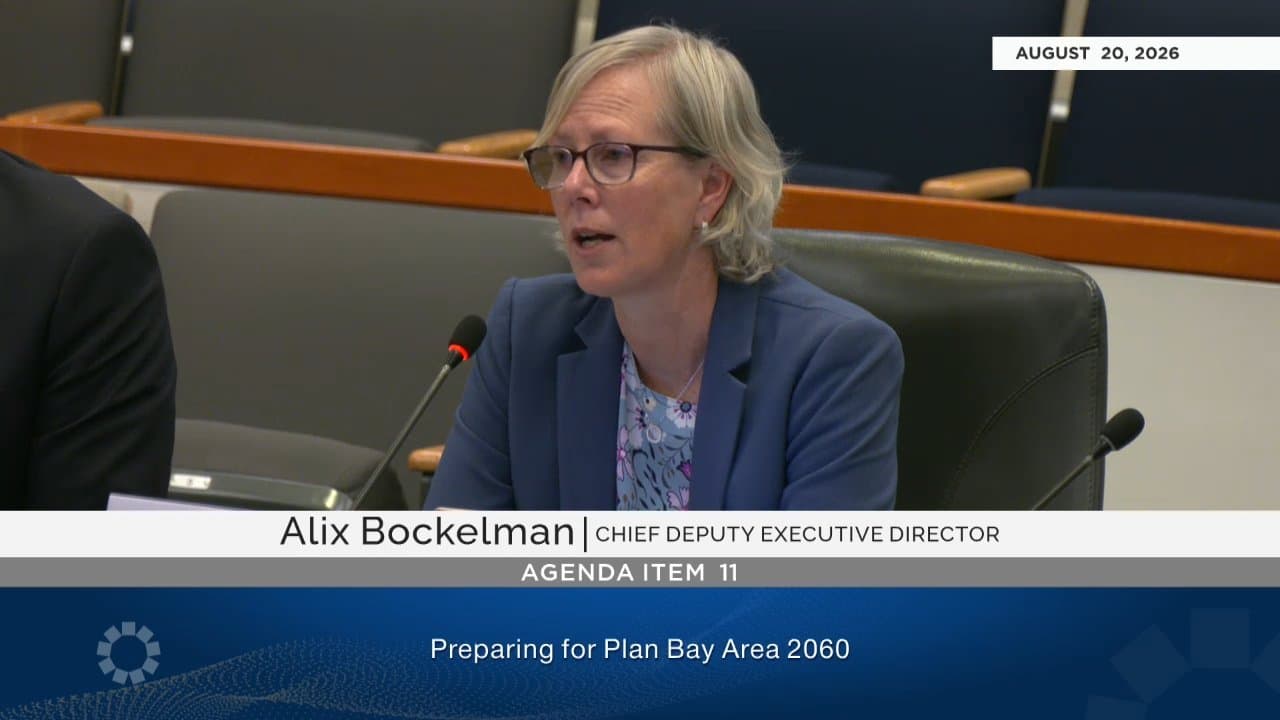
- Executive director's report: Chief Deputy Executive Director Alex Bockelman noted that Gov. Gavin Newsom signed AB 179, creating a California Housing and Homelessness Agency. He also reported that Santa Rosa Junior College became ABAG Power's 53rd member and that BayREN launched a second cohort with Oakland, Concord, Pinole, Fairfax and San Mateo.
- Advisory council feedback: Community Advisory Council Chair Karina Liu reported feedback on engagement, capacity building for community-based organizations and the limits of place-based equity tools. "We didn't take any formal actions," she said.
Looking Ahead
The Sept. 7 meeting is canceled. The board's next regular meeting is Nov. 19, after the Plan Bay Area 2060 kickoff and the Oct. 28-29 joint workshop.